Early warning for at-risk students: daily risk scores from your rules in Classter.
How do you spot students who are slipping before it is too late? The Early Warning System reads attendance, results, engagement and unpaid fees together every day, against weights you set. Each student gets a 0 to 100 score. AI explains it and suggests a next step.
| Student | Class | Risk | Main factors |
|---|---|---|---|
| Daniel K. | 10A | 82 | Attendance, 3 missed assessments |
| Sofia M. | 11B | 67 | Grades falling in 2 subjects |
| Leo P. | 10C | 54 | Unjustified absences |
| Anna T. | 9A | 21 | Stable |
Show the real screen
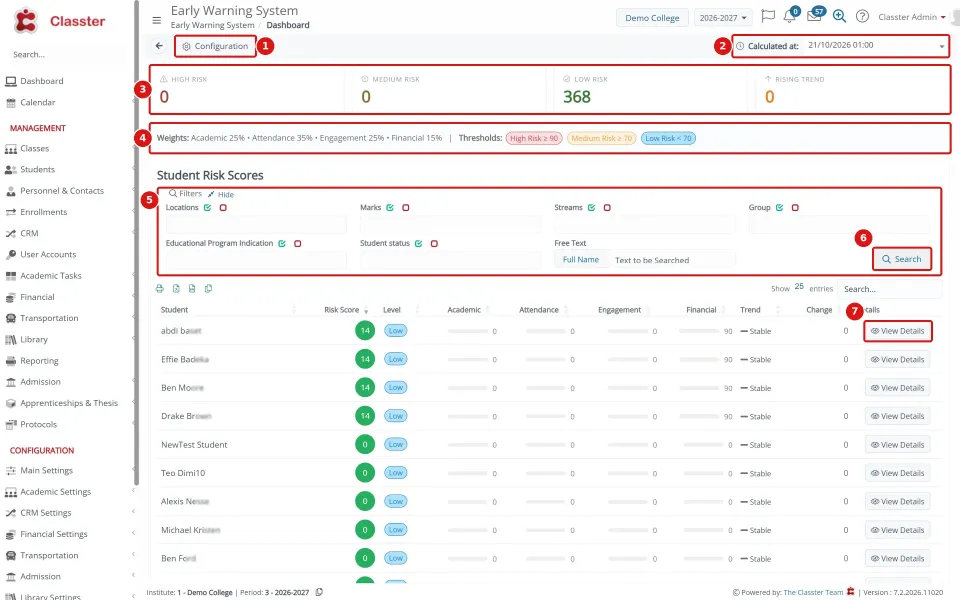
Your rules raise the flag. You still have time to help.
Set your rules
Choose the signals and weights. By default: Academic 25, Attendance 35, Engagement 25, Financial 15.
Score every day
Each student gets a 0 to 100 risk score, recalculated daily, with history.
See who needs you
High at 90 and above, Medium at 70 and above, in one list.
Understand and act
AI explains one student's score and suggests a next step. A person decides what to do.
What this replaces.
- Waiting for end-of-term results to notice a student
- Cross-checking attendance, marks and fee lists by hand
The Early Warning System is New (live since June 2026, in early use) and needs the AI module. The score comes from your rules; AI explains it and does not decide.
The people who run it.
For
The questions people ask about this.
What is an early warning system for at-risk students?
An early warning system flags students who may fail or drop out, early enough to help. In Classter, each student gets a daily 0 to 100 risk score from rules the school sets across attendance, results, engagement and unpaid fees. AI explains a student's score and suggests a next step, and staff decide what happens.
Last checked Nov 2026Can we change how Classter calculates student risk?
Yes. In the Classter Early Warning System, the school chooses the signals and their weights. The default weights are Academic 25, Attendance 35, Engagement 25 and Financial 15, with High risk at 90 or above and Medium at 70 or above. Change them to match your policy, and scores recalculate daily with history.
Last checked Nov 2026Does the AI decide which students are at risk?
No. In Classter the risk score comes from the school's own rules, not from a model guessing. AI is used to explain a student's score in plain words and suggest a next step, such as a call home. A person reads it and decides. The feature needs the AI module and is New since June 2026.
Last checked Nov 2026Can unpaid fees count?
Who sees the scores?
Does it work for colleges?
Bring your hardest question. We'll start there.
A 30-minute call on Teams with a Classter specialist for your country. Price first, then the parts you care about.