Admissions software: take applications online and turn offers into enrolled students.
Applicants apply on your own form, upload documents and pay the fee. Your team runs interviews and assessments, ranks by points and sends offers. Accept the offer, and the student record is ready.
Show the real screen
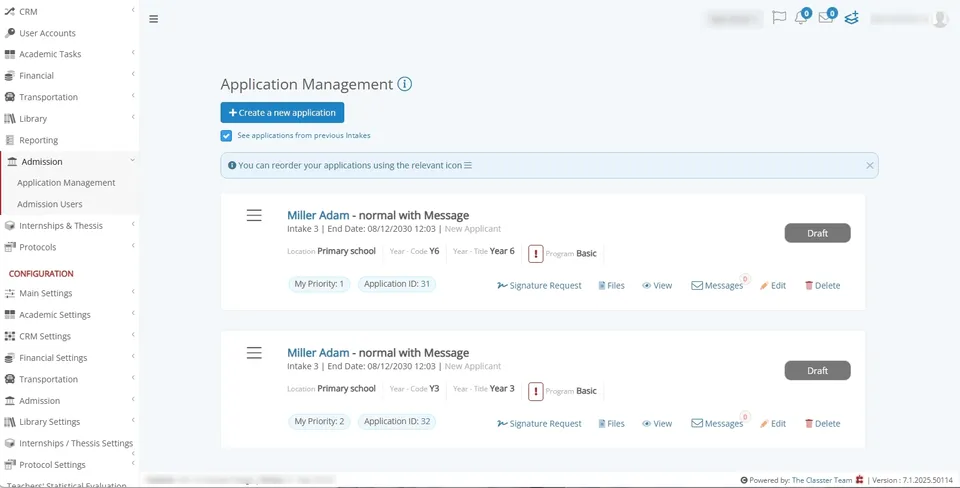
Admissions in Classter, in four answers.
How does online admissions work in Classter?
Classter publishes an application form for each intake, programme and campus. Applicants create an account, upload documents, give consents and pay the application fee in one go, and can save a draft to finish later. Your team sees every application in one list, filtered by programme, status or missing document.
Last checked Nov 2026Can Classter rank applicants by interviews and assessments?
Yes. In Classter you record entrance assessments and interview results with your own scoring, and the applicant list ranks itself by points. Interview slots are booked through Calendly or by your team, and remarks stay visible to the admissions team only. The offer meeting starts from the same numbers for everyone.
Last checked Nov 2026What happens when an applicant accepts an offer?
The family accepts the offer online, before your deadline, and pays the deposit by payment link. Classter then turns the applicant into a student record, with parents, payers, documents and a fee arrangement built from your price list already in place. Nobody retypes the application into another system before the first day.
Last checked Nov 2026Do we need a separate CRM for student recruitment?
Not necessarily. Classter runs enquiries, applications, interviews and offers on its own, so many schools and academies use it as their admissions CRM. If your marketing team already works in HubSpot, Classter syncs applicants with it both ways, so campaigns stay in HubSpot and the applicant record stays in Classter.
Last checked Nov 2026Where do you keep track of the families who called about next year?
Each enquiry becomes a candidate in the Academic CRM. Calls, meetings, open-day visits and remarks are logged on it, so the history follows the family into the application and nobody asks the same question twice.
- Candidates with calls, meetings and remarks, each with a category
- Visibility rules for notes that only admissions should see
- Open days and events with invitations and RSVPs
- The enquiry carries on into the application and the student record
- HubSpot sync if your marketing team runs campaigns there
| Family | Last contact | Action | Next |
|---|---|---|---|
| Andreou | Call, 12 Nov | Asked about Year 7 fees | Send prospectus |
| O'Brien | Open day, 8 Nov | Toured the music wing | Invite to apply |
| Haddad | Email, 3 Nov | Needs the school bus | Call back |
Open an intake. Applications arrive complete.
Publish an application form for each intake and programme. Applicants upload documents, give consents and pay the application fee in one go, so your team stops chasing the missing page.
- A form per intake, programme and campus
- Documents, consents and e-signatures with DocuSign or Legalesign
- Application fees paid by card when they apply
- Sibling applications, and agents who apply for a student
- Identity checked with eIDAS or Malta eID where your country uses it
Show the real screen
Interviews, assessments and points, in one list.
Book interview slots, record entrance assessments and add up points. The list ranks itself, so the offer meeting starts from the same numbers for everyone.
- Entrance assessments and interviews with your own scoring
- Interview slots through Calendly, or booked by your team
- Remarks and meeting notes visible to the admissions team only
- Filter by programme, status or missing document
| Applicant | Assessment | Interview | Points | Next |
|---|---|---|---|---|
| K. Doyle | 18 | 9 | 27 | Make offer |
| S. Nolan | 16 | 8 | 24 | Make offer |
| R. Kelly | 14 | Booked 12 Mar | 14 | Interview |
| M. Byrne | Not taken | 0 | Missing ID |
Send the offer. Take the deposit.
Offers go out from Classter. The family accepts online and pays the deposit by link. Returning students re-register the same way each year.
- Accept or decline online, with a deadline
- Deposits and first instalments by payment link
- Re-registration for returning students
- Recruitment data synced with HubSpot if your marketing team uses it
Enrolled means enrolled.
An accepted applicant becomes a student, with family, documents and fee arrangement already in place. Nobody retypes the application into another system.
- Student record created from the application
- Parents and payers linked from the form
- Fee arrangement built from your price list
- Class and group placement on the same screen
| Relative | Relation | Role |
|---|---|---|
| Maria Papadaki | Mother | Payer |
| Giorgos Papadakis | Father | App access |
| Eleni Papadaki | Sister · Year 5 | Sibling linked |
Your CRM, your signatures, your sign-in.
Keep HubSpot for marketing and Calendly for interviews. Classter holds the applicant and, once they accept, the student.
Questions buyers ask about admissions.
How is Admissions priced?
Can we track enquiries before anyone applies?
Can applicants use our own website?
We run several intakes and programmes at once. Does that work?
Can we bring last year's applicants and current students across?
Do you replace HubSpot or our CRM?
Can agents apply on behalf of students?
Do you check applicant identity?
Bring your hardest question. We'll start there.
A 30-minute call on Teams with a Classter specialist for your country. Price first, then the parts you care about.