




Running a school today looks very different than it did even a few years ago. By 2026, School Management Systems (SMS) will no longer just be back-office tools. They are central platforms that help schools keep student data organised, support academic processes, and manage daily operations with greater clarity and control.
As enrolment processes grow more complex, compliance requirements tighten, and expectations for real-time communication increase, many schools are asking the same question. Can disconnected tools still support modern school operations, or is a unified system now essential?
This article explores what school management systems look like in 2026, the features that matter most, the trends shaping modern platforms, and how to choose a solution that supports efficiency, compliance, and long-term growth.
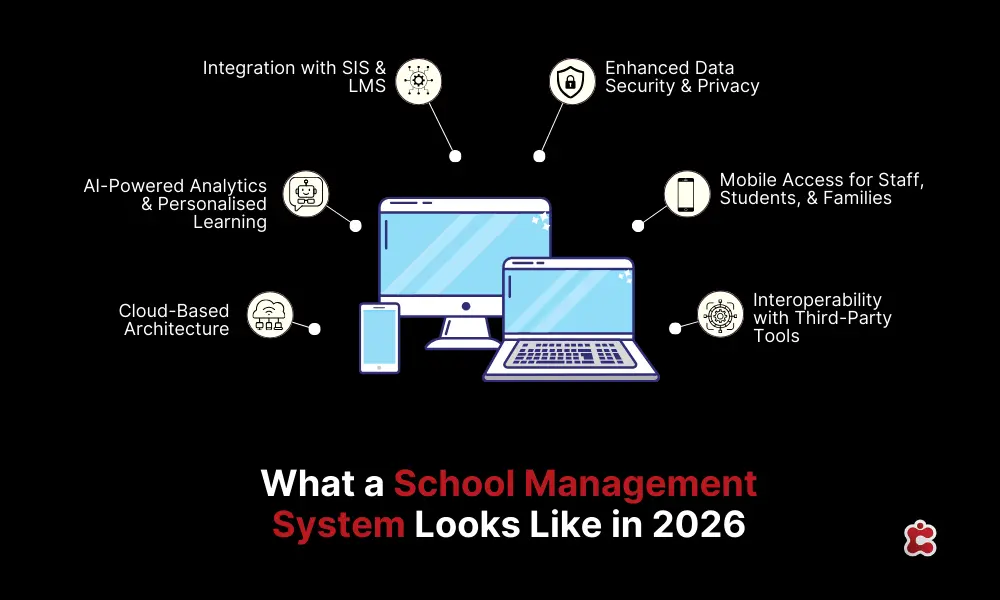
What a School Management System Looks Like in 2026
In 2026, a school management system is a fully connected digital platform that supports every part of school operations. This will include everything from student records to academic delivery and administration. Instead of relying on separate tools, schools use a single system to manage enrolment, attendance, grades, reporting, and communication in one place.
Cloud-Based Architecture
School management systems in 2026 operate in the cloud, allowing schools to access data and tools from anywhere without relying on on-site servers. Cloud-based platforms support automatic updates, easier scaling, and more reliable system performance as institutional needs change.
AI-Powered Analytics and Personalised Learning
Modern school management systems use AI-powered analytics to turn student data into actionable insights. Schools can identify learning patterns, track progress, and support personalised learning pathways while improving academic and operational decision-making.
Integration with Student Information Systems and Learning Management Systems
A school management system in 2026 integrates Student Information Systems (SIS) and Learning Management Systems (LMS) within a single platform or through seamless connections. The SIS manages enrolment, attendance, grades, and official records, while the LMS supports teaching, assessments, and learning content, ensuring consistent data across academic and administrative processes.
Enhanced Data Security and Privacy
With increasing regulatory requirements, school management systems prioritise data security and privacy. Modern platforms include role-based access controls, audit trails, and compliance-ready data management to protect sensitive student and staff information.
Mobile Access for Staff, Students, and Families
Mobile access is a standard feature of school management systems in 2026. Staff, students, and families can access schedules, grades, communication tools, and key updates through mobile-friendly interfaces, supporting engagement and day-to-day efficiency.
Workflow Automation Across School Operations
In 2026, school management systems include built-in workflow automation that reduces manual administrative tasks. Processes such as enrolment approvals, attendance tracking, reporting, billing, and internal requests are automated through rule-based workflows. This helps schools improve efficiency, reduce errors, and ensure processes are followed consistently across departments.
Interoperability with Third-Party Tools
Modern school management systems are designed to work alongside other digital tools. In 2026, interoperability allows schools to connect finance systems, communication platforms, and external learning tools without duplicating data or disrupting workflows.
How to Choose a School Management System in 2026
Choosing a school management system in 2026 means balancing current needs with long-term flexibility. Schools should focus on platforms that simplify operations, support growth, and adapt as requirements change.
- Define Institutional Needs
Start by understanding what the school needs today. School type, size, and operational complexity all influence which features matter most, from enrolment workflows to reporting and compliance.
- Evaluate Platform Scope
Decide whether an all-in-one school management system or a modular approach is the best fit. All-in-one platforms reduce fragmentation by centralising data and processes, while modular systems offer flexibility but often require more management.
- Assess Usability and Adoption
A system must be easy for staff to use. Clear onboarding processes and realistic training requirements help ensure adoption across administrative and academic teams.
- Consider Integration and Future Flexibility
The platform should integrate with existing tools and support future expansion, including additional users, programmes, or campuses.
- Review Vendor Support and Roadmap
Finally, evaluate the vendor’s update cycle, support model, and long-term roadmap to ensure the system remains relevant as school management needs evolve.
All-in-One School Management Systems vs Standalone Tools
| Criteria | All-in-One School Management Systems | Standalone Tools |
| System structure | Single, unified platform covering administration, student data, and academics | Multiple separate systems for attendance, finance, learning, and communication |
| Data management | Centralised student data with one source of truth | Data stored across different databases, often duplicated |
| Student Information System (SIS) | Built in or natively integrated | Separate SIS requiring manual syncing |
| Learning Management System (LMS) | Integrated with academic and administrative data | Operates independently from student records |
| Reporting and insights | Real-time, cross-department reporting | Limited reporting based on individual tools |
| Administrative workload | Reduced manual work through automation | Higher workload due to data re-entry |
| Compliance and accuracy | Stronger data consistency and audit readiness | Higher risk of errors and compliance gaps |
The Future of School Management Systems Beyond 2026
- Platform consolidation
Schools will continue to move away from fragmented tools toward unified school management systems that centralise academic, administrative, and operational functions in one platform. - Data-driven operations
School management systems will increasingly support real-time reporting and analytics, helping institutions make informed decisions based on accurate and connected student and operational data. - Smarter automation
Automation will expand beyond basic workflows to reduce manual tasks across enrolment, reporting, and communication, allowing staff to focus on higher-value work. - Stronger governance
Future school management systems will place greater emphasis on data governance, access control, and compliance, ensuring schools can manage information securely and responsibly at scale.
Why Choose Classter in 2026
In 2026, educational institutions need more than separate tools stitched together. They need one reliable platform that connects data, people, and processes without added complexity. Classter offers an all-in-one school management system that brings administration, student information, academic management, and communication into a single environment.
With built-in integrations across Student Information Systems and Learning Management Systems, Classter eliminates data silos and manual work. Schools gain real-time visibility, stronger compliance, and the flexibility to scale as needs change. Its modular design allows institutions to activate only what they need while keeping everything connected through one source of truth.
If you want a future-ready platform that simplifies school operations and supports long-term growth, book a personalised demo and see how Classter works in practice.
FAQ’s
School management software in 2026 is a centralised digital platform that manages administration, student data, academics, and communication in one system. It replaces disconnected tools with a single source of truth.
All-in-one school management software reduces data silos, manual work, and errors. It improves efficiency, compliance, and visibility by keeping all school operations in one connected platform.
Classter connects student records, enrolment, attendance, grades, and reporting with learning activities such as assessments and course management, ensuring consistent data across the institution.