




There are countless Student Information Systems (SIS) on the market. Each one promises “transformation”, “efficiency”, “seamless integration”. The language is polished. The demos are flawless. The roadmaps look reassuring.
But beneath all of it, one question matters more than any feature comparison:
Does it actually work for the people who have to use it every day?
In higher education, a Student Information System (SIS) isn’t just another platform you onboard and forget. It touches everything: admissions, enrollment, academic records, grading, progression, finance, billing, data security, compliance, and long-term planning. It becomes the operational heartbeat of your institution.
So the decision shouldn’t come down to who presents best in a boardroom. It should come down to what your Registrar, your IT team, your Finance office, and your Academic leadership actually need to do their jobs with confidence. That is why this checklist exists. To guide real conversations and help your selection committee make the right call. Let’s take a closer look.
Why SIS Decisions Stall in Higher Education
In higher education, selecting a student information system is rarely stalled by technology alone. It slows down because alignment takes work.
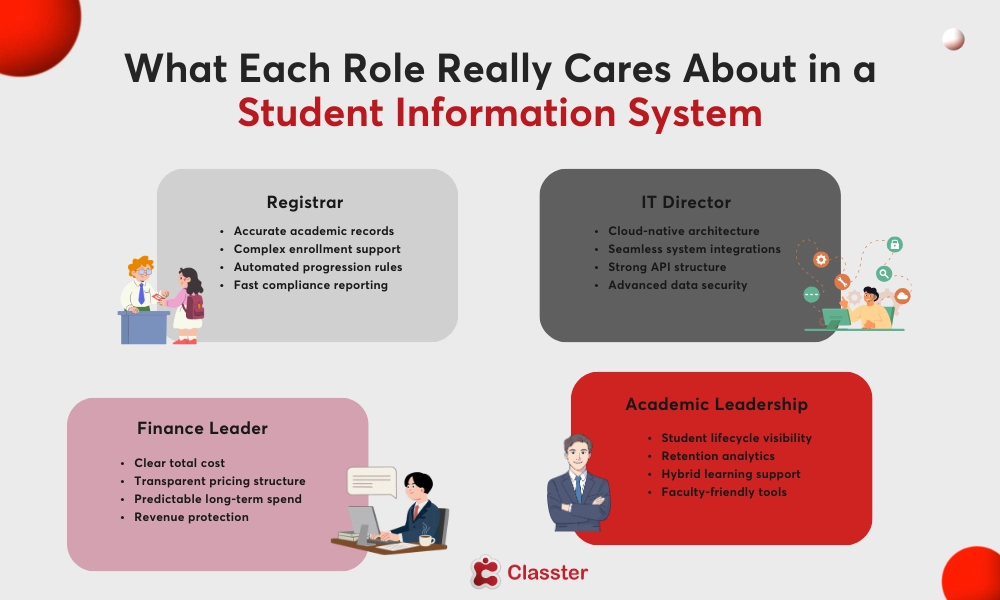
The Registrar is thinking about academic rules, compliance, and peak enrollment pressure. IT is focused on infrastructure resilience and data security. Finance is looking closely at cost structures and long-term ROI evaluation. Academic leadership is asking how this Higher Ed Software supports strategy, growth, and student outcomes. When expectations are fragmented or measured differently, momentum fades.
Add to that the pull of a polished demo and the hesitation around disrupting academic operations, and the process becomes even more cautious. None of these signals dysfunction. It signals responsibility.
What institutions ultimately need is a student information system that meets cross functional needs, strengthens confidence across teams, and delivers measurable value without creating financial strain.
The Registrar’s Checklist
For the Registrar, a SIS must reflect academic reality. It should support institutional rules, protect compliance standards, and simplify daily operations without forcing teams into workarounds. Precision is foundational.
Core capabilities the Registrar will evaluate:
- Advanced enrollment management that supports complex program structures, cross registrations, and flexible academic calendars.
- Integrated curriculum and progression rules that automate prerequisites, credit limits, and graduation eligibility checks.
- Comprehensive grading and transcript management with accurate audit trails and version control.
- Centralized, real-time data integrity across departments to eliminate reconciliation gaps.
- Regulatory and accreditation reporting tools that generate compliant reports quickly.
Peak period performance stability to withstand high registration traffic without system slowdowns. - User-friendly interfaces that reduce training time for faculty and administrative staff.
The IT Director’s Checklist
IT teams carry the responsibility of protecting institutional infrastructure while enabling innovation. Every new Student Information System must integrate with the existing architecture, strengthen data security, and scale without adding operational strain. The decision is not about features. It is about long-term stability and controlled growth.
Core capabilities IT will evaluate:
- Cloud native architecture that supports flexibility, performance, and future adaptability.
- Seamless integration with LMS, CRM, finance, and HR systems to avoid fragmented data environments.
- Well-documented APIs that allow secure, structured connectivity.
- Advanced data security controls aligned with GDPR and regional compliance standards.
- Role-based access permissions that protect sensitive academic and financial information.
- Disaster recovery frameworks and uptime guarantees that minimize institutional risk.
- Scalable infrastructure capable of supporting enrollment growth.
- Transparent vendor roadmaps that signal long-term product direction.
The Finance Leader’s Checklist
Finance leaders approach a student information system with disciplined scrutiny. The question is not whether the platform is impressive. It is whether the investment is sustainable, measurable, and defensible over time. In higher education, financial decisions must balance operational improvement with long-term stability.
What Finance will scrutinize:
- Total cost of ownership over 5–7 years, including licenses, upgrades, and support.
- Clear distinction between implementation and subscription costs to avoid blurred budgeting.
- Migration and training expenses are often underestimated in early projections.
- Hidden fees or modular pricing structures that inflate costs over time.
- Operational efficiency gains translated into measurable cost savings.
- Revenue leakage prevention, particularly in billing and enrollment processes.
- Robust reporting tools that support forecasting and strategic planning.
- A structured ROI evaluation model that connects technology investment to financial outcomes.
Academic Leadership’s Checklist
Academic leaders view a student information system through the lens of strategy and student impact. Provosts and Deans are not evaluating infrastructure details or pricing structures. They are assessing whether this Higher Ed Software strengthens academic quality, supports innovation, and enhances the overall student experience. The platform must align with institutional vision, not simply operational needs.
What Academic Leadership will evaluate:
- Student lifecycle visibility, from admissions through graduation, with clear academic insights.
- Support for hybrid, blended, and online learning models as delivery evolves.
- Faculty empowerment tools that simplify grading, communication, and academic management.
- Retention and progression tracking capabilities with early warning indicators.
- Real-time academic performance dashboards to inform leadership decisions.
- Scalability for new programs and strategic expansion.
- Competitive positioning, ensuring the institution remains digitally progressive.
Academic Leadership’s Checklist
Academic leadership evaluates a student information system through a strategic lens. The concern is not operational mechanics alone, but whether the platform meaningfully enhances academic delivery and the student experience across higher education. Provosts and Deans are asking whether this decision strengthens institutional direction or simply maintains the status quo.
What Academic Leadership will evaluate:
- End-to-end student lifecycle visibility, from recruitment to graduation, with clear academic insights.
- Support for hybrid, blended, and fully online models that reflect evolving delivery formats.
- Faculty-centric tools that streamline grading, advising, and communication rather than adding friction.
- Built in retention tracking mechanisms with early alerts and progression analytics.
- Real-time academic performance dashboards to inform data-driven strategy.
- Infrastructure that supports long-term growth, new programs, and cross-campus expansion.
- Digital maturity and competitiveness, ensuring the institution remains forward-looking.
Red Flags in SIS Vendor Evaluation
Not every risk is obvious during a polished demo. Some signals appear in the details, in what is avoided, softened, or left undefined. Identifying red flags early protects time, budget, and institutional stability.
Strategic Red Flags
- Over customization as the primary selling point. If everything requires tailoring, long term maintainability may suffer.
- No clear product roadmap. A student information system without a forward direction can quickly become legacy.
- Vague responses about data security. In higher education, compliance and protection standards must be explicit.
- ROI claims without measurable frameworks. Promises should translate into structured ROI evaluation models.
- Weak integration documentation. Poor API clarity signals future friction.
- Reference clients unwilling to engage. Hesitation often reveals hidden complexity.
Operational Red Flags
- Extended implementation timelines with unclear ownership. Accountability should be defined from the outset.
- Heavy reliance on manual configuration. Sustainable systems reduce dependency on constant adjustment.
- No formal training structure. Adoption requires structure, not assumption.
- Limited reporting flexibility. Higher Ed Software should expand insight, not restrict it.
SIS Selection Scorecard
Use this scorecard during your selection meetings. Ask each stakeholder to score independently before discussing results as a group.
Scoring Guide
1 = High risk / weak alignment
3 = Acceptable but needs clarification
5 = Strong institutional fit
SIS Evaluation Scorecard
| Category | Criteria | Score (1–5) |
| Strategic Fit | Alignment with institutional goals | |
| Support for higher education complexity | ||
| Future scalability | ||
| Operational Strength | Registrar workflow compatibility | |
| Faculty usability | ||
| Reporting depth | ||
| Technology & Data Security | Security certifications | |
| Integration capabilities | ||
| Infrastructure reliability | ||
| Financial Viability | Transparent pricing | |
| Clear ROI evaluation model | ||
| Predictable long term costs | ||
| Vendor Partnership | Implementation clarity | |
| Training support | ||
| Roadmap transparency |
Total Score: ____ / 75
Interpretation
60–75: Strong institutional fit
45–59: Viable with conditions
Below 45: High strategic risk
Share This With Your Selection Committee
If your institution is evaluating a student information system, share this checklist with your Registrar, IT Director, Finance lead, and Academic leadership before your next discussion. Use it to ground the conversation in real stakeholder needs rather than surface level impressions. When each team member scores independently, patterns emerge. You begin to see where alignment is strong and where assumptions differ. That clarity changes the tone of vendor conversations. It shifts the focus from persuasion to fit. Thoughtful alignment now reduces the risk of costly adjustments, operational friction, and strategic regret later.
FAQ’s
A student information system is the core administrative platform that manages admissions, enrollment, academic records, grading, billing, compliance reporting, and institutional data security. In higher education, it functions as the operational backbone that connects academic, financial, and administrative processes across departments.
ROI evaluation should include total cost of ownership, implementation expenses, operational efficiency gains, revenue leakage prevention, and long-term scalability. Measuring both cost savings and institutional value ensures the investment is financially sustainable.
Yes. Independent scoring prevents group bias and highlights perception gaps between departments. Comparing results helps institutions identify alignment risks before entering vendor negotiations.