




Tracking something like student engagement may seem like an abstract goal, but in practice, it comes down to a handful of measurable signals that your school is already collecting every day. Attendance records, grade trajectories, assignment submission rates, and portal login activity. The data is there. The question is whether your systems connect in a way that makes it useful before a problem becomes serious.
The challenge for most schools is not a lack of information. It is fragmentation. Attendance lives in one place, grades in another, portal activity in a third. No single person has a complete view until the situation has already escalated, and by then, the window for early intervention has closed.
This is where the right school software tools make a genuine difference. Not by replacing teacher judgment, but by surfacing the data that makes that judgment possible earlier, more consistently, and at a scale that individual monitoring cannot match. This guide covers what student engagement actually looks like as data, which software features create the most practical impact, and the specific tactics schools can implement with tools they may already have.
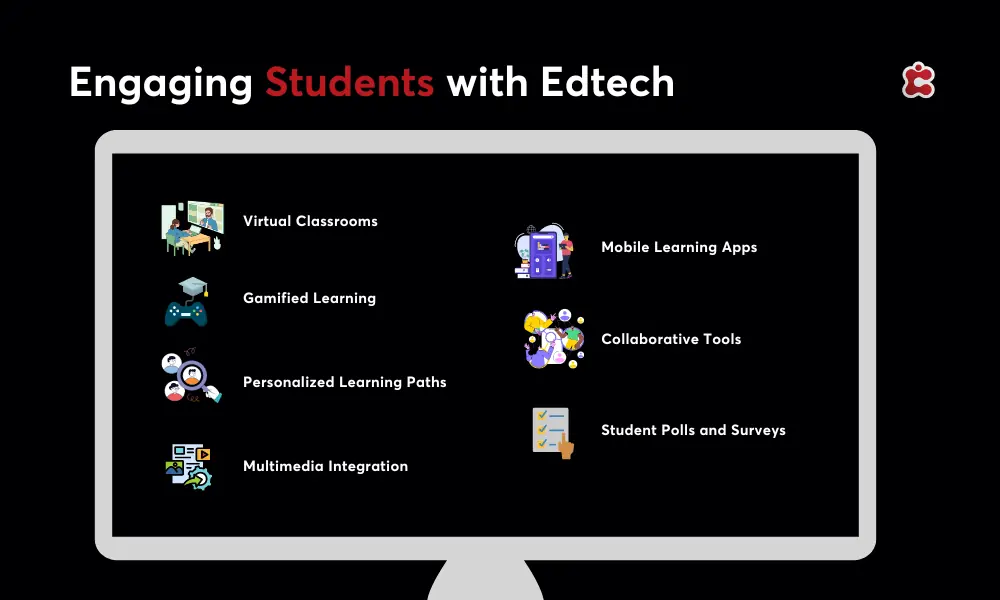
Why Student Engagement Is a Data Problem
Engagement is often discussed as a culture or motivation issue. And it is, in part. But before a school can address the culture, it needs to know where the problem is. That requires data, and it requires that data to be connected.
Research consistently links engagement to outcomes. Institutions that prioritize engagement strategies see significantly higher retention rates. Studies have noted that students who are more actively engaged with faculty, peers, and subject matter are more likely to persist and achieve at higher levels.
The practical question for school administrators and teachers is not whether engagement matters. It is whether their current systems give them the visibility to act on it in time.
The Engagement Signals Your Software Should Be Tracking
Engagement is not a single metric. It is a pattern built from multiple data points across the student experience. The table below shows the signals that matter most and where school software can surface them.
| Engagement Signal | Where It Shows Up | What School Software Can Do |
|---|---|---|
| Attendance patterns | SIS/attendance module | Flag early warning signs, trigger parent alerts |
| Assignment submission rates | LMS gradebook | Identify students missing multiple submissions |
| Grade trajectory | Gradebook / SIS | Track trend over time, not just single results |
| Portal login frequency | Student portal | Flag students who have not logged in recently |
| Parent response to communications | CRM / communication module | Identify families with low engagement and adjust outreach |
| Participation in school events | CRM / Academic CRM | Track involvement beyond the classroom |
The keyword in that table is connected. Each of these signals on its own is useful. Together, they provide a picture of a student’s engagement that is far more reliable than any single indicator. A student who misses one class and submits all their work is very different from a student who misses one class, has not logged into the portal in two weeks, and submits their last assignment three days late.
Schools whose data lives in separate systems have to manually connect these dots. Schools whose platforms connect them automatically get the picture without the manual effort, and they get it faster.
The Software Features That Drive Real Engagement Improvement
Attendance tracking with automated alerts
Attendance is the earliest and most reliable indicator of engagement. A student whose attendance is slipping has already begun to disconnect from the school experience. The question is whether the system tells the right people quickly enough to respond.
Attendance software that allows administrators and teachers to set configurable absence thresholds and automatically notifies parents when a student crosses them removes the manual step that otherwise delays the response. A parent who receives an alert after two consecutive absences can have a conversation with their child that day. A parent who finds out three weeks later at a parent-teacher meeting cannot.
Student portals with real-time academic visibility
A student portal that shows grades, upcoming deadlines, attendance records, and teacher feedback in one place gives students agency over their own academic progress. When students can see clearly where they stand, they are more likely to take action. When the information is scattered or inaccessible, momentum stalls. A well-designed student portal is one of the most underutilized engagement tools available to schools.
The design of the portal matters. A portal that is technically functional but requires too many steps to find relevant information will see low adoption. Students in 2026 expect mobile-responsive, intuitive access. A portal that works well on a phone and surfaces the most relevant information immediately is meaningfully different from one that technically exists but is rarely used.
Parent portals that inform without overwhelming
Parent involvement is one of the strongest predictors of student engagement, particularly in K-12 settings. Parents who know what is happening academically are better equipped to support learning at home, have more productive conversations with their children, and flag concerns to teachers before they escalate.
A parent portal that provides real-time access to attendance, grades, upcoming assessments, and fee status removes the information gap that often exists between schools and families. Rather than a parent receiving a termly report card and little else, they have continuous visibility that mirrors what the school itself can see.
The practical impact is not just on engagement metrics. It is on the quality of the parent-school relationship. Families who feel informed and included are more likely to engage constructively when issues arise, rather than feeling blindsided.
LMS tools that support participation beyond the classroom
An LMS that supports structured discussion forums, peer review tools, and asynchronous assignment submission creates participation pathways for students who do not engage as readily in live classroom settings. Not every student who is quieter in class is disengaged in learning. Some simply need a different format.
Discussion forums where students can contribute at their own pace, respond to peers, and engage with course material outside scheduled class time extend the engagement window beyond the school day. For hybrid and blended learning environments, this is not optional infrastructure. It is the primary engagement mechanism.
Assignment visibility within the LMS, where students can see what is due, what has been submitted, and what feedback has been provided in one place, directly reduces the friction that leads to missed work. When students know what is expected and can easily access it, completion rates improve.
Targeted communication and CRM tools
Generic mass communication to all families produces low engagement. A school that sends the same weekly newsletter to every parent, regardless of their child’s year group, program, or current academic situation, is missing the opportunity to make communication feel relevant. Academic CRM tools allow schools to segment their communication by cohort, grade level, program, or engagement status, so that each family receives information that is actually relevant to them.
For students themselves, targeted communication can be used to reach out proactively when engagement signals indicate a concern, without waiting for a formal meeting or a grade report. A personal message from a teacher or advisor, triggered by an automated alert, can shift a student’s trajectory in a way that a generic school-wide communication never would.
Practical Tactics: Using Software Features to Drive Engagement
The table below maps specific software features to practical engagement tactics that schools can implement.
| Software Feature | Practical Engagement Tactic |
|---|---|
| Attendance alerts | Set automated parent notifications when a student reaches a defined absence threshold before the teacher has to act |
| Student portal | Give students a single place to see grades, deadlines, and feedback, reducing the friction between effort and visibility |
| Parent portal | Surface real-time grade and attendance data so parents can have informed conversations at home, not just at parent-teacher evenings |
| Gradebook analytics | Review grade distribution across a class after each assessment to identify whether the issue is individual or systemic |
| LMS discussion tools | Create structured discussion forums where quieter students can contribute asynchronously without the pressure of speaking in class |
| Targeted communication | Segment messaging by cohort, grade level, or program rather than sending identical updates to every family |
| Assignment deadline reminders | Automate submission reminders 48 hours before a deadline, reducing the volume of last-minute queries and missed work |
| Alumni and community tools | Connect current students with alumni networks and employer portals to make the school experience feel relevant beyond graduation |
The common thread across all of these tactics is speed. Engagement software is most valuable when it closes the gap between a signal appearing in the data and a human being taking action. Every day that passes between a student showing signs of disengagement and someone reaching out is a day where the pattern deepens.
Building an Engagement-Aware Culture With Software Support
Software tools do not improve engagement on their own. They improve the conditions under which teachers and administrators can act. The cultural shift that needs to accompany better tooling is one where engagement data is reviewed regularly and acted on proactively, not just consulted when a problem has already become a crisis.
This means setting up regular review rhythms. Weekly or biweekly attendance reviews using dashboard data rather than manual reports. Monthly grade trajectory checks for students who are trending downward. Termly reviews of parent portal adoption rates to identify families who are not engaging with the platform and may need additional outreach.
It also means ensuring that the right data reaches the right people. A class teacher seeing individual student engagement data is useful. Ahead of the year, seeing aggregated engagement across their year group can identify systemic issues that individual teachers would not spot. A school director, seeing institution-wide engagement trends, can make resource allocation decisions based on evidence rather than intuition.
Connected software makes all three levels of visibility possible from the same platform. Disconnected systems make each level require separate effort and separate reporting, which means the review rhythms that create an engagement-aware culture are much harder to sustain.
How Classter Supports Student Engagement
Classter’s platform is designed to give schools a connected view of student engagement across the full academic and administrative experience. The SIS module tracks attendance with configurable alert thresholds that notify parents and staff automatically. The student and parent portals provide real-time access to grades, deadlines, attendance, and communication history in one place.
The Academics and LMS module supports course delivery, assignment management, discussion tools, and gradebook tracking within the same platform that manages student records. There is no gap between what is recorded academically and what is visible in the student portal, because they share the same data foundation.
The Academic CRM component enables targeted communication by cohort, program, or engagement status, giving schools the segmentation capability to make outreach relevant rather than generic. Alumni and employer portals extend the engagement model beyond graduation, which is increasingly important for institutions that want to maintain meaningful relationships with their communities over time.
Because all of these tools operate within one integrated platform, the engagement data that matters is visible in one place, to the right people, without requiring manual aggregation. That is the structural difference between software that supports engagement and software that simply records what has happened after the fact.
FAQ’s
By making engagement data visible to the right people at the right time. When teachers can see attendance trends, grade trajectories, and submission rates in one place, they can act before disengagement becomes a bigger problem. Parents have real-time access to their child’s progress, and they can support learning at home. When students have a clear view of their own deadlines and grades, they are more likely to take ownership.
Attendance flagging with configurable thresholds, grade trend tracking over time, LMS submission rate visibility, parent communication history, student portal login monitoring, and reporting that aggregates engagement data across classes and cohorts for administrator review.
Classter provides connected engagement tools across its SIS, LMS, Academic CRM, and portal modules. Attendance alerts, student and parent portals, gradebook tracking, discussion tools, and targeted communication all operate within the same platform, giving schools a complete view of student engagement without needing separate tools.