


Schools in 2026 are operating in a far more complex environment than ever before. Rising expectations from students and parents, hybrid learning models, tighter compliance requirements, and growing pressure on administrative teams have pushed traditional systems to their limits. For many institutions, managing academics, operations, and engagement across disconnected tools is no longer sustainable.
This shift is driving schools to rethink what school management software should deliver today. Decision-makers are increasingly looking for platforms that do more than just store data. They need connected systems that support the full student lifecycle, reduce administrative friction, and scale seamlessly across K12 and higher education environments.
This article explores why Classter is widely regarded as the best school management software in 2026, and what sets it apart for schools preparing for the future of education.
Why Schools Are Moving Away From Fragmented Systems in 2026
In 2026, fragmented school systems will no longer keep pace with the demands of modern education. Managing student records, learning platforms, finance, and communication across separate tools creates data silos, manual work, and unnecessary complexity.
Disconnected systems make it harder for schools to get a clear, real-time view of performance and operations. Administrators spend more time reconciling data, while educators are forced to navigate multiple platforms just to complete everyday tasks.
As expectations for speed, accuracy, and visibility continue to rise, schools are shifting toward unified school management software that brings everything together in a connected environment. The move away from fragmented systems is driven by a need for simplicity, scalability, and better decision-making across the entire institution.
What Modern School Management Software Needs to Deliver Today
Modern schools are facing growing academic and operational complexity, which is why platforms like Classter are increasingly shaping how institutions evaluate school management software in 2026. As expectations rise, schools need systems that go beyond administration to support clarity, efficiency, and adaptability across the entire institution.
Key capabilities modern platforms need to deliver include:
- Centralized data visibility: A single source of truth that connects academic, operational, and financial data for real-time insight and decision-making.
- End-to-end automation: Streamlined workflows for admissions, attendance, grading, billing, and reporting to reduce manual work and errors.
- Scalability across education models: The ability to support K-12 and higher education, multiple campuses, hybrid learning, and evolving institutional structures.
- Flexible configuration: Tools that adapt to local regulations, academic frameworks, and internal processes without heavy customization.
- Intuitive user experience: Role-based access and simple interfaces that encourage adoption by administrators, educators, students, and parents.
- Secure, cloud-based infrastructure: Reliable performance, data protection, and compliance in a digital-first environment.
Together, these capabilities define what schools now expect from modern school management software and why all-in-one platforms are becoming the standard.
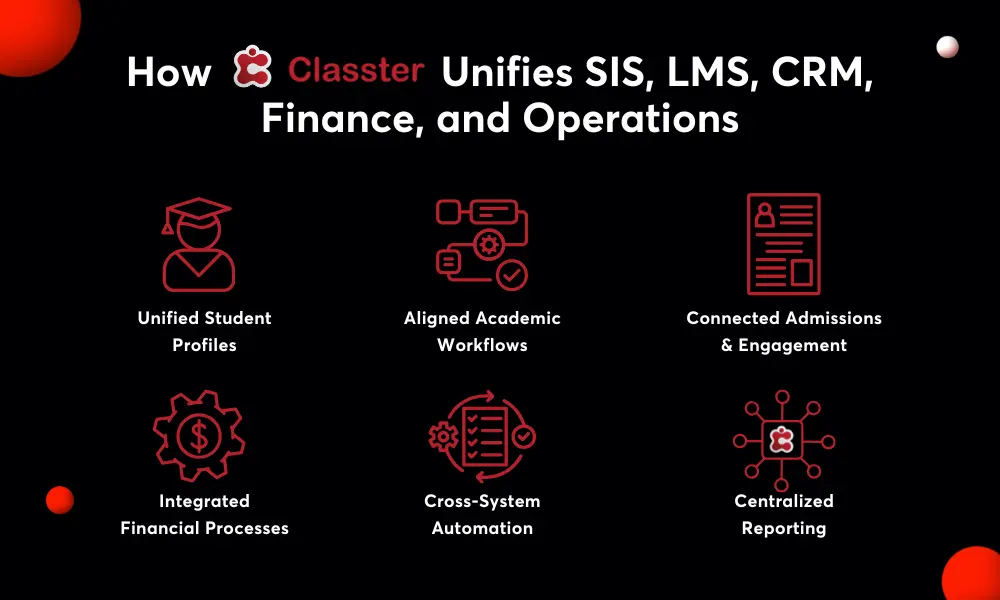
How Classter Unifies SIS, LMS, CRM, Finance, and Operations
Classter unifies SIS, LMS, CRM, finance, and operations by structuring every function around a shared data foundation. Rather than operating as separate modules, each area works together as part of a single system.
This unified approach enables:
- Unified student profiles: Academic, learning, communication, and financial data connected in one place.
- Aligned academic workflows: Enrollment, courses, assessments, and progress tracking remain fully synchronized.
- Connected admissions and engagement: Application data and communication history flow directly into student records.
- Integrated financial processes: Billing and payments are linked to enrollment and academic activity.
- Cross-system automation: Actions in one area trigger workflows across others.
- Centralized reporting: Academic, operational, and financial insights available from a single platform.
This structure allows schools to manage complexity with greater consistency, visibility, and control.
Built for Growth: Scalability Across Campuses, Programs, and Regions
Schools planning for 2026 need systems that can scale without increasing complexity. As institutions expand across campuses, introduce new programs, or operate in multiple regions, technology must support growth without forcing teams to rebuild processes or adopt additional tools.
Classter is designed to scale alongside the institution. It supports multi-campus structures, varied academic programs, and different operational requirements within a single platform. Schools can manage distinct academic calendars, grading models, and administrative workflows while maintaining centralized oversight.
Regional scalability is equally important. Classter accommodates different regulatory requirements, languages, currencies, and reporting standards, making it suitable for institutions operating across borders. As enrollment grows or structures evolve, the platform adapts without disrupting existing operations.
Why an All-in-One School Management System Matters More Than Ever
An all-in-one school management system addresses this by consolidating critical functions into a single platform. When student information, learning activity, admissions, finance, and operations operate within the same environment, institutions gain clearer oversight and more consistent processes across departments.
This approach also reduces reliance on manual work and third-party integrations, helping schools respond faster to change. With shared data and aligned workflows, teams can make decisions based on real-time information rather than reconciling reports from multiple systems.
As expectations for efficiency, accountability, and scalability continue to rise, all-in-one school management systems are no longer a convenience. They are becoming essential infrastructure for schools planning for long-term sustainability and growth.
FAQs
All-in-one school management software reduces data silos, manual work, and integration challenges by connecting SIS, LMS, finance, and operations within a single environment.
Yes. Classter is designed to support K-12 schools, colleges, and universities, with flexible configuration for different academic models, campuses, and programs.
Classter supports multi-campus structures, regional requirements, and institutional growth while maintaining centralized oversight and consistent workflows.