




Every school management software vendor has added AI to their marketing materials. It is in the headlines, the product demos, and the conference keynotes. It is also, in many cases, a label applied to functionality that is little more than automated reminders and pre-built reports.
That does not mean AI in school administration is not real. It is. But the gap between what vendors promise and what schools actually experience when they implement these tools is wide enough to warrant a clear-eyed assessment.
This article explains what AI in school management actually does in 2026, where it delivers genuine value for administrators, the risks and limitations, and what to look for when evaluating whether a platform uses AI in ways that will help your institution.
Why AI Is Becoming Relevant for School Administrators Now
School administration generates enormous volumes of data every day. Enrollment inquiries, attendance records, gradebook entries, billing transactions, parent communications, timetable changes, and staff records. For most schools, the majority of that data is collected but not fully used. It sits in systems that store information without surfacing the patterns hidden inside it.
AI changes the relationship between data and decision-making. Rather than a database that records what happened, an AI-enabled system can identify what is likely to happen, flag what needs attention before it becomes a problem, and automate the responses that previously required manual action.
AI tools are already being used for data analysis, strategic planning, and administrative support across institutions of varying sizes and resources. The adoption curve is steep, and schools that understand what the technology actually does will be better positioned to use it well.
What AI Actually Does in School Management Software
The most practical AI applications in school management fall into a handful of functional areas. Each one has a clear before-and-after for administrators who are currently handling these tasks manually.
| Area | What AI Does | Benefit for Schools |
|---|---|---|
| Student records | Flags anomalies and incomplete data | Cleaner, more reliable records |
| Attendance | Identifies absence patterns and triggers alerts | Earlier intervention for at-risk students |
| Enrollment | Forecasts demand and scores inquiry quality | Better resource planning and yield rates |
| Billing and payments | Predicts late payments, automates reminders | Improved cash flow, less manual follow-up |
| Academic performance | Detects early warning signs of underperformance | Timely support before problems escalate |
| Scheduling | Optimizes timetables based on constraints | Fewer conflicts, better resource utilization |
| Communication | Segments audiences and personalizes outreach | Higher engagement, fewer missed touchpoints |
| Reporting | Auto-generates compliance and board reports | Hours saved per reporting cycle |
Predictive analytics for student performance
This is where AI delivers some of its most significant educational value. By analyzing attendance patterns, assessment scores, submission rates, and engagement data, AI systems can identify students who are at risk of falling behind weeks before the problem is visible in a grade report.
Instead of a teacher noticing in week eight that a student has been disengaged since week three, the system flags the pattern in week four and prompts an intervention. That earlier response has a measurable impact on retention and outcomes, particularly for institutions managing large cohorts where individual monitoring is impractical.
Enrollment forecasting
Enrollment management has historically relied on gut feel and prior year comparisons. AI brings a more analytical approach: using historical inquiry patterns, conversion rates, marketing channel data, and external factors to forecast how many students are likely to enroll in a given intake.
For institutions using an integrated admissions module, AI-assisted forecasting helps admissions teams prioritize follow-up, allocate staff time during peak periods, and plan capacity more accurately. This reduces both under-enrollment and last-minute scrambles.
Automated billing and payment management
Late fee collection is a persistent operational problem for schools. AI can analyze historical payment behavior to predict which families are likely to miss a payment, triggering proactive outreach before the due date rather than reactive follow-up after it. This improves cash flow and reduces the volume of overdue accounts without increasing manual effort from the finance team.
Intelligent scheduling
Timetabling is one of the most complex and time-consuming tasks in school management. AI-assisted scheduling tools analyze teacher availability, room capacity, subject requirements, and student group constraints to generate optimized timetables that would take a human administrator days to produce manually. Changes, whether a room becomes unavailable or a teacher is absent, can be accommodated with automated rescheduling suggestions rather than starting from scratch.
AI in the LMS
Within the Learning Management System(LMS), AI can analyze assignment performance and engagement patterns to highlight learning gaps and suggest targeted support. Teachers get a clearer picture of where each student is struggling without having to manually review individual submissions. For large cohorts, this kind of pattern recognition at scale is simply not possible without automation.
Communication and family engagement
AI enables more intelligent outreach by segmenting families based on behavior and context rather than sending identical messages to everyone. A family that has visited the school twice and downloaded the prospectus should receive different follow-up than a family that submitted a quick online inquiry and has not engaged since. AI-driven communication tools make that segmentation automatic, which improves response rates and reduces the volume of irrelevant messages families receive.
The Hype vs the Reality
Before evaluating AI features in any school management platform, it helps to be clear about what AI can and cannot do in an educational context.
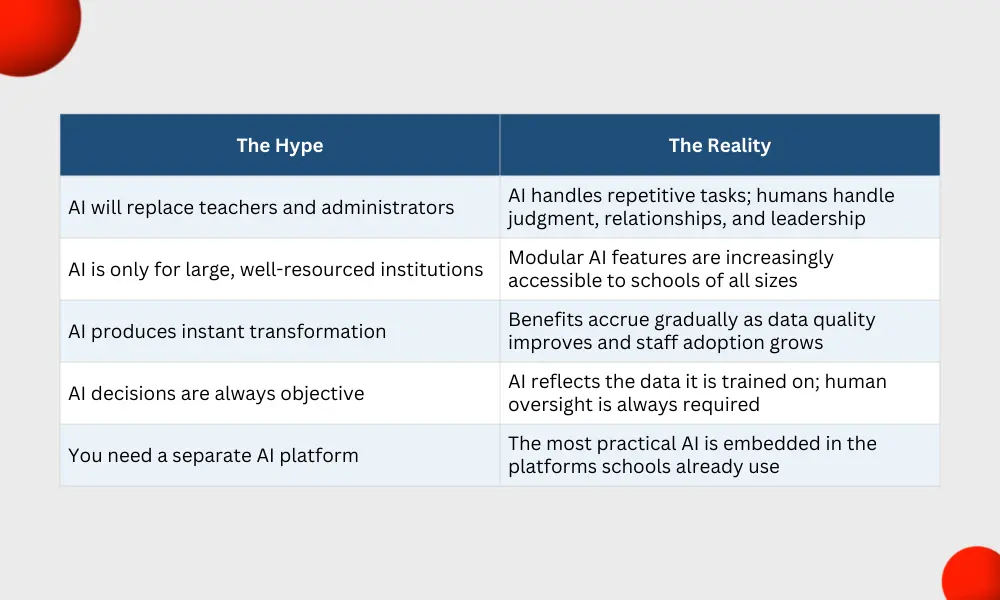
The most important point in that table is the last one. The most accessible and useful AI for school administrators is not a separate AI tool bolted onto existing systems. It is AI that is embedded within the platforms schools already use, drawing on the data those platforms collect, and surfacing insights within the workflows where administrators already spend their time.
Data Privacy and Responsible AI in Schools
Student data is among the most sensitive information that any organization manages. Before implementing AI features in any school management platform, administrators need to understand exactly what data the AI is using, how it is stored, and who has access to it.
Key questions to ask any vendor:
- Where is student data hosted, and in which jurisdiction?
- Is the data used to train the vendor’s AI models, or is it kept strictly within your institution’s environment?
- What access controls exist to ensure AI-generated insights are seen only by appropriate staff?
- How are AI recommendations audited, and what oversight exists for automated decisions?
- Does the platform comply with GDPR, FERPA, or other relevant regional data protection regulations?
AI that surfaces a recommendation about a student’s academic trajectory is making a judgment that will influence how staff respond to that student. Human oversight is not optional. The AI should inform the decision, not make it.
How to Evaluate AI Features in School Management Software
Not all AI features are equally useful or equally well-implemented. When evaluating platforms, these questions will help separate meaningful AI from marketing language.
- Is the AI embedded in the platform or a separate add-on? Embedded AI that draws on the data your school already generates is more immediately useful than a standalone tool that requires separate data feeds.
- What specific tasks does it automate? Ask for a concrete demonstration of the AI in action, not a general description of capabilities.
- How transparent is the system about how recommendations are made? Black-box AI that produces outputs without explanation is harder for staff to trust and act on appropriately.
- What happens when the AI is wrong? Every AI system produces errors. The question is whether the platform is designed to surface them and allow human correction.
- Does the AI improve over time with your institution’s data? Systems that learn from your specific patterns will become more accurate as adoption grows.
Where Classter Sits in the AI Conversation
Classter’s platform is built around integrated automation and intelligent workflows across its SIS, SMS, LMS, CRM, and billing modules. Rather than adding AI as a marketing layer, Classter is designed to surface insights from the data that schools generate every day and automatically trigger the right actions.
In practice, this means attendance patterns that might indicate a student is disengaging are flagged for the relevant teacher or administrator. Enrollment pipelines show real-time conversion data that helps admissions teams prioritize their follow-up. Billing workflows trigger reminders based on payment history rather than sending identical reminders to every family on the same schedule. Reporting tools generate compliance and board-level summaries without requiring manual data aggregation.
Classter’s integration with Microsoft Azure infrastructure also means the data foundations that AI depends on, security, reliability, and structured storage, are in place. AI is only as useful as the quality and consistency of the data it draws on, and a platform that has been collecting structured school data for years is better positioned to surface meaningful insights than one that has to build that foundation from scratch.
The conversation about AI in education will continue to evolve rapidly. Classter’s approach is to embed practical automation where it reduces real administrative friction, rather than deploying AI as a headline feature that does not translate into day-to-day value for school staff.
FAQ’s
AI in school management refers to the use of artificial intelligence to automate administrative tasks, analyze student data, predict outcomes, and improve decision-making across operations, including enrollment, attendance, billing, scheduling, and communication.
Predictive attendance alerts, enrollment forecasting, automated billing reminders, AI-assisted report generation, and intelligent communication segmentation are the most immediately useful AI features for school administrators in 2026.
Classter integrates automation and intelligent workflows across its SIS, SMS, LMS, and CRM modules. Its platform is built to surface insights from the data schools generate every day and trigger the right actions automatically, reducing manual workload across enrollment, attendance, billing, and communication.