




For most of their history, public school districts didn’t need a marketing plan. Students showed up because they lived in the zone, funding followed attendance, and the job of the enrollment office was administrative, not persuasive. That’s no longer true in a growing number of districts, and the shift has happened fast enough that many administrative teams are building the muscle for it in real time, with no playbook and no prior experience to draw on.
The numbers behind that shift are stark. A Rand Corporation survey of 481 school district leaders, conducted in spring 2026, found that budget shortfalls are now the single most common challenge districts report, cited by 54% of leaders, up sharply from 33% just a year earlier. Declining enrollment followed close behind at 36%. Compare that to concerns that used to dominate the conversation, like teacher recruitment (down to 35% from 42%) or chronic absenteeism (down to 31% from 38%), and a clear picture emerges: money and enrollment have overtaken almost everything else as the defining pressure on district leadership, according to K-12 Dive’s reporting on the survey.
Why Districts That Never Competed for Students Suddenly Have To
The causes aren’t mysterious, even if the response is new. District leaders interviewed by Rand pointed to declining birth rates, out-migration, and local labor market shifts as the demographic backdrop, factors mostly outside anyone’s control. But layered on top of that is something districts can actually respond to: the growth of school choice. As charter schools, voucher programs, and open-enrollment policies give families more options than the neighborhood assignment they used to be stuck with, a district’s enrollment stops being guaranteed and starts being something it has to earn, year over year, family by family.
The response shows up clearly in the same survey. Forty percent of districts said they’re now considering marketing campaigns specifically to promote the benefits of attending their public schools, essentially treating enrollment the way a private school or a university admissions office always has. A third are expanding pre-K services to build relationships with families earlier, before a competing option gets the chance. Another third are adding extracurricular and specialized programs, sports, gifted and talented tracks, out-of-school offerings, as reasons for a family to choose to stay rather than look elsewhere. None of this maps neatly onto the systems most district back offices were built around, because those systems were built to process enrollment, not to win it.
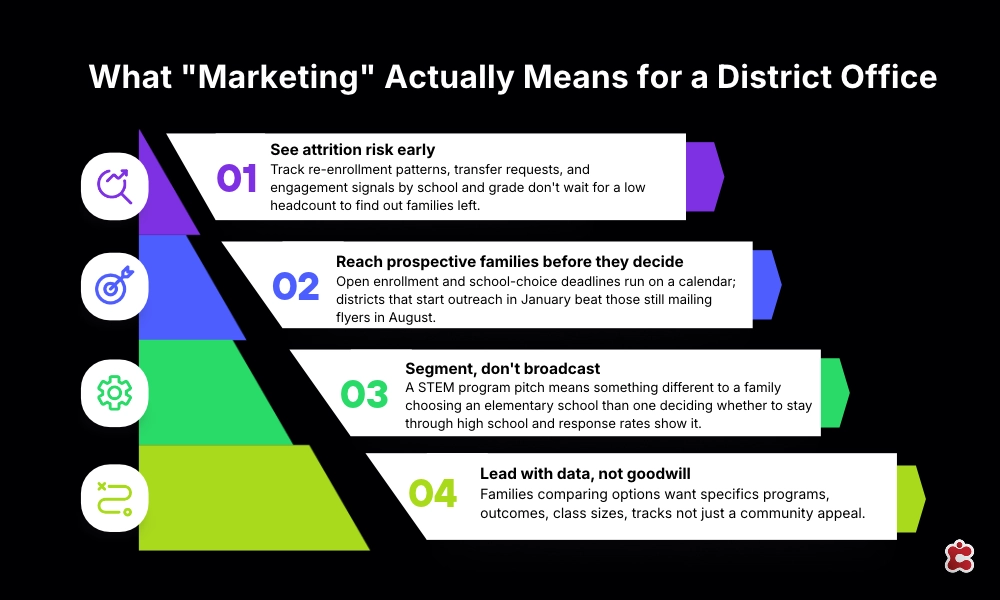
What “Marketing” Actually Means for a District Office
It’s worth being precise about what this shift requires, because “marketing” can sound like it belongs to a communications department with a budget for billboards. In practice, for a district facing this pressure, it looks like something closer to a retention and recruitment funnel:
- Knowing which families are at risk of leaving. A district can’t respond to attrition it can’t see. That means tracking re-enrollment patterns, transfer requests, and engagement signals by school and by grade level, not discovering the drop after the fact when next year’s headcount comes in low.
- Reaching prospective families before a decision is made, not after. Open enrollment periods and school-choice deadlines happen on a calendar. A district that starts communicating with prospective kindergarten families in January is competing on a different timeline than one that starts sending flyers in August.
- Segmenting outreach instead of broadcasting it. A message about a new STEM program lands differently with a family choosing between elementary schools than with a family deciding whether to stay for high school. Blast communication to everyone and the response rate reflects it.
- Making the case with data, not just goodwill. Families comparing options want to see something concrete: program offerings, outcomes, class sizes, specialized tracks, not just a general appeal to community spirit.
The Rand data backs up why this can’t be a one-time campaign. Rural districts, despite facing the steepest enrollment declines at 39%, were the least likely to be actively planning retention strategies, largely because they face less nearby competition than urban and suburban districts. That gap is worth noting: the districts under the most demographic pressure aren’t necessarily the ones building the tools to respond to it, and treating this as a communications sprint rather than an ongoing capability is a mismatch with how the problem actually plays out over multiple enrollment cycles.
Where This Overlaps With Systems Districts Already Have
The good news for districts standing up this capability under budget pressure is that most of what’s needed doesn’t require buying a separate marketing platform. It requires using data that already exists inside the student information system, tied to the same records that already track admissions, attendance, and communication.
Classter’s Academic CRM module is built around exactly this kind of targeted outreach: segmented messaging by cohort, program, or engagement status, rather than one message sent to every family on file. Combined with the Admissions module, which tracks applicants and re-enrollment status from first inquiry through to registration, a district gets visibility into where families are dropping out of the funnel, whether that’s a family that never completed an open-enrollment application or a current student whose family hasn’t re-registered for the next year, early enough to actually do something about it.
That’s the real shift underneath the marketing language. Districts don’t need to become advertising agencies. They need the same operational visibility over enrollment and retention that they’ve always had over attendance and grading, just pointed at a new problem.
The Bottom Line
School choice, demographic decline, and tightening budgets aren’t going away, and none of the district leaders Rand interviewed expect them to. What’s changing is the expectation that a public school district can simply assume its enrollment. Districts that treat retention and recruitment as an ongoing, data-informed practice, not a one-off flyer campaign when the numbers look bad, are the ones positioned to hold onto families who now have real alternatives.
See how Classter’s Academic CRM and Admissions modules give districts the same visibility into enrollment and retention they already have over attendance and grades. Book a demo
FAQ’s
Even districts with less nearby school-choice competition are affected by declining enrollment tied to birth rates and out-migration. The Rand survey found rural districts face the steepest enrollment declines of any group, even though they’re currently the least likely to be actively planning a response.
Traditional admissions communication is largely administrative: confirming applications, sending required forms. Enrollment marketing is proactive: reaching prospective and current families before a decision point, with a specific message about why to choose or stay, rather than simply processing whoever applies.
Before the point where a family would otherwise start looking at alternatives. Districts competing with open-enrollment or school-choice deadlines are increasingly starting outreach for the following year months in advance, rather than waiting for a formal re-registration period to begin.
Much of it depends on data visibility rather than headcount. Knowing which families haven’t re-registered, which applications stalled, and which cohorts are at risk of leaving can be built into the systems a district already uses for admissions and communication, rather than requiring a new department.
Yes. The Rand survey found a third of districts are expanding pre-K to build family relationships earlier, and a third are adding extracurricular or specialized programs as retention strategies. Both are responses to the same underlying pressure: giving families a reason to choose or stay with the district rather than a competing option.