




If you have been researching school management software, you have probably run into a wall of acronyms. SIS. SMS. LMS. ERP. They are often used interchangeably in vendor brochures, but they actually refer to distinct types of tools with different functions and scopes.
This matters because buying the wrong system, or trying to bolt two incompatible platforms together, creates exactly the kind of administrative chaos you were trying to solve in the first place.
This article breaks down the real difference between a Student Information System (SIS) and a School Management System (SMS), explains where each one fits, and helps you figure out which solution is right for your institution, whether you run a single K12 school or a multi-site organization.
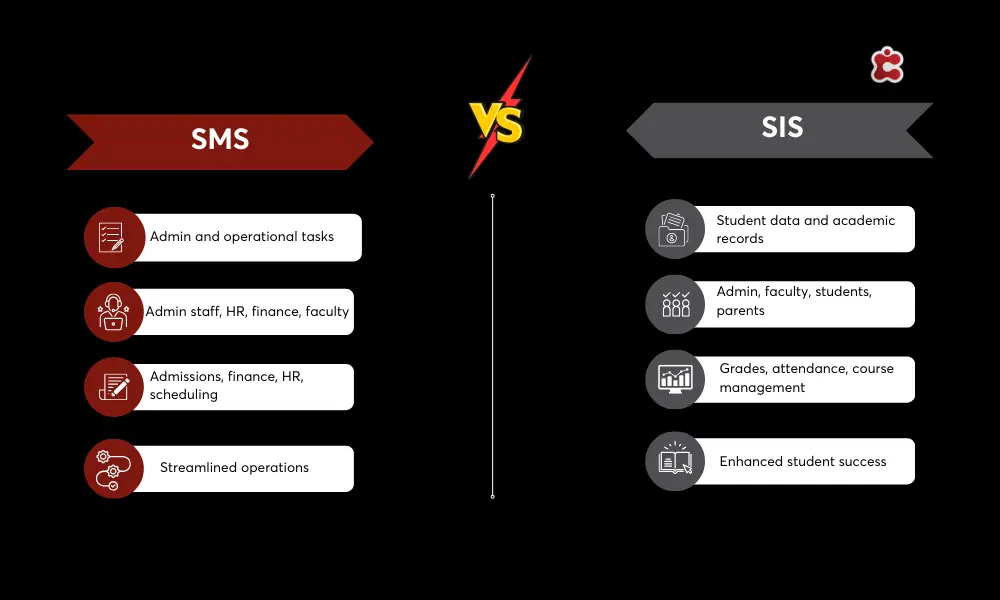
What Is a Student Information System (SIS)?
A Student Information System is a database-driven platform designed to store, manage, and report on student data throughout the academic lifecycle. It is the system of record for everything related to an individual student, from the moment they apply to the day they graduate.
Think of it as the administrative backbone for student-facing processes. The SIS tracks who students are, what courses they are enrolled in, how they are performing, and whether they are meeting requirements to progress or graduate.
Core Features of a Student Information System
- Enrollment and registration management
- Student profiles and demographic data
- Course catalogs and class scheduling
- Gradebook, assessments, and transcripts
- Attendance tracking
- Reporting for compliance and accreditation
- Parent and student portals
- Communication tools for student-facing updates
The SIS is primarily used by registrars, academic coordinators, and teachers. It answers questions like: How many students are enrolled in a given subject? What is a student’s current GPA? Who has excessive absences this term?
What Is a School Management System (SMS)?
A School Management System takes a wider operational view. While a SIS centers on the student, an SMS centers on the institution. It covers the administrative and logistical processes that keep a school running day-to-day, many of which extend beyond the student record entirely.
An SMS is the tool school directors, operations managers, and finance teams rely on. It manages the workflows that sit outside the classroom but make everything inside the classroom possible.
Core Features of a School Management System
- Billing, invoicing, and tuition management
- Staff HR records and payroll coordination
- Timetable and resource scheduling
- Facilities and transportation management
- Document and compliance workflows
- Vendor and procurement tracking
- Multi-campus or multi-institution oversight
- Institutional reporting and analytics
The SMS answers operational questions: Is tuition being collected on time? Are staff resources allocated correctly across campuses? Are classrooms and buses scheduled efficiently? It treats the school as an organization that needs to be managed, not just a place where learning happens.
SIS vs SMS: A Side-by-Side Comparison
The table below summarizes where each system focuses and where they overlap.
| Feature | SIS | SMS |
|---|---|---|
| Primary focus | Student data records | Institutional operations |
| Enrollment management | Yes | Partial |
| Gradebook and assessments | Yes | Limited |
| Attendance tracking | Yes | Yes |
| Billing and payments | Basic | Advanced |
| Staff and HR management | No | Yes |
| Timetable and scheduling | Limited | Yes |
| Parent and student portals | Yes | Yes |
| Reporting and analytics | Student-focused | Institution-wide |
| Learning management (LMS) | Rarely | Sometimes |
As the table shows, there is genuine overlap in some areas, particularly attendance tracking and portals. That overlap is exactly why the two terms get confused. But the strategic intent is different: a SIS is optimized for managing student outcomes, while an SMS is optimized for running the institution.
Where the Confusion Comes From
The SIS vs SMS distinction is cleaner in theory than in practice. Here is why institutions get tangled up:
Vendors use the terms interchangeably
Some platforms market themselves as a SIS but include billing and HR features. Others call themselves an SMS but are essentially student databases with a few add-ons. There is no universal standard for what each label includes, which means you need to look past the name and evaluate the actual feature set.
Needs differ by institution type
A small K12 school may find that a solid SIS covers 80% of what they need. A large higher education institution or a multi-site academy group will likely hit the ceiling of a SIS-only approach quickly, because operational complexity scales with size. The SMS becomes essential when you have multiple departments, campuses, or revenue streams to manage.
Legacy systems blur the lines
Many schools have been running on legacy software that was built as a one-size-fits-all tool. Over time, these platforms accumulated features without a coherent product logic. If your current system does some things well and others poorly, it is often because it started as one type of tool and had features grafted onto it.
Do You Need a SIS, an SMS, or Both?
The honest answer is: most institutions eventually need both. The question is whether you manage two separate systems or invest in a platform that integrates both functions natively.
Start with a SIS if:
- You are a smaller school primarily focused on improving student record management
- Your operational processes are already well-handled by existing tools
- You need better compliance reporting or gradebook functionality as your first priority
- You are in the early stages of digitizing your administration
Prioritize SMS capabilities if:
- You are managing complex billing, multiple fee structures, or payment plans
- You have staff scheduling or HR workflows that are creating bottlenecks
- You run multiple campuses or programs and need consolidated oversight
- Your operational inefficiencies are costing more time and money than your student data gaps
Consider an integrated platform if:
- You want a single system of record for both student data and institutional operations
- You are replacing multiple legacy tools and want to reduce your IT overhead
- You need data to flow freely between academic, financial, and operational teams
- You want a unified reporting view across all functions of your institution
Running a SIS and SMS as separate, disconnected tools creates the exact fragmentation you are trying to avoid. When student enrollment data does not sync with billing, or when attendance records do not connect to parent communication tools, your staff ends up reconciling data manually. That is time your team does not have.
The Case for an Integrated SIS and SMS Platform
The most forward-looking institutions are moving away from point solutions and toward integrated platforms that handle both student management and institutional operations in one place.
The benefits of integration go beyond convenience. When your SIS and SMS share a common data layer, you eliminate double entry, reduce reporting errors, and give every stakeholder, whether a teacher, a finance officer, or a school director, a single consistent view of the information they need.
There are also significant cost and compliance advantages. One platform means one vendor relationship, one support contract, one set of data security controls, and one place to run institution-wide reports. For schools operating across multiple countries or complying with regional data protection requirements, this consolidation is not just efficient. It is essential.
For 12 schools, academies, training centers, and mixed institutions, an integrated platform removes the pressure of choosing between student-focused and operations-focused tools. You get both, working together, without the integration headaches.
How Classter Combines SIS and SMS Functionality
On the SIS side, Classter manages the full student lifecycle: admissions, enrollment, course registration, gradebook, attendance, transcripts, and compliance reporting. On the SMS side, it handles billing and payments, staff management, timetabling, transportation, document workflows, and institutional analytics.
Rather than forcing institutions to integrate two separate tools, Classter provides a modular architecture where each component shares the same data foundation. A student enrolled through the admissions module is automatically available in the billing module. Attendance data feeds directly into parent communication. Financial reports pull from the same records as academic reports.
Classter currently serves institutions in 35+ countries, ranging from individual K-12 schools to multi-campus academies and higher education providers. The platform is designed to scale with institutional complexity, adding modules as needs grow without requiring a system migration.
A SIS manages student data like grades, enrollment, and attendance. An SMS manages institutional operations like billing, staffing, and scheduling. One is student-centered, the other is institution-centered. Most schools need both.
It depends on your biggest pain point. Struggling with student records, grades, or compliance? Start with a SIS. Dealing with billing, scheduling, or operational chaos? You need SMS capabilities. If it’s both, an integrated platform is the smarter move.
Classter is both. It is an all-in-one platform that combines SIS, SMS, LMS, CRM, and ERP functionality in a single system. Rather than forcing institutions to choose between student data management and operational tools, Classter handles both within one unified platform.