



Your institution enrolls 2,000 students. You run a tight operation. Then you open the renewal quote from your enterprise SIS vendor and the number on the page belongs to a research university with 40,000 students on five campuses.
This is not an accident. Enterprise student information systems were designed from the ground up for massive institutions. Their pricing, their architecture, and their support model all assume scale that most universities simply do not have.
Mid-sized institutions across Europe and the Mediterranean are starting to ask a hard question: are we paying for a platform that was never really built for us? The answer, increasingly, is yes. And the exit is accelerating.
This article explains why the enterprise SIS model breaks down below a certain enrollment threshold, and what decision-makers at smaller institutions should look for instead.
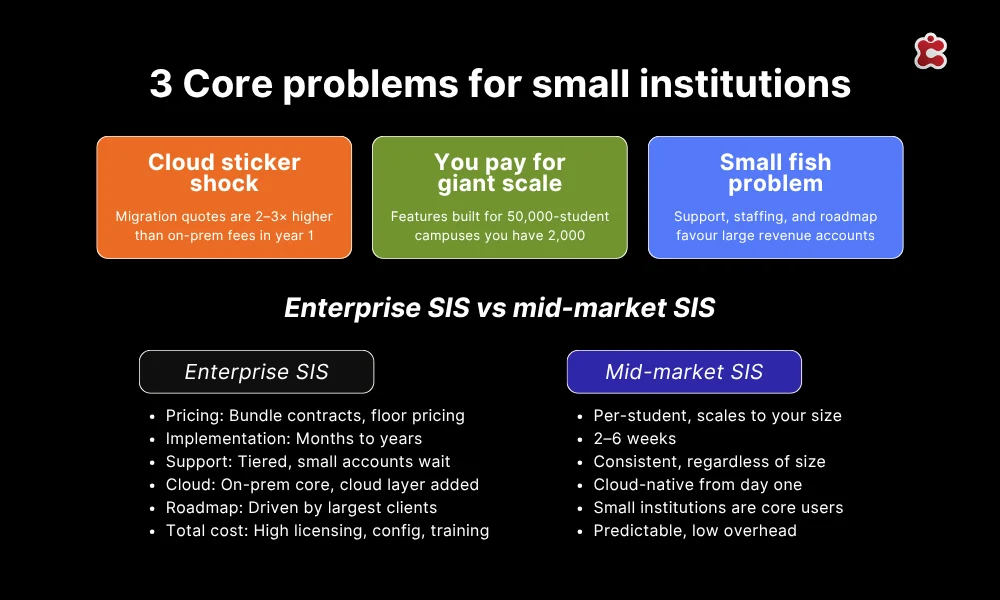
Cloud Migration Sticker Shock
Legacy enterprise SIS vendors built their platforms in an on-premises era. You hosted the servers. Your IT team managed the infrastructure. The vendor shipped software.
That model no longer works. Cloud is now the default expectation for institutional software, and vendors know it. So over the past several years, every major enterprise vendor has launched a cloud offering, usually by layering cloud infrastructure on top of an existing on-prem codebase.
Here is the problem. Their cloud pricing was not recalibrated for smaller institutions. It was designed to capture margin from large universities already locked into multi-year contracts. When you are running 2,000 students, the numbers do not scale down proportionally. You are often paying a floor price that assumes 10 times your actual user base.
One pattern shows up repeatedly in procurement conversations:
- The on-prem contract had predictable annual maintenance fees.
- The cloud migration quote is two to three times higher in year one alone.
- The vendor frames it as an “investment in modernization.”
- The institution absorbs the cost because switching feels even harder.
Vendors need cloud revenue. Their investor relations and product roadmaps depend on it. Your migration is their revenue event. That misalignment of incentives is built into the commercial structure of the relationship, and smaller institutions feel it most acutely.
You Are Paying for an Aircraft Carrier to Cross a River
Enterprise SIS platforms ship features designed for institutions with dozens of campuses, hundreds of degree programs, complex research compliance requirements, and HR workflows touching thousands of staff. They are genuinely impressive pieces of engineering for the institutions they were built for.
A 2,000-student university is not one of those institutions. But you are still paying for everything in the package.
Think about what that actually means in practice:
- Module licensing for enrollment management tools built for 50,000-student funnels.
- Compliance frameworks designed for US Title IV or multi-country regulatory environments you do not operate in.
- Financial aid processing infrastructure for programs your institution does not run.
- Complex workflow builders that require a dedicated SIS administrator to configure.
The vendor will tell you that flexibility is a feature. It is not, when that flexibility requires a team of consultants and six months of configuration to do something your registrar used to handle in a spreadsheet.
Over-engineering has a direct cost. It inflates licensing. It extends implementation timelines. It creates ongoing administrative overhead just to maintain configurations that should be simple. And it means your staff spend time navigating a system that was not designed with their actual workflows in mind.
The right-sized SIS for a small or mid-sized institution is not a stripped-down enterprise platform. It is a platform designed for that scale from the beginning.
You Are a Small Fish. Your Vendor Knows It.
Enterprise software vendors organize their customer success resources around revenue contribution. This is rational from a business perspective. A university paying seven figures a year in licensing gets dedicated account management, faster SLA response times, and a seat at the product advisory table. A university paying a fraction of that does not.
For mid-sized institutions, this creates three concrete problems:
- Support tickets go into a queue that prioritizes by account size, not urgency. A critical enrollment deadline for your institution is a low-priority ticket in a global support system.
- Implementation projects are staffed with junior consultants or handed off to third-party partners the vendor has certified but does not fully control. The institution absorbs the risk when timelines slip.
- Roadmap feedback from small accounts rarely shapes product direction. The features that get built are the features your larger peers ask for.
This is not a complaint about bad intent. It is a structural reality. When your annual contract value represents a fraction of a percent of a vendor’s revenue, your leverage is minimal.
The consequence is that mid-sized institutions often end up in a costly holding pattern. They have invested too much in the existing system to walk away easily, but they are not getting the support or the product development that would justify staying. This is the “small fish” trap, and it is one of the primary reasons institutions start looking for a SIS for small universities that operates on a different commercial model.
Enterprise SIS vs. Modern Mid-Market SIS: A Direct Comparison
| Factor | Enterprise SIS | Mid-Market SIS |
| Pricing model | Large enterprise contracts built around module bundles, rarely scaled to institution size | Per-student pricing that adjusts to your actual enrolment |
| Implementation timeline | Long, resource-heavy deployments requiring dedicated project teams | Fast, focused onboarding with minimal IT dependency |
| Support model | Support priority tied to contract value; smaller accounts wait longer | Consistent access to support regardless of institution size |
| Feature scope | Broad feature set designed for large, complex multi-campus institutions | Focused modules matched to the workflows a smaller institution actually uses |
| Cloud architecture | On-premises origins; cloud offered as a migration or add-on layer | Built cloud-native from the ground up |
| Product roadmap influence | Driven by the largest clients; smaller institutions have little voice | Smaller institutions are a core user base, not an afterthought |
| Total cost of ownership | High upfront and ongoing costs including configuration, training, and maintenance | Lower overhead with straightforward setup and predictable annual costs |
What a Better Model Actually Looks Like
The alternative to enterprise SIS is not a cheaper version of the same thing. It is a platform architected for institutions in the 500 to 10,000 student range, with commercial terms that reflect that reality.
When evaluating options, mid-sized institutions should look for four things:
- Per-student pricing that scales down honestly. You should not pay a floor price designed for a campus ten times your size.
- Cloud-native architecture. Not a cloud wrapper over an on-prem codebase. A system built for cloud from the start.
- Modular configuration without professional services dependency. Your team should be able to configure workflows without a consultant on the phone.
- Implementation timelines measured in weeks, not years. A 2,000-student institution does not have a 24-month change management runway.
Classter is built on this model. It serves more than 500 institutions across Europe and the Mediterranean region. Pricing starts at around 8.50 euros per student per year, a figure that reflects actual institutional size rather than enterprise floor pricing. Core deployment typically takes between two and six weeks.
The platform consolidates student information, admissions, scheduling, billing, and communication in a single cloud-native system. It does not require an enterprise IT department to run or a multi-year contract to justify.
It is not the right fit for every institution. But for a 1,000 to 5,000-student university that has been absorbing the cost and complexity of an enterprise platform it was never designed for, it is worth an honest evaluation.
Ready to See It in Action?
Exploring SIS alternatives? Book a free Classter demo to see how 500+ institutions have consolidated their entire student data operation into a single platform, without the enterprise price tag or the 18-month implementation.
Book a free Classter demo today.
FAQ’s
An enterprise SIS is built for large institutions with tens of thousands of students, multiple campuses, and complex compliance requirements. It comes with broad functionality, long implementation cycles, and pricing structured around that scale. A mid-market SIS is designed from the start for smaller institutions. It covers the same core functions admissions, enrolment, scheduling, billing, communication but with less overhead, faster setup, and costs that actually reflect your size. The key difference is fit. One was built for you. The other was not.
There is no single trigger, but a few patterns signal that a switch is worth evaluating seriously. Your renewal costs keep climbing without a corresponding improvement in value. Your team works around the system rather than with it. Support response times are slow and implementation changes require outside consultants. Your vendor’s roadmap is built around problems your institution does not have. If two or more of those are true, the cost of staying is likely higher than the cost of moving.
Classter assigns a dedicated onboarding team to every institution from day one. The goal is a working deployment in two to six weeks, not months. After go-live, support is not tiered by contract size. Every institution gets access to the same team and the same response standards. Classter also runs an active user community where institutions share configurations and request features. Because mid-sized institutions make up the core of the customer base, their feedback directly shapes how the product develops.