




A student on the main campus fails a course with a 58%. A student in the exact same program, at a satellite campus two hours away, fails the same course with a 62% because that department rounds differently and calls it a “D” instead of an “F.” Neither registrar did anything wrong by their own department’s rules. But when both records land in front of an accreditor, a financial aid auditor, or a transfer institution reviewing a credit, the inconsistency becomes the institution’s problem, not the department’s.
This is what academic compliance actually looks like at scale. It’s rarely one dramatic violation. It’s hundreds of small, locally reasonable decisions, made independently across programs, departments, and campuses, that stop lining up the moment someone tries to compare them.
Why Multi-Campus and Multi-Program Institutions Drift Out of Sync
Most institutions don’t set out to run inconsistent academic rules. It happens gradually, as programs grow, campuses are added, and departments build their own workarounds to get through registration week. A grading scale gets adjusted locally to “fit” a professional program’s needs. A satellite campus adopts a slightly different late-withdrawal policy because its student population skews part-time. A department starts tracking attendance in a spreadsheet because the main system doesn’t handle its lab schedule well.
Individually, none of these decisions look risky. Collectively, they produce an institution where the same transcript notation, the same grade point value, or the same academic standing designation can mean different things depending on which office produced it. Governance research on multi-campus higher education systems describes this as the central tension of the model: campuses need enough autonomy to serve their specific student populations, but the system needs enough consistency to be accountable as a single institution when regulators, accreditors, or the public come asking.
Grading Structures: One Rubric, Many Interpretations
Grading is where inconsistency shows up first, because grading is where the most local judgment gets exercised. A 90 might be an A at one campus and an A- at another. A pass/fail designation might roll into GPA calculations in one department and not another. Rounding conventions, grade replacement policies for retaken courses, and the treatment of incomplete grades all tend to vary more than institutions realize until someone builds a report that spans departments.
The stakes here go beyond internal tidiness. Academic standing determinations affect financial aid eligibility, probation and dismissal decisions, and how a transcript reads to an outside evaluator. When grading logic lives in scattered spreadsheets and department-specific configurations rather than a single, institution-wide rule set, an appeals case or an audit can turn into a forensic exercise: reconstructing which rule applied, to which student, in which term, in which department, and why.
Reporting: When Every Department Defines “Completion” Differently
Ask five departments to report their program completion rate and it’s common to get five slightly different numbers, not because anyone is manipulating data, but because “completion” gets defined differently by each. Does it count students who finished in more than the standard timeframe? Does it include students who completed a substituted course? Departments answer these questions locally, in isolation, because no shared definition was ever imposed from above.
That’s manageable until the numbers need to be aggregated for an institutional report, a board presentation, or a regulator. Federal scrutiny of higher education reporting has intensified rather than eased. Recent enforcement activity has included formal reviews and disclosure investigations at individual institutions, a reminder that reporting inconsistencies that once went unnoticed internally are increasingly likely to surface externally, at the worst possible moment.
Compliance Requirements: What Accreditors and Regulators Actually Expect
Accreditation reviews and financial compliance audits share a common expectation that institutions rarely state explicitly: whatever policy exists on paper needs to be demonstrably applied the same way everywhere it’s supposed to apply. An accreditor doesn’t just want to see a written grading policy. They want evidence that the policy governs actual grade records across every program and campus it claims to cover.
This is where credentialing and transcript consistency become a compliance issue as much as an academic one. As one EDUCAUSE Review analysis on institutional credentialing put it, colleges and universities need a consistent document structure and data standard across the institution so that academic and campus-based achievements can be understood the same way regardless of where they were earned. Without that consistency, an institution can find itself unable to produce a clean, unified answer to a question as basic as “how many students in this program are in good academic standing,” because the answer depends on which campus’s records get pulled.
The broader trend data supports treating this as a priority now rather than later. National persistence and completion figures have been climbing, with the national persistence rate reaching 77.6% in the most recent reporting, which means more of an institution’s students are moving through multi-term, sometimes multi-campus academic paths where inconsistent rules compound over time rather than resolving themselves.
Building Institution-Wide Governance Without Erasing Local Flexibility
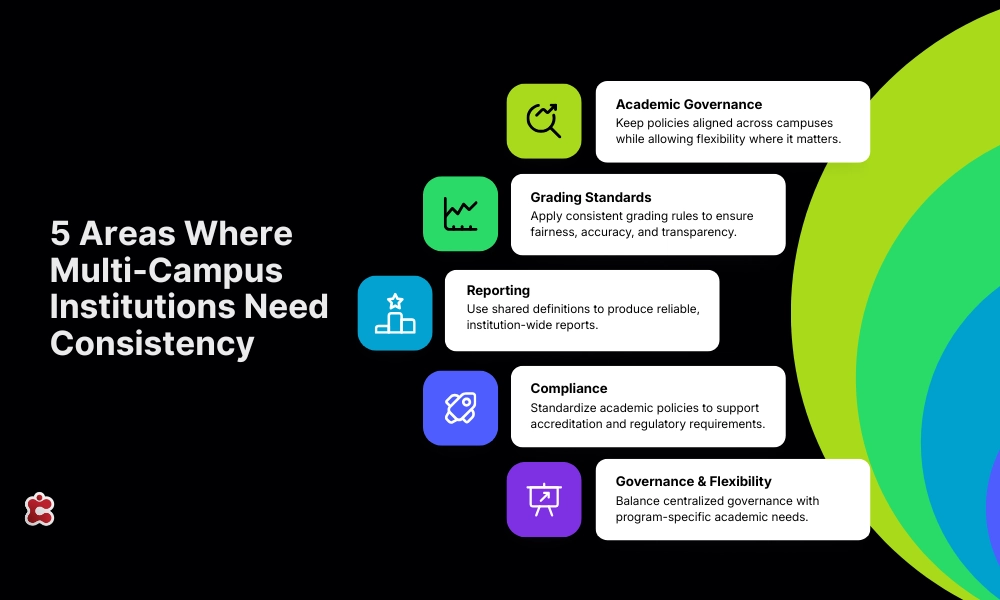
The instinct after identifying this problem is often to centralize everything, but that overcorrection creates its own failures. A nursing program and an executive MBA program have legitimate reasons to grade, schedule, and assess differently.
The goal isn’t uniformity for its own sake. It’s making sure that wherever local flexibility is legitimate, it’s explicit and documented, and wherever consistency is required for compliance or comparability, it’s enforced by the system rather than left to department-level memory.
In practice, that means separating academic rules into two categories:
| Should be centrally governed | Can remain program or campus-specific |
| GPA calculation methodology | Course-specific assessment weighting |
| Academic standing thresholds | Attendance policy details within compliance limits |
| Grade point scale and rounding rules | Elective structure and course sequencing |
| Transcript notation standards | Local advising and support workflows |
| Compliance and accreditation reporting definitions | Program-specific rubrics within the approved scale |
| Data retention and audit trail requirements | Departmental scheduling preferences |
The institutions that manage this well tend to build the central rules into the systems people actually use every day, rather than relying on a policy manual that departments consult inconsistently. If the grading scale, standing thresholds, and reporting definitions are enforced by the platform itself, department-level drift becomes much harder to introduce by accident.
Where Classter Fits
This is the problem a centralized academic data model is built to solve. Rather than each campus or department maintaining its own grading logic and reporting definitions, Classter’s Student Information System applies consistent grading scales, academic standing rules, and reporting definitions across every program and campus configured in the system, while still allowing programs to configure the course-level and assessment-level detail that genuinely should stay local.
The Academics & LMS module keeps gradebook structures and academic records tied to the same underlying rule set institution-wide, so a grade calculated at one campus follows the same logic as a grade calculated at another. For institutions running multiple campuses or school types under one governing body, the School Districts solution is built specifically around maintaining this kind of consistency across constituent schools without requiring every site to lose its own operational identity.
The Bottom Line
Academic compliance across a multi-campus or multi-program institution rarely fails because of one bad policy. It fails because dozens of individually reasonable local decisions were never reconciled against a shared standard, until an accreditor, an auditor, or a student appeal forced the question. The institutions that handle this well aren’t the ones with the most rigid rules. They’re the ones that decided, in advance, exactly which rules apply everywhere and which ones don’t, and then built systems that enforce that distinction automatically rather than trusting it to be remembered.
See how Classter keeps grading, standing, and reporting consistent across every campus and program in one place. Book a demo
FAQ’s
Variation in course design and assessment style is normal and expected. The risk appears when the underlying calculation logic, GPA weighting, rounding rules, or academic standing thresholds, differs in ways that produce different outcomes for students in comparable situations. That’s the layer that should be standardized institution-wide.
No. Legitimate differences in student population, program type, and local regulation often justify different operational policies. What accreditors and auditors expect is that any variation is documented and intentional, not the result of disconnected systems that simply never synchronized.
Academic standing determinations and transcript notations are usually the fastest way to surface a problem, since they combine grading logic, GPA calculation, and reporting definitions in one place. Pulling standing determinations for the same GPA range across two campuses is often the quickest diagnostic.
They typically request evidence that a written policy is applied uniformly wherever it claims to apply, not just that the policy exists. That means being able to produce actual grade and standing records across every relevant program and campus, not only the policy document itself.
Not if it’s done correctly. Centralizing the rules that affect compliance, comparability, and reporting, such as grading scales and standing thresholds, does not require standardizing course content, assessment design, or program-specific teaching approaches.