



A student rarely falls behind overnight. The mark slips, then the attendance thins out, then the logins stop. Each of those signals already exists somewhere in Classter. A homeroom teacher sees the absences, the registrar sees the failed courses, finance sees the overdue balance, but nobody sees all three on the same student on the same morning. The meeting that would have helped happens a term later.
Early Warning System closes that gap. It’s live now for every school with the AI module licensed and switched on.
What a case looks like
Here’s a real shape of output, not a hypothetical: a student comes back with a total risk score of 72 against a High threshold of 70. The rule trail shows exactly why: GPA down more than 20% (actual 23.4%, +50 points), two or more failed courses (+40), an absence rate over 15% (actual 17.2%, +60), five consecutive absences (+50), no login for 14 days (+60). Attendance alone offered 110 points from two firing rules, but the category caps at 100 before it’s weighted, so one over-eager rule can’t swamp the other three categories.
What it watches
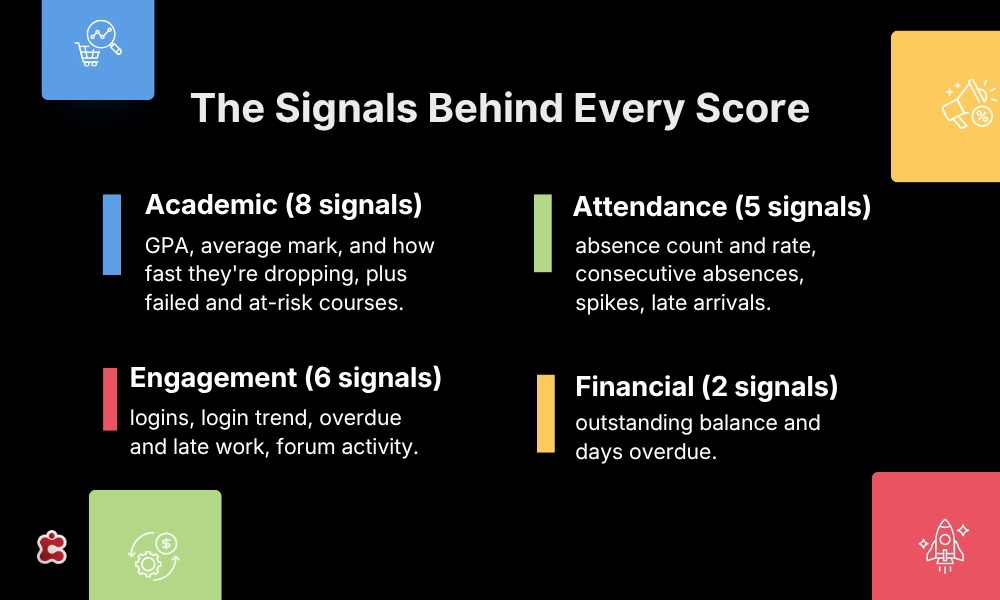
On whatever schedule a school chooses, Early Warning System reads 21 raw signals per student across four categories, applies the rules that school has written, and produces one ranked list: High, Medium, Low, each entry with the reasons attached.
Academic (8 signals): current and previous GPA and the drop between them, current and previous average mark and its drop, failed course count, at-risk course count. Trajectory counts as much as level a strong student falling fast is a different case from a weak one holding steady.
Attendance (5 signals): absence count and rate, consecutive absences, a recent-spike flag, late arrivals. Five absences in a row reads very differently from five spread across a term.
Engagement (6 signals): days since last login, login days in the last 30, overdue assignments, late submissions, a negative login-trend flag, forum posts. Usually the first category to move disengagement tends to show up weeks before it shows up in a grade.
Financial (2 signals): outstanding balance and days overdue. Deliberately small and usually weighted lightly a real retention signal, but one that reflects a family’s circumstances rather than a student’s work.
The rules are the school’s, not ours
No default model ships with Early Warning System. No trained weights, no hidden cut-offs. A school authors its own rules on the configuration screen, which signal, which comparison, which threshold, how many points, then sets what each category is worth (the four weights must total exactly 100%), where its own High and Medium thresholds begin, and how often the engine runs. Rules can be added, edited, reordered, or switched off any time, with no ticket and no deployment. A disabled rule stops counting from the next run, and past scores keep the value they were given so the history stays honest. Two schools running the same version can produce entirely different lists. That’s by design.
Where it runs, and when
Each run checks that the school still has the feature enabled, reads the configuration and every active rule, pulls fresh data for every enrolled student, tests each rule, caps and weights the categories into a single 0 to 100 score, and saves the result, held until 2 a.m. in that school’s own timezone, so the list is ready before the day starts, never mid-lesson. Every enrolled student is scored on every run, including at institutes carrying close to eight thousand students. Write-backs are chunked so a single oversized batch can’t time out the whole run.
If something fails partway, the run is recorded honestly as unsuccessful rather than silently retried and duplicated. A partial save is never re-queued.
AI writes the explanation. It never decides the score.
By the time a model is involved, the ranking is already finished, saved, and reproducible from the school’s own rules. What the model adds is the sentence a form tutor can actually act on: why this student is on the list, and what to try first. If that step times out, fails, or the school’s monthly AI budget is spent, the list still arrives, correct, just without the extra sentence.
Four ways to question the same number
A ranked list on its own invites the wrong conversation: “why is that name there?”, answered with a shrug. Opening a student’s record answers it four ways at once:
- Category breakdown, where “she’s failing” and “she stopped logging in” turn out to be different problems that happen to add up to the same total.
- Score history, every run since the school’s first. A steady 55 and a 20 that climbed to 55 over six weeks are the same number and completely different situations.
- Rule trail, not “attendance is a problem,” but the exact rule, the exact measurement, and the exact points it added.
- AI read, what that particular combination usually means, and a starting point.
If a name looks wrong, a school can find the rule that put it there and adjust it the same afternoon.
Where it stands, and what’s next
The scoring engine, the authoring screen, the score history, and the AI explanations are all live today. This isn’t a prototype. What’s next on the roadmap is closing the loop: recording what staff actually did after a student appeared on the list, and whether it worked. That’s the difference between a list that flags risk and a system that gets better every term, but it isn’t built yet, so today’s release is about the list itself.
Getting started
The engine is finished. What makes it useful is tuning the thresholds to match how your school actually thinks about risk. Start with High set deliberately low, see how many names come back, and raise it until the list is a size your team can act on. Nothing is lost between runs, every list is kept, so mornings are comparable over time.
Available to schools with the AI module licensed and enabled. Schools on the legacy pre-AI version keep their existing view during migration to the new module-based access.