




Fee collection is one of the most operationally sensitive functions in any school or university. Get it right and it runs invisibly payments arrive, accounts reconcile, cash flow is predictable. Get it wrong and the consequences ripple in two directions at once: the institution faces cash flow pressure, and the students facing chasers and holds face something that can push them toward leaving entirely.
The tension most CFOs navigate is real. The institution needs fees paid on time. Students particularly those managing tight budgets, part-time work, and financial complexity for the first time need flexibility, clarity, and to feel like a student rather than a debtor. Too often, the process optimises for one at the cost of the other. Manual follow-ups are inconsistent, aggressive in tone when they finally happen, and land on students who may already be struggling. Automated systems, when poorly configured, send generic, impersonal messages that feel like form letters from a collections agency.
Neither approach is what finance teams actually want. They want timely payments, accurate records, manageable workload, and students who pay because the process made it easy not because they were embarrassed into it.
This article covers the practical levers available to finance teams: how to automate effectively, how to structure payment plans that improve both collection rates and student satisfaction, how to communicate about money in a way that maintains the institutional relationship, and how a connected billing system changes what’s possible across all of it.
The Scale of the Problem Finance Teams Are Managing
Before solutions, the numbers that frame the challenge.
More than 30% of students miss tuition deadlines each term, according to a survey of higher education leaders conducted by ECSI in partnership with Higher Ed Dive. Financial stress remains one of the most consistent drivers of dropout, attrition, and academic disengagement. Separately, 59% of students across 1,500 surveyed said they had considered dropping out due to financial stress with 61% saying it hurt their academic performance and 78% linking it to mental health challenges. In 2025, 38% of students cited paying for college as a top stressor, up from 34% the previous year.
These figures matter for CFOs not just as welfare data but as financial data. A student who withdraws mid-year due to financial pressure doesn’t just represent a welfare failure they represent lost tuition revenue that is significantly harder to replace than it would have been to retain. The cost of poor fee communication is not just operational; it flows directly to the revenue line.
And yet the CFPB’s review of tuition payment plans across nearly 450 institutions found that many plans feature inconsistent disclosures, confusing repayment terms, and late fees applied with insufficient notice practices that put students at risk of falling further behind, not less. The gap between what institutions intend and what students experience is often wide. Closing it is both a welfare priority and a financial one.
Why Manual Fee Management Fails Both Sides
Most finance teams that still manage fee collection primarily through manual processes spreadsheet tracking, individually composed reminder emails, phone follow-ups from staff are not making a deliberate choice. They are working with what exists. The problems with that approach are predictable and well-documented.
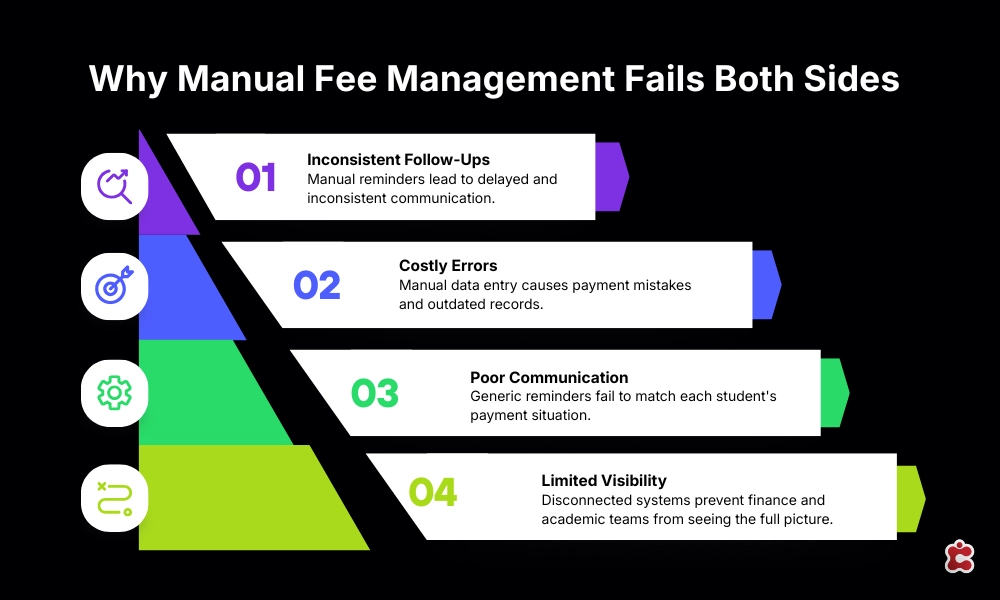
Inconsistency. When reminders are sent manually, they go out when a staff member gets to them which varies depending on workload, competing priorities, and how recently the outstanding list was reviewed. Some students receive a reminder three days after a missed payment. Others wait three weeks. The inconsistency itself creates confusion: students who received a long grace period in one term expect the same in the next, and are surprised when the process is different.
Errors. Manual reconciliation between a billing system and student records is error-prone at a rate of 30 to 45%, according to industry studies of manual data entry in education finance. A student who has paid but whose record hasn’t been updated receives a reminder for a payment they’ve already made. The result is not just frustration it is an erosion of trust in the institution’s administrative competence.
Tone mismatch. A staff member composing reminder emails under time pressure does not always strike the right tone. When reminders are written once generically, urgently, without consideration of whether the student is one day or thirty days overdue they land harder than intended. A student who is one day past due because their bank transfer was delayed does not need the same communication as a student who is a month overdue and unresponsive.
Invisibility. Without a system that tracks payment status centrally and connects it to the student record, finance teams and academic teams are working from different pictures. A personal tutor who doesn’t know that their tutee has an overdue payment and an escalating collection process is not in a position to provide joined-up support. The financial situation and the academic situation are managed separately even when they are the same situation.
Automation That Improves Collection and Protects the Relationship
The goal of payment reminder automation is not to remove human judgment from the process. It is to ensure that the routine, time-sensitive communications happen consistently and correctly freeing staff to focus on the cases that genuinely require a human conversation.
Effective reminder automation is built on three principles: timing, tone calibration, and personalisation.
Timing: Stage-Based Reminders That Match the Situation
A well-designed reminder cadence is different at each stage of the payment timeline. A student who is three days from a due date needs a different message from a student who is three days past it and both are different from a student who is thirty days overdue.
A practical staging approach looks like this:
| Stage | Trigger | Channel | Tone | Action |
| Pre-due reminder | 5–7 days before due date | Friendly, informational | Payment link, due date confirmation | |
| Due date reminder | Day of due date | Email + SMS | Neutral, clear | Payment link, contact details |
| First overdue | 1–3 days past due | Gentle, no assumption of fault | Payment link, offer of support contact | |
| Second overdue | 7–10 days past due | Email + SMS | Direct, specific amount | Payment link, payment plan option |
| Third overdue | 21–30 days past due | Email + SMS + staff flag | Firm, clear consequences | Staff review triggered, support referral |
| Escalation | 30+ days | Staff contact | Personalised | Human conversation, not automated |
This kind of structured cadence does two things simultaneously. It ensures that no student falls through the gap no overdue balance sits unnoticed until it becomes a crisis. And it ensures that the tone of communication matches the stage a student who forgot once is not treated the same as a student who has been unresponsive for a month.
The escalation point is important. Automation handles the routine stages; a staff flag triggers human review for anything beyond thirty days. The decision to place a registration hold, restrict access to services, or escalate to a formal process should always involve human judgement both because the circumstances may have context the system doesn’t have, and because these decisions have significant consequences for students.
Personalisation: Messages That Don’t Feel Like Form Letters
SMS messages carry open rates as high as 98%, making them a highly effective channel for payment communication. But high open rates also mean high impact a message that feels impersonal or threatening is read and resented rather than read and acted on.
The difference between an effective payment reminder and a damaging one is almost entirely in the personalisation and framing. Addressing the student by name, specifying the exact amount and due date, referencing their programme, and including a direct payment link transforms a generic financial notice into a clear, actionable communication. It signals that the institution knows who they are not just that they owe money.
Where possible, reminder messages should also acknowledge that many late payments are accidental. A first overdue reminder framed as “we noticed your payment of [amount] wasn’t received by [date] if you’ve already paid, please disregard this” is significantly less alienating than “your account is overdue.” The first version treats the student as someone who probably just forgot. The second treats them as a debtor from the first contact.
The Right Moment to Offer a Payment Plan
Payment plans, when offered at the right moment, convert potential dropouts into continuing students. When offered at the wrong moment buried in a complicated fee schedule at enrolment, or mentioned only after a student is already significantly overdue they either go unnoticed or arrive too late to help.
The right moment to surface a payment plan option is the first overdue reminder. A student who has missed a payment is, at that moment, likely experiencing some combination of confusion, embarrassment, and concern. A reminder that says “we noticed your payment hasn’t arrived if you’d find it helpful, we can discuss a payment plan that works better for your situation” does something a standard overdue notice doesn’t: it gives the student a face-saving path forward.
Nearly 4 million students in the US are enrolled in some form of tuition payment plan each term. The demand is substantial. The CFPB’s review of these plans highlighted that the risks to students are concentrated in poorly disclosed terms and confusing conditions not in the plans themselves. Institutions that offer clear, simply structured plans with transparent terms protect both the student and themselves.
Invoicing That Students Actually Understand
One of the most underinvested areas of school finance communication is the invoice itself. Most institutional fee invoices are designed for accounting accuracy, not human comprehension. They contain the correct figures, but presented in a format that requires financial literacy to read correctly.
A student receiving a fee statement for the first time particularly an 18-year-old managing their own finances for the first time may not understand the difference between charges, credits, adjustments, and balances due. They may not know which figure to pay, by which date, through which channel. The result is not failure to pay; it is failure to pay correctly, which creates reconciliation issues and follow-up cycles that absorb finance team time.
Effective invoicing in education has three characteristics:
Clarity of amount due. The figure the student needs to pay should be immediately visible not buried in a table of line items. A clearly labelled “Amount Due: [figure] by [date]” at the top of the statement, before any itemisation, removes the ambiguity that produces follow-up queries.
Plain-language itemisation. Line items should be labelled in language the student recognises, not accounting terminology. “Tuition Semester 2” is clear. “Academic Fee Assessment 2025/26 S2 UG” is not. The invoice is a communication with a student, not an entry in a general ledger.
Direct payment instructions. The invoice should include a direct link to the payment portal, or a QR code, or both. Every step between reading an invoice and making a payment is an opportunity for the payment not to happen.
Automating invoice generation so that invoices are produced and distributed automatically at defined points in the academic calendar, populated from the same student record that drives enrolment and course registration removes the manual effort and the delays that create their own collection problems. A student who receives their invoice late because the finance team hadn’t finished generating the cohort’s statements by hand has a legitimate reason for a late payment that the institution created.
Connecting Financial Data to the Student Record
The limitation of standalone fee management whether manual or automated is that financial data stays in the finance team’s world and doesn’t inform the wider institutional picture.
A student with an overdue balance who is also showing declining attendance is a student at significant risk of withdrawal. The attendance data lives with the academic team. The financial data lives with the finance team. If those two pieces of information are never in the same view, no one has the complete picture that would enable a meaningful early intervention.
A connected billing system one that integrates with the student information system rather than operating separately from it makes this possible. Authorised staff can see, against the same student record, whether there is an academic concern and a financial concern simultaneously. The pastoral tutor who has a welfare conversation with a struggling student can see whether the financial situation is part of the picture. The finance officer reviewing overdue accounts can see whether the student is also flagged for academic support.
This connection also changes the quality of the financial data available for institutional decision-making. A CFO with a real-time view of payment status across the student population by cohort, programme, payment method, and instalment schedule can forecast cash flow accurately, identify patterns in late payment that suggest structural problems with how fee schedules are designed, and make informed decisions about where flexibility is needed and where collections processes need to tighten.
Automation also eliminates the reconciliation burden that consumes finance team capacity at the end of every collection cycle. When the billing system generates invoices from the same student record used by admissions and academic management, and when payment receipts update that record automatically, the manual process of matching payments to students and updating multiple systems becomes redundant. A university with more than 12,000 students that moved from manual fee processing to an integrated system cut payment verification time from two to three days to same-day processing, and eliminated the staff hours previously consumed by transaction reconciliation.
How Classter Supports Finance Teams Without Alienating Students
Classter’s Billing and Payments module is built as an integrated component of the school management platform not a standalone finance tool. Every transaction, invoice, and payment record connects directly to the student profile maintained in the Student Information System, which means the finance team and the wider institution are always working from the same data.
Fee structures are configured once by programme, cohort, scholarship status, or any combination of institutional-defined categories and applied automatically at enrolment. Invoices are generated and distributed without manual production, populated from the same record that holds the student’s programme and registration details. Payment plans are configurable, with instalment schedules set at the institutional level and applied or adjusted at the individual student level where circumstances require it.
Automated reminders follow the configured cadence timed, personalised, multi-channel without requiring finance staff to monitor individual accounts and compose individual messages. Overdue accounts beyond the automated escalation threshold are flagged for staff review, ensuring that the cases requiring human judgement get human attention, and the routine cases are handled consistently without consuming staff time.
Because financial data is connected to the student record rather than siloed in a separate system, academic staff with appropriate access can see payment status alongside the academic and attendance data they already work with. The Academic CRM allows support conversations to be logged against the same student profile, so that financial support referrals, payment plan arrangements, and pastoral contacts are all visible to the people responsible for the student’s overall wellbeing.
Real-time reporting gives finance teams and institutional leadership a live view of collection performance, outstanding balances by cohort, payment method distribution, and instalment schedule adherence. According to Inside Higher Ed’s 2025 Survey of College and University Chief Business Officers, 88% of CBOs believe their institution is transparent about costs but only 42% believe the same of higher education as a whole. That gap between self-perception and sector-wide reality signals how much room exists for finance teams to differentiate through clearer, more student-friendly financial communication. A connected platform makes that transparency operationally achievable rather than aspirationally stated.
Getting the Balance Right: Firmness Without Alienation
The underlying challenge in education fee collection is that the institutional relationship is not a commercial one. A student who misses a payment from a software vendor receives a late payment notice. A student who misses a payment to their university receives a communication from an institution that is simultaneously responsible for their education, their academic record, their career prospects, and their sense of belonging to a community.
That context doesn’t mean institutions should be soft about fee collection. It means the approach to collection has to account for the relationship and recognise that a student who feels treated with dignity through a financial difficulty is far more likely to stay enrolled, complete, and remain a positive ambassador for the institution than one who felt pursued and embarrassed out the door.
The practical principles that follow from this are straightforward. Lead with reminders rather than consequences. Give students a clear path to resolve their situation a payment link, a payment plan offer, a contact person rather than a statement of what will happen if they don’t act. Reserve holds and restrictions for cases that have genuinely exhausted more supportive options, and involve human judgement before applying them. Communicate in the student’s language, not the institution’s accounting terminology.
Automation supports all of this but only when it’s configured with the student experience in mind, not just the collection objective. A system that sends the right message at the right moment through the right channel, personalised to the individual student’s situation, achieves better collection rates than a manual process while preserving the relationship that manual processes, at their worst, can damage beyond repair.
Conclusion
The CFO’s challenge in education fee collection is not primarily a financial problem. It is a communication and systems problem. The fees owed are known. The students are identifiable. The payment methods exist. What is often missing is the infrastructure to surface the right information at the right time, communicate about it clearly and consistently, and connect the financial picture to the wider institutional view of each student.
When that infrastructure exists automated reminders that stage correctly, invoices students can actually read, payment plans surfaced at the moment they’re needed, and billing data connected to the student record collection rates improve, finance team workload falls, and students experience the financial relationship with their institution as manageable rather than stressful.
Both outcomes are achievable at the same time. They are not in tension. They are, in practice, the same outcome: a system that works.
Want to see how Classter’s Billing and Payments module supports fee collection without compromising the student experience?
Book a demo and we’ll walk you through how it works.
FAQ’s
Research consistently shows that most missed payments are not deliberate they reflect confusion about amounts or due dates, temporary cash flow difficulties, or simply forgetting amid competing demands. A Higher Ed Dive survey found more than 30% of students miss tuition deadlines each term. The most effective response is a reminder system that catches approaching deadlines before they pass, not a collections process that activates after the fact.
By staging reminders to match the situation. A pre-due reminder is informational and friendly; a first overdue reminder assumes the most charitable explanation and offers a clear path to resolve the situation; later reminders become more direct. The tone should escalate gradually, and any action with significant consequences a registration hold, a transcript restriction should require human review and approval before it is applied, regardless of what the automated system recommends.
Transparency and simplicity. The CFPB’s review of tuition payment plans across nearly 450 institutions found that the risks to students are concentrated in inconsistent disclosures and confusing terms not in the plans themselves. An effective plan has clearly stated instalment amounts, clearly stated due dates, clearly stated consequences for missed instalments, and a straightforward process for requesting a modification if circumstances change. Surfacing the option at the first overdue reminder as a proactive offer rather than a last resort increases uptake and reduces the risk of escalation.
In two ways. First, it eliminates the manual reconciliation step invoices are generated from the same student record used by admissions and academics, and payment receipts update that record automatically, removing the error-prone process of matching payments across separate systems. Second, it makes financial status visible alongside academic and pastoral data, allowing the institution to identify students where financial difficulty and academic disengagement are co-occurring and intervene in a joined-up way rather than through parallel, disconnected processes.
Typically around 21 to 30 days past due, after two or three automated reminders have been sent without response. At this point, a staff flag should trigger a personal outreach a phone call or a personalised email from a named person before any formal hold or restriction is applied. The student may have circumstances that explain the delay and that would change the institution’s approach. Automated systems should not have the authority to apply significant consequences without human review of individual cases.
Directly and significantly. Financial stress is one of the most consistent predictors of student withdrawal, cited by 59% of students who considered dropping out in research by Ellucian Health. The institutions that manage financial communication well clearly, proactively, and with support options surfaced before situations escalate retain students who would otherwise leave. The collection improvement and the retention improvement are the same intervention: earlier, clearer, more supportive financial communication.