



Few roles in education absorb more administrative friction than the registrar’s office during a curriculum or program change.
A new course gets approved by faculty senate. Then it needs to be added to the catalogue, reflected in the programme structure, assigned prerequisite rules, mapped into the timetable, and updated across every student record where it affects degree requirements. Each of those steps typically happens in a different system, triggered by a different person, tracked through a different email thread.
Then the programme changes again next term.
The registrar’s office has always been the operational backbone of academic administration the function that translates academic decisions into working records, accurate catalogues, correct student transcripts, and compliant reports. But as curriculum reform accelerates across both K-12 and higher education, the manual workload that accompanies each change has become one of the most significant drains on registrar capacity.
This article looks at where that manual work actually comes from, why email-based approval chains and disconnected systems compound it, and what a centralised system changes in practice.
Why Curriculum Changes Create So Much Registrar Work
The instinct is to treat curriculum changes as an academic matter something that happens between faculty, curriculum committees, and academic leadership, with the registrar simply processing the outcome. In practice, every curriculum change creates a cascade of administrative tasks that fall squarely on the registrar’s desk.
Consider what a single programme update typically involves:
A department proposes a course modification. The proposal circulates for review department head, curriculum committee, academic board, sometimes an external accreditation body. Each stage requires documentation, sign-off, and follow-up. Once approved, the change needs to be reflected in the academic catalogue, updated in the student information system, communicated to students already enrolled in the programme, and assessed for its impact on anyone mid-degree who is following the old programme structure.
If the change involves a prerequisite rule adding, removing, or modifying a condition that determines whether a student can progress that rule needs to be enforced consistently across enrolment, grade processing, and degree audit systems. If those systems don’t share data, the registrar’s team has to manually verify compliance at each stage.
A course approval process that involves multiple review stages requiring approvals from faculty, committees, and administrators creates delays through lost paperwork, email backlogs, and inefficient tracking systems. That delay doesn’t just affect the registrar it impacts curriculum planning, student enrolment, and the institution’s ability to implement new programmes or update existing ones in a timely manner.
The Arizona Board of Regents update to the General Education Curriculum policy, which introduced a new Civic Institutions requirement and reduced an existing Building Connections requirement, required approval from the University-Wide General Education Committee, Undergraduate Council, Undergraduate College Academic Administrators Council, Faculty Senate, and the Provost five sequential approvals before the change could be implemented in the academic catalogue. That approval chain, replicated across dozens of programme changes each year, represents a significant sustained workload for the registrar’s team regardless of the academic merit of any individual change.
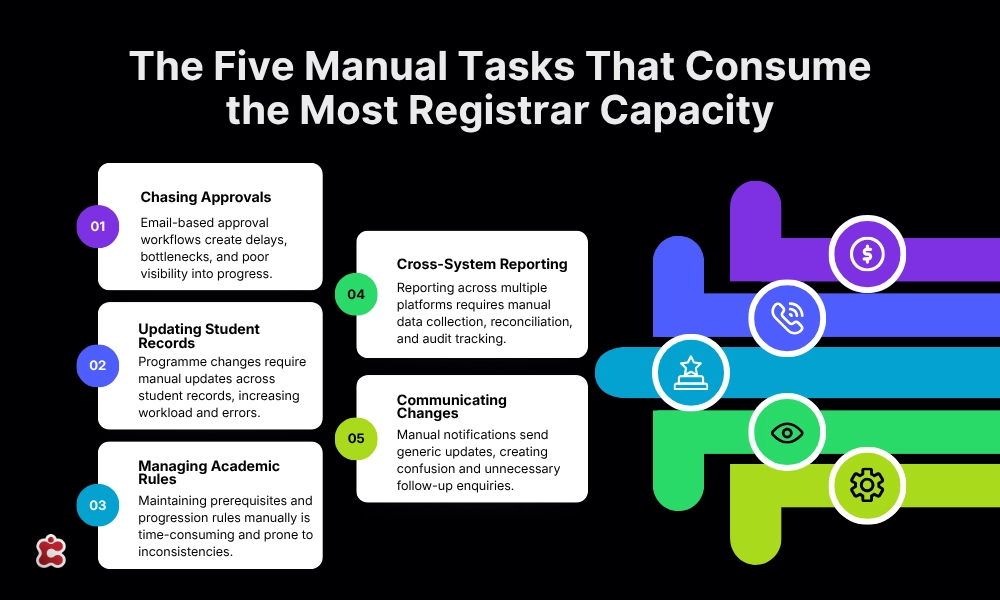
The Five Manual Tasks That Consume the Most Registrar Capacity
Understanding where the time goes is the first step toward recovering it. These are the five areas where disconnected processes create the most friction for registrars managing curriculum and programme changes.
1. Chasing Approvals Through Email
The most common workflow for curriculum approvals in schools and universities is still email. A proposal document is drafted, attached to an email, sent to the first approver, and then forwarded sequentially through each stage of review. The registrar’s team is responsible for tracking which proposals are at which stage, following up when a stage stalls, and consolidating the final approved documentation when the chain is complete.
When one approver is on leave or slow to respond, the entire chain waits. When a proposal is revised mid-process, earlier email threads become unreliable records of what was actually approved. When a proposal reaches the registrar’s office for implementation, it may arrive as a PDF attachment to a thread of forty emails with no formal record of when each stage was completed or who approved what.
Universities that digitise curriculum and academic approval forms to reduce the hours spent chasing signatures can reduce turnaround times from weeks to days, sometimes to hours. But that reduction requires replacing email chains with structured workflows where approval stages are tracked, timestamped, and visible to everyone involved not reconstructed from an inbox.
2. Updating Student Records After a Programme Change
When a programme changes, the registrar’s team has to determine which students are affected and update their records accordingly. This sounds straightforward. In practice, it is one of the most time-intensive tasks the registrar’s office handles particularly when students are at different stages of the same programme and the change affects whether their completed coursework still satisfies their degree requirements.
A student who completed a course last year that is now no longer required may have that credit treated differently in a degree audit than a student who completed the same course under the old programme structure. An incoming student who enrols after the change takes effect starts with a different set of requirements than a continuing student who grandfathered into the old structure. Each of these distinctions requires a manual assessment of the individual student record and a decision about what to update.
Manual methods of maintaining student information and the repetitive tasks that could be automated consume hours that registrar teams spend on the phone and responding to email enquiries that could be self-served through an accurate, up-to-date student portal instead.
3. Maintaining Academic Rules and Prerequisite Logic
Prerequisite rules the academic conditions that govern whether a student can register for a course or progress to the next stage of their programme are among the most technically complex records the registrar maintains. A change to a course that serves as a prerequisite for several others creates a ripple of rule updates that have to be applied consistently across every affected progression pathway.
In institutions where academic rules are maintained in one system but registration is managed in another, enforcing the updated rules requires manual verification at the point of registration checking each student’s eligibility against criteria that should be automated. This is exactly the kind of repetitive, rule-based verification that is both time-consuming and error-prone when done manually.
Without a centralised system, different stakeholders may lack visibility into where a proposal or rule update stands in the process, leading to redundant enquiries, miscommunication, and delays in implementation. The student who gets blocked from registering for a course because a prerequisite rule was updated in one system but not another is the visible consequence of that disconnect.
4. Producing Reports That Span Multiple Systems
Curriculum change creates a reporting obligation. Accreditation bodies, regulatory authorities, and institutional leadership all need to be able to see what changed, when, who approved it, and how it has been implemented across student records. In many institutions, producing that documentation requires extracting data from the academic catalogue, the SIS, the timetable system, and the approval records all of which live in different places and were not designed to generate a unified report.
Academic processes involved in programme management often involve complex approval chains and version control that a workflow system needs to track but most email-based processes don’t. The audit trail, when it exists at all, has to be reconstructed manually from email threads and shared folders rather than drawn from a system that recorded each step automatically.
For institutions subject to accreditation requirements and increasingly, for those navigating the EU AI Act’s phased requirements for educational data governance from 2026 to 2027 the ability to produce a clean, timestamped record of curriculum decisions is not optional. It is a compliance requirement.
5. Communicating Changes to Students and Advisers
The final piece of the manual workload is communication. Once a programme change has been approved and implemented, students and academic advisers need to know what changed, how it affects them, and what action if any they need to take. In most institutions, that communication is drafted and sent manually by the registrar’s team, often through a general email that reaches everyone whether or not they are affected. A student whose programme was not changed by the update has no need for the communication but receives it anyway.
A student whose degree requirements were affected materially gets the same generic message as everyone else, without a personalised account of what changed in their specific academic plan. The registrar’s team then fields follow-up enquiries from students who didn’t understand which parts of the announcement applied to them enquiries that consume further time that could have been avoided with targeted, record-driven communications.
What a Centralised System Changes
The registrar’s office doesn’t need to eliminate human judgment from curriculum management. Most of what makes curriculum change administratively burdensome is not the decisions themselves it’s the infrastructure around those decisions: the tracking, the updating, the verifying, and the communicating. Those are precisely the tasks that a centralised system can handle consistently and automatically.
Here is what changes when curriculum and programme management runs through a single unified platform rather than across disconnected systems.
Structured Approval Workflows Replace Email Chains
A centralised system defines the approval stages for each type of curriculum proposal new course, course modification, programme restructure, prerequisite change and routes proposals through those stages automatically. Each approver receives a notification when action is required, the proposal is locked at the approved version, and the completion of each stage is timestamped in an auditable record.
The registrar’s team doesn’t need to chase. They can see, at any point, which proposals are active, where each one is in the approval process, and which stages are overdue. When a proposal is finally approved, the implementation steps can be triggered directly from the same system no manual handoff required.
| Process | Email-based | Centralised System |
| Proposal visibility | Only visible to sender and current approver | Visible to all authorised stakeholders in real time |
| Approval tracking | Reconstructed from email thread | Timestamped at each stage automatically |
| Overdue follow-up | Manual chase from registrar team | Automated reminder to responsible approver |
| Audit trail | PDF attachment to email chain | Structured record in system, always retrievable |
| Implementation trigger | Manual handoff to registrar | Automated upon final approval |
Student Records Update From One Source
When the approved programme change is recorded in the system, the student records it affects update accordingly without the registrar’s team manually identifying which students are affected and making individual record changes. The system applies the change to every affected record, distinguishing between students grandfathered into the old programme structure and those subject to the new one based on their enrolment date or cohort.
Degree audits reflect the updated requirements immediately. Students checking their academic progress through a self-service portal see the current picture not an outdated snapshot from before the change was implemented. Academic advisers working with students see the same updated data without having to call the registrar’s office to confirm what the current requirements are.
Academic Rules Are Enforced Automatically
Prerequisite and progression rules defined in the system are applied at the point of registration not verified manually by staff. A student who attempts to register for a course they are not yet eligible for is blocked automatically, with a clear explanation of which prerequisite is not satisfied. A student who has met all conditions progresses without needing a manual clearance from the registrar’s team.
When a rule changes a prerequisite is added, removed, or modified it is updated once in the system and applied consistently from that point forward. There is no risk that the updated rule is enforced in one system but not another, because there is only one system.
Reporting Draws on Live Data
An accreditation report, an end-of-year programme summary, or a board update on curriculum changes doesn’t require data extraction from multiple systems and a day of manual reconciliation. The reporting draws on the same data that the system uses to manage programmes, approvals, and student records which means it is always current, and always consistent with the underlying administrative record.
The audit trail for any curriculum decision who proposed it, who reviewed it, who approved it, when it was implemented, which student records it affected is retrievable from the system without reconstruction.
How Classter Supports the Registrar’s Office During Programme Changes
Classter’s unified platform is built around the principle that academic decisions and administrative records should live in the same system not travel between them through email and manual processes.
The Academic Programme Management module allows registrars to define and update programme structures, course catalogues, and academic rules in a single environment. Changes made to a programme are reflected immediately across the student records, timetables, and reporting functions that depend on that programme data without manual propagation.
The Student Information System holds the student academic record that all other functions reference. When a programme changes, the SIS applies the update to the cohort it affects, maintains the historic record for students on the previous structure, and ensures that degree audit tools reflect current requirements for each student accurately.
Approval workflows in Classter allow registrar teams to define structured, multi-stage review processes for curriculum proposals replacing email chains with a tracked, auditable system that routes proposals to the right approvers automatically and records each stage upon completion. According to University Business, whose reporting on the AACRAO survey found that registrars are frequently excluded from curriculum decision-making processes at a moment when their data-driven insights are most needed, having the registrar’s office as a formal, visible participant in the approval workflow rather than a downstream recipient of decisions made elsewhere changes both the quality of the process and the workload it generates.
The Academic Reporting and Analytics tools allow registrars to produce curriculum change documentation, programme summaries, and compliance reports from the same data that drives day-to-day administration without building reports from scratch each time they are needed. For institutions managing complex approval chains, multiple programme structures, or frequent curriculum revisions, Campus Technology’s guidance on managing large-scale administrative transformations consistently points to the same principle: the technology change is secondary to the process design. Centralising the process in one system only delivers its full value when the workflows are defined clearly upfront who approves what, in what sequence, with what authority.
Where to Start: A Practical Transition Plan for Registrar Offices
Moving from email-based curriculum management to a centralised system doesn’t require replacing everything at once. The most effective approaches start with the highest-friction processes and expand from there.
Audit your current workflow. Map every curriculum change process currently in use: course creation, course modification, programme restructure, prerequisite changes, and student record updates. For each, document how many steps it involves, how long it typically takes, and where delays most commonly occur. The gaps will identify themselves.
Define your approval hierarchy before selecting tools. The most common implementation mistake is importing existing email processes directly into a new system and reproducing the same bottlenecks in digital form. Before configuring workflows, define who has authority to approve each type of change, what the mandatory review stages are, and what constitutes a complete and implementable proposal. Get this agreed with academic leadership before the system is configured.
Start with high-volume, repeatable processes. New course requests and course modifications are typically the highest volume and most repeatable of the registrar’s curriculum workflows. Automating these first generates the fastest time savings and gives the team experience with the system before tackling more complex programme restructures.
Build the connection to student records from day one. The full value of a centralised curriculum management system is only realised when approved changes automatically propagate to student records. Configure this connection during implementation not as a later addition. The manual student record update is the most time-consuming part of the current process; leaving it manual defeats much of the purpose of the transition.
Involve academic advisers in the rollout. Advisers are often the primary interface between programme changes and the students they affect. If advisers can see updated programme structures and student records in the same system, the volume of follow-up enquiries to the registrar’s office drops significantly. Include them in training and ensure they have the access they need.
Conclusion
Curriculum and programme change is a permanent feature of academic administration, not an occasional disruption. The frequency of change is increasing driven by accreditation requirements, employer-driven programme alignment, the growth of micro-credentials, and broader structural reforms moving through education systems at both K-12 and higher education levels.
Registrar offices that manage this change through email chains, manual record updates, and disconnected systems are not just absorbing unnecessary workload. They are creating conditions where errors are likely, audit trails are fragile, and the people who most need accurate information students checking degree progress, advisers supporting programme transitions, leadership reviewing implementation are working from incomplete pictures.
A centralised system doesn’t remove the complexity of curriculum management. It removes the unnecessary administrative overhead that surrounds it, and gives the registrar’s office the tools to manage change at the pace the institution actually needs.
Want to see how Classter supports registrar workflows during curriculum and programme changes?
Book a demo and we’ll walk you through how it works in practice.
FAQ’s
Because each curriculum decision creates a cascade of downstream administrative tasks: updating the academic catalogue, revising prerequisite rules, amending student records, producing compliance documentation, and communicating changes to students and advisers. In institutions where each of these tasks happens in a different system or through email the registrar’s team manages the connections between them manually. It’s not the academic complexity that creates the workload; it’s the administrative infrastructure around it.
Approval chains managed through email. When proposals circulate sequentially via email attachments, the status of any given proposal is visible only to the sender and the current approver. Follow-up relies on manual chasing, overdue stages go unnoticed until someone flags them, and the final approved document arrives as an email attachment with no structured record of when each stage was completed. Replacing email chains with structured digital workflows with automated notifications and timestamped approvals is typically the single change that produces the largest reduction in approval cycle time.
By connecting the programme management module directly to the student information system. When an approved programme change is recorded, the system applies it to the cohort it affects distinguishing between students on the old structure and those subject to the new requirements based on their enrolment cohort without requiring the registrar’s team to identify affected students and update records individually. Degree audits and student-facing portals reflect the update immediately.
An academic rules engine is the component of a student information or programme management system that stores and enforces prerequisite and progression rules automatically. Rather than relying on staff to manually verify whether a student meets the conditions for course registration or programme progression, the system checks eligibility against the defined rules in real time. When a rule changes a prerequisite is added, removed, or modified it is updated once in the system and applied consistently from that point forward across all registration and progression decisions.
Start with the highest-volume, most repeatable workflows first typically new course requests and course modifications rather than attempting to automate everything simultaneously. Define the approval hierarchy and workflow stages clearly before configuring the system, so that digital workflows reflect an improved process rather than a digitised version of the existing email chain. Connect curriculum management to student records from the beginning of implementation, since the manual student record update is typically the most time-consuming part of the current process. Involve academic advisers in the rollout, as adviser access to current programme data reduces the volume of follow-up enquiries to the registrar’s office significantly.
Accreditation bodies typically require evidence that curriculum changes were properly reviewed and approved, that academic standards were maintained, and that students were appropriately informed of changes affecting their degree requirements. A centralised system that records each stage of the approval process with a timestamp, maintains version control over programme structures, and tracks which student records were updated and when produces this documentation automatically rather than requiring the registrar’s team to reconstruct it from email threads. This is particularly important as regulatory requirements for educational data governance continue to evolve in both the EU and US contexts.