




There’s a version of this story every school administrator knows.
It starts with a reasonable decision: a new attendance tool gets adopted because it solves a real problem. Then a separate billing platform. Then a learning management system. A communication portal. A reporting dashboard. An HR module. Each purchase made sense at the time. Each solved something the previous system didn’t cover.
And then, quietly, the cost of running all of them starts to exceed the cost of the problems they were bought to solve.
This is the hidden cost of disconnected school systems. Not a single, visible budget line but a diffuse, compounding drain on staff time, data accuracy, reporting quality, and ultimately, institutional effectiveness. It doesn’t show up in an invoice. It shows up in the Friday afternoon that a senior administrator spends reconciling three spreadsheets that should have been one report.
This article names the costs clearly and explains why more tools is almost never the answer.
How Schools End Up With Too Many Systems
Fragmented school technology stacks are rarely the result of poor planning. They’re usually the result of many reasonable decisions made in sequence, without a unified architecture in view.
A department head finds a useful tool and adopts it. An IT team purchases a compliance platform in response to a regulatory change. A pandemic forces rapid adoption of remote learning tools that become permanent fixtures. Over time, the average school accumulates platforms across attendance, finance, academics, HR, communications, and reporting each maintained separately, each requiring its own login, data entry, and administration.
The scale of this problem is significant. Research tracking K-12 technology adoption found that districts waste an average of 43% of their EdTech software licences, with annual costs from unused or redundant tools running between $200,000 and $400,000 per district. That figure covers licence fees alone it doesn’t include the staff time required to maintain and navigate them.
For higher education institutions and multi-campus schools, the picture is often worse. Legacy platforms were procured at different times, by different departments, with no shared data architecture. McKinsey research confirms the outcome: higher education software systems “were not built to interoperate, and institutions have needed to write a large amount of custom code to make these systems communicate.” That custom code is expensive to build and even more expensive to maintain and it still breaks.
Meanwhile, as the CoSN 2026 State of EdTech report found, organisational silos ranked among the top challenges to effective technology implementation for K-12 technology leaders across 44 states sitting alongside budget constraints as the two primary obstacles. The technology problem and the organisational problem are, it turns out, the same problem.
The Four Real Costs of Disconnected Systems
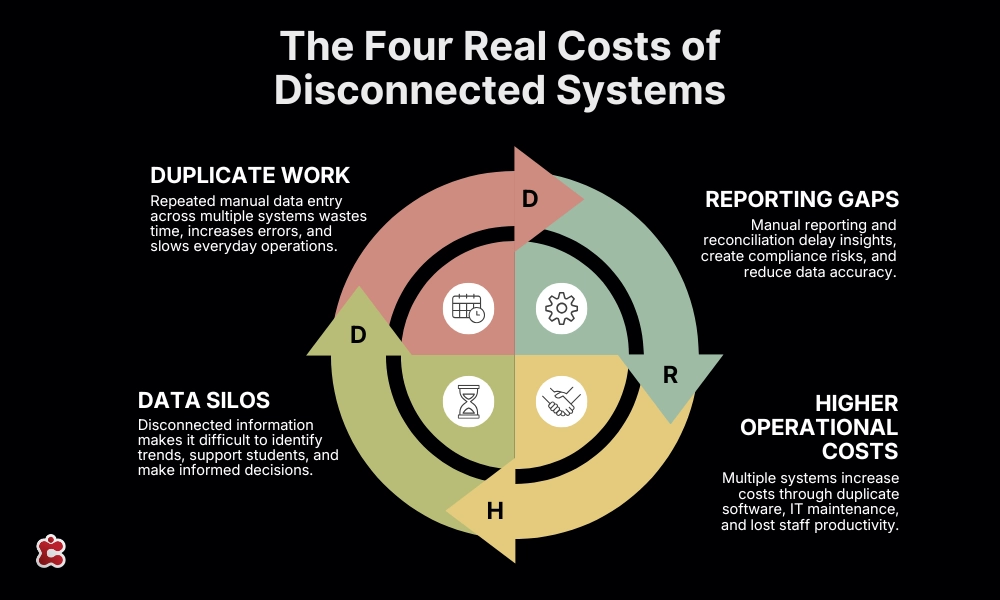
1. Duplicate Work That Accumulates Every Single Day
When systems don’t share data, people become the integration layer. A student enrols: their details are entered into the admissions system, then re-entered into the SIS, then re-entered into the billing platform, then added manually to the communication portal. When those details change an address update, a programme transfer, a name correction the process repeats across every system that holds a copy.
This is not a minor inconvenience. Research on information silos across organisations found that employees waste an average of 12 hours per week navigating and reconciling disconnected systems 30% of the standard working week consumed not by productive work, but by the overhead of fragmentation. In a school context, that time comes from the administrators, registrars, and finance staff who could otherwise be focusing on the work that actually requires human judgment.
Double data entry also introduces errors. Every manual transfer is an opportunity for a field to be mistyped, a record to be skipped, or a version to fall out of sync. When a billing system holds a different address from the SIS, or a grade report references a student ID that doesn’t match the attendance record, the downstream consequences delayed communications, inaccurate reports, compliance gaps multiply.
2. Data Silos That Prevent Meaningful Decision-Making
A school that runs its attendance in one system, its grades in another, its finances in a third, and its communications in a fourth doesn’t have a data problem. It has four data problems, none of which can be fully understood from inside the silo where it lives.
As Education Week’s coverage of the K-12 data landscape has consistently found, school districts are not short on assessment and operational data they are short on connected, usable data that supports decision-making. The data exists. The ability to read it in context does not.
Consider what this means in practice. An administrator trying to understand why enrolment numbers dropped this term needs attendance trends, academic performance data, payment default rates, and student communication records across the same population of students, in the same time period. If those datasets live in separate systems with no shared student identifier, assembling the picture requires manual extraction from four platforms, manual reconciliation of four export formats, and significant time before any analysis can begin.
By that point, the enrolment window has closed. The insight arrives too late to change anything.
Leadership that lacks a comprehensive, real-time view of institutional performance faces a predictable set of downstream problems: ineffective resource allocation, enrolment forecasting errors, and missed opportunities for early intervention. The silos don’t just slow down reporting they change what decisions get made, and when.
3. Reporting Gaps That Undermine Accountability and Compliance
Reporting is one of the most time-consuming administrative functions in education and one of the most directly affected by disconnected systems. When the data required for a report lives across multiple platforms, someone has to pull it manually, reconcile any discrepancies, and hope that the figures align well enough to submit with confidence.
Often they don’t. Different systems capture data at different frequencies, with different field structures, and against different definitions. An attendance system that logs absences by session may not produce data that maps cleanly onto the daily attendance figures required for regulatory reporting. A billing platform that categorises payment types differently from the SIS creates reconciliation problems at every financial audit.
The result is reporting that is either late, incomplete, or accompanied by caveats that undermine its value. For schools subject to regulatory oversight which, to varying degrees, includes all of them reporting gaps are not just an administrative inconvenience. They are a compliance risk.
| System Scenario | Reporting Outcome |
| Attendance, grades, billing all separate | Manual extraction and reconciliation required before any cross-functional report |
| SIS and LMS not integrated | Academic performance reports miss engagement and submission data |
| Finance system not linked to enrolment | Payment default rates can’t be correlated with retention patterns |
| Communications platform siloed | Contact history invisible to staff reviewing student risk |
| All modules unified on one platform | Reports draw on live data; no extraction, no reconciliation |
The compliance dimension is sharpening. The EU AI Act classifies education AI as high-risk and requires specific data governance and transparency measures phasing in from 2026 to 2027. The EU Data Act mandates data portability for education data from September 2025. FERPA requirements in the US place specific obligations on how student data is stored, accessed, and transferred between systems. Each of these requirements becomes significantly harder to meet when student data is scattered across platforms that were never designed to share it.
4. Higher Operational Costs Visible and Hidden
The direct costs of running multiple disconnected systems are real and quantifiable: licence fees for redundant tools, integration middleware that has to be purchased or custom-built to connect platforms that won’t talk natively, IT staff time consumed by maintenance rather than improvement.
The EBS Integrator analysis of European higher education found that 70% of IT capacity in institutions with legacy, disconnected architectures is spent maintaining those systems leaving only 30% for innovation, improvement, and support. That’s not a marginal inefficiency. It’s a structural constraint on what IT teams can achieve.
One analysis estimated that data silos cost organisations an average of $7.8 million annually in lost productivity through duplicated effort, delayed decisions, missed opportunities, and the labour hours consumed navigating fragmented systems. While that figure spans sectors, the mechanism is identical in education: staff time is finite, and every hour spent managing disconnected tools is an hour not spent on teaching support, student care, or institutional development.
The hidden costs are harder to quantify but equally real. When a report takes three days to produce manually that should take thirty minutes, the three days isn’t free it’s borrowed from other priorities. When a data error in one system propagates to others before it’s caught, the correction effort multiplies. When staff turnover brings new people who have to learn four platforms instead of one, the onboarding cost is invisible on a balance sheet but very visible to the manager running the induction.
What Disconnection Costs Students
The operational costs above are significant enough on their own. But the deeper argument for connected systems isn’t about administrative efficiency it’s about what fragmentation does to student outcomes.
When an adviser can’t see a student’s full picture attendance, academic trend, payment status, engagement history, support contact record in a single view, early warning signs go unnoticed. Not because the data doesn’t exist. Because it exists in three systems that don’t talk, reviewed by different teams with no shared workflow.
Research on student outcomes consistently confirms that early, connected intervention changes retention rates. Institutions using integrated tools that connected planning, scheduling, and academic data saw a 4.1 percentage point lift in student persistence compared to those operating with disconnected systems. One university that implemented a connected early-warning system saw its retention rate rise by more than eight percentage points in the first year. The intervention wasn’t a new programme. It was the ability to see what was already happening, sooner.
Disconnected systems don’t just make administration harder. They make student support slower, less accurate, and less likely to reach the students who need it.
Why “More Integrations” Is Not the Answer
The instinctive response to fragmentation is integration building connections between existing systems so that data can flow between them. This works, to a point. But it comes with its own costs and limitations that are worth naming clearly.
Custom integrations are expensive to build, require ongoing maintenance, and break when either connected system updates its API or data schema. Every new point-to-point connection adds complexity to the overall architecture. A school running eight platforms with integrations between them has a web of dependencies that becomes increasingly brittle over time and increasingly expensive to maintain when something changes.
Integration also doesn’t solve the underlying problem of multiple sources of truth. If a student’s record lives in five systems that sync periodically, the record in each system at any given moment may be slightly different, depending on when the last sync ran. For administrative staff making decisions in real time, this uncertainty is its own cost they can’t always trust that what they’re seeing is current.
The more durable solution is consolidation: reducing the number of systems, not adding connections between them. Fewer platforms, each doing more, with a single student record that every function reads from and writes to. This is architecturally simpler, cheaper to maintain, and far more reliable as a foundation for reporting and decision-making.
How Classter Addresses the Disconnection Problem
Classter is built on the premise that a school should be able to run its core operations on a unified platform not a collection of tools patched together with integrations.
The School Management System covers academic operations including timetabling, attendance, and class management. The Student Information System holds the central student record that every other module references. The Learning Management System handles academic content and engagement. Billing, HR, communications, admissions, and reporting all operate within the same platform, reading from and writing to the same data.
This means that when a student’s address changes, it changes once and is immediately current everywhere. When a finance officer wants to understand which students with outstanding payments also have attendance concerns, the data to answer that question is in one place, accessible through a single report. When a board asks for end-of-term performance data, it doesn’t require a week of manual extraction it’s a dashboard view.
The ERP for Educational Institutions module connects financial, operational, and HR data into the same unified architecture so that reporting that currently requires reconciling three separate systems can be done from a single source of truth.
For schools that do need specific external integrations, Classter provides an open API but the goal is to minimise the number of external dependencies, not maximise them. The fewer systems you have to connect, the fewer connections that can break.
A Practical Audit: How Fragmented Is Your Current Stack?
Before committing to any change, it’s worth mapping what you’re actually running. Most schools discover, when they do this systematically, that they have more redundancy and more fragmentation than they’d assumed.
Work through these questions with your IT lead and a representative from each operational team:
Identify your platforms. List every software system currently in use across attendance, grades, billing, HR, communications, library, transport, and reporting. Include spreadsheets and manual processes that are filling gaps between systems.
Map the data flows. For each piece of data that needs to exist in more than one system (student name, enrolment status, attendance record, payment status), trace how it gets there. Is it entered manually each time? Synced by an integration? How often does the sync run, and what happens when it fails?
Count the logins. How many separate platforms does an administrator need to access to do their job on a typical day? Each login is a context switch; each context switch has a cost.
Find the reconciliation points. Where in your current process does someone have to compare two systems to check whether they agree? How long does that take, and how often does it surface a discrepancy?
Calculate the reporting overhead. For your most common reports end-of-term performance, attendance summaries, financial statements estimate how long they currently take to produce. What proportion of that time is data extraction versus actual analysis?
According to District Administration magazine’s reporting on the hidden costs of EdTech sprawl, the starting point for fixing fragmented systems is asking three questions: Are multiple systems performing similar functions? Where are staff spending the most time on repetitive tasks? Which data points are hardest to access or consolidate? The answers, reliably, point to the same underlying architecture problem.
Conclusion
The hidden cost of disconnected school systems is hidden precisely because it doesn’t appear on a single invoice or budget line. It accumulates in the hours staff spend on manual reconciliation, in the reporting gaps that undermine accountability, in the data errors that propagate across systems, and in the interventions that arrive too late because the information that would have enabled them was trapped in the wrong place.
The answer is not more tools. It is fewer designed to work together from the start, unified around a single student record that everyone in the institution can trust.
Schools that make that shift recover more than operational efficiency. They recover the analytical capacity to understand what’s happening in their institution in real time, the reporting reliability to meet their obligations with confidence, and the staff time to focus on the work that actually requires human judgment.
If you’re ready to find out what a unified platform would look like for your institution, book a demo with Classter and we’ll walk you through how it works in practice.
FAQ’s
It refers to a technology setup where different administrative functions attendance, grades, billing, communications, HR are handled by separate software platforms that don’t share data natively. Each holds its own version of student and operational records, requiring manual transfer, custom integrations, or periodic syncing to stay aligned. The result is duplicate work, data inconsistencies, and fragmented reporting.
When relevant data lives in separate systems, no one has a complete picture. An administrator trying to identify at-risk students, understand an enrolment trend, or prepare a board report has to manually extract data from multiple sources before any analysis can begin. This takes time, introduces errors, and means that insights arrive after the decision window has closed. The data exists it’s just not usable.
Partially. Integrations can improve data flow between systems, but they come with ongoing maintenance costs and break when either connected system is updated. They also don’t solve the problem of having multiple sources of truth data that exists in several places and may be slightly different in each depending on when the last sync ran. The more durable solution is consolidating onto fewer platforms that share a unified data model from the start.
Significant ones. Regulatory requirements around student data including FERPA in the US and the EU Data Act and AI Act for European institutions place specific obligations on how data is stored, accessed, and transferred. Meeting those obligations is considerably harder when student records are scattered across multiple platforms with different access controls, update frequencies, and export formats. Data portability requirements in particular become difficult to satisfy when there is no single, authoritative source of truth.
Research on teacher and administrator workload consistently identifies system complexity and administrative burden as contributors to burnout. Navigating multiple platforms, remembering multiple logins, and spending significant time on manual data tasks reduces the time available for meaningful work and increases frustration. Simplifying the technology environment is one of the most direct levers available for reducing administrative burden without reducing administrative capacity.
With an honest audit. Map every platform currently in use, trace how data flows between them, identify where manual reconciliation is happening, and calculate the time cost of current reporting processes. The gaps and redundancies will become visible quickly. From there, prioritise consolidation in the areas where fragmentation has the highest operational or compliance cost typically student records, attendance, and billing before expanding to other functions.