


A year ago, the conversation about AI in schools was still mostly about classrooms. Would students use it to cheat? Should teachers use it to mark essays? Could it personalise learning at scale? Those questions haven’t disappeared but they’ve been joined by a quieter, more consequential shift.
The schools that have moved fastest with AI in 2025 and early 2026 aren’t the ones that deployed it in the classroom first. They’re the ones that pointed it at their operations at enrolment pipelines, at timetabling nightmares, at the mountains of student data that accumulate every year and mostly go unanalysed.
Back-to-school season is, as it turns out, the perfect AI use case. And 2026 is the year this stops being a pilot project and becomes standard practice.
Why Back-to-School Prep Is the Perfect AI Use Case
To understand why AI fits the back-to-school window so well, consider what the window actually involves.
In the six to eight weeks between the end of the previous academic year and the start of the next one, school operations teams are managing an extraordinary volume of interconnected tasks many of them data-heavy, deadline-driven, and highly repetitive.
Enrolment projections need to be made before offers go out. Student records need to be updated, cleaned, and transferred. Timetables need to be built from scratch across dozens of constraints room capacity, teacher availability, curriculum requirements, student option choices. Welcome communications need to go out to hundreds or thousands of incoming students, ideally personalised. Fee schedules and payment reminders need to be activated the moment enrolment is confirmed.
Each of these tasks shares the same characteristics: they involve large datasets, they follow predictable rules or patterns, they have hard deadlines, and they’re currently being done mostly by hand.
That’s exactly where AI performs well. Not at tasks requiring human judgment, pastoral care, or institutional wisdom but at tasks that are repetitive, data-driven, and time-critical.
The mistake most schools make is waiting for a comprehensive AI strategy before acting. The smarter approach is to identify the two or three back-to-school tasks where AI can reduce manual effort most dramatically this year and start there.
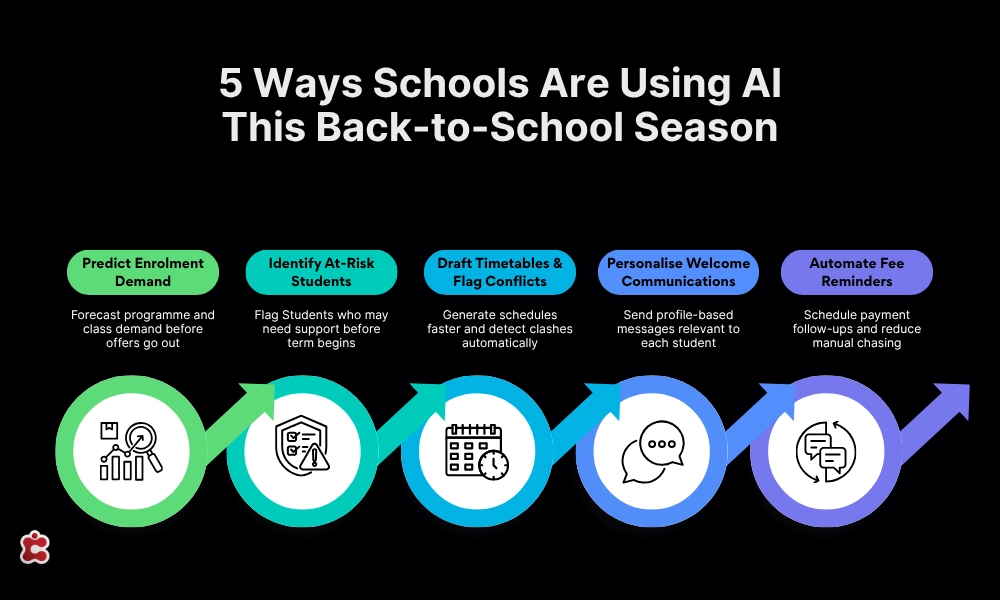
Five Ways Schools Are Using AI This Back-to-School Season
1. Predicting Enrolment Demand Before Offers Go Out
One of the most costly back-to-school problems is one of the least discussed: capacity mismatches. Schools particularly secondary schools and higher education institutions with multiple programme options frequently find themselves either over-subscribed in some areas and under-subscribed in others, or holding offers for more students than they can actually accommodate.
The traditional approach is to look at last year’s numbers and apply a rough multiplier. AI-enhanced analytics does something more useful: it analyses multiple years of enrolment data, cross-references with application patterns, demographic trends, and even external signals like local school closures or population shifts, and produces demand forecasts at the programme or class level not just the institution level.
Schools using predictive enrolment analytics are reporting earlier, more accurate capacity decisions that reduce last-minute scrambles to find additional classroom space or recruit additional staff.
In Classter, the Academic CRM module provides analytics across the full enrolment pipeline from enquiry through application to confirmed enrolmentgiving admissions and operations teams the data visibility to spot demand trends as they emerge, not after offers have gone out.
2. Identifying At-Risk Students Before They Arrive
Traditionally, at-risk identification happens reactively. A student misses a few classes. Grades start to slide. A teacher flags the concern. By that point, the student has already lost momentum.
Forward-thinking schools are flipping this. By analysing historical student data prior academic performance, attendance patterns, engagement metrics, demographic factors before the new year starts, they can identify students who are statistically more likely to struggle in their first term and put support structures in place before the first day.
This isn’t about labelling students or making deterministic predictions. It’s about giving pastoral teams a prioritised list of students to check in with proactively students who might benefit from an early conversation with a tutor, an introduction to support services, or a more structured onboarding experience.
The data for this already exists in most schools’ SIS. The barrier isn’t data availability it’s analytical capacity. Most schools don’t have the bandwidth to run this kind of analysis manually. AI-enhanced reporting tools do it automatically.
Classter’s SIS reporting and grade analytics allow schools to build early-warning dashboards that flag students based on configurable risk indicators drawing on historical academic data, attendance records, and engagement patterns already stored in the platform.
3. Auto-Generating Draft Timetables and Flagging Conflicts
Timetabling is the back-to-school task that almost every operations team dreads most. In a complex school environment, building a timetable involves satisfying dozens sometimes hundreds of constraints simultaneously: teacher availability, room capacity, student option combinations, curriculum sequencing, contractual limits on consecutive teaching hours, accessibility requirements.
A timetable that works for 90% of students and staff but creates an impossible clash for 10% isn’t a good timetable. Finding those clashes manually, in a document with hundreds of entries, is the kind of task that consumes entire weeks.
AI-assisted timetable generation doesn’t replace the human judgment of an experienced administrator. What it does is handle the combinatorial complexity generating a draft timetable that satisfies the stated constraints, flagging conflicts automatically, and offering alternative configurations when clashes can’t be resolved without a trade-off.
The human remains in the loop for final decisions and exceptions. But instead of spending two weeks building a timetable from scratch, the administrator spends two days reviewing and refining a draft that’s already 80% of the way there.
Classter’s Academics & LMS scheduling module provides automated timetable generation with conflict detection, supporting multi-campus, multi-programme environments. Schools using the module report significantly reduced timetabling time and fewer scheduling errors making it to the start of term.
4. Personalising Welcome Communications Per Student Profile
Welcome communications are one of those tasks that looks simple on the surface and turns out to be surprisingly time-consuming when done well. A single “Dear Student” bulk email treats a first-year undergraduate the same as a returning postgraduate student, an international student the same as a local one, a scholarship recipient the same as a student who’s still completing their financial aid application.
Personalised welcome communications messages that reference the student’s programme, their specific enrolment status, relevant deadlines, and support resources appropriate to their situation produce meaningfully better outcomes. Students feel seen. Key information reaches the right people at the right time. Fewer students arrive on the first day confused about what they’re supposed to do.
AI-assisted communication drafting allows schools to create communication templates that pull from student profile data and auto-personalise at scale. Instead of one generic email going to three thousand students, three thousand slightly different emails go out each one relevant to its recipient in the time it would previously have taken to draft one.
Classter’s CRM module supports automated, profile-based messaging across the student lifecycle. Communications can be triggered by enrolment status, programme, fee payment state, or any other field in the student record automatically, at the right moment, without manual intervention for each student.
5. Automating Fee Reminders and Payment Follow-Ups
Payment chasing is one of the most time-consuming tasks in school finance administration and one of the most automatable. A student’s payment deadline is a known date. Whether they’ve paid is a known fact. The reminder email is a known template. The only reason a human is sending it is that the system isn’t set up to do it automatically.
AI-enhanced payment automation goes further than simple scheduled reminders. It can analyse payment behaviour patterns which students tend to pay late, which respond to reminders, which require escalation and adjust communication timing and tone accordingly. A student with a history of paying within three days of the deadline doesn’t need a reminder two weeks out. A student who paid late last semester and hasn’t yet set up a payment plan might benefit from a different message, at a different point in the cycle.
The result is higher payment rates, fewer late fees being contested, and finance teams that spend their time on exceptions rather than routine follow-ups.
Classter’s Billing & Payments automation handles fee scheduling, instalment plan management, and payment reminders automatically with configurable rules that can be tailored to student profile and payment history.
What AI Can’t Do
Any useful thought leadership piece on AI in education has to reckon with the limits and in school administration, those limits matter.
AI can’t make pastoral judgments. An algorithm can flag a student as statistically at-risk. It cannot understand the family circumstances, the personal history, or the conversation context that determines the right intervention. That judgment belongs to humans.
AI can’t replace institutional knowledge. An experienced timetabler knows that two particular teachers shouldn’t be scheduled back-to-back on a Monday morning for reasons the system doesn’t capture. AI works with the data it has; it doesn’t know what it doesn’t know.
AI output requires human review. This is not optional. Auto-generated communications should be reviewed before sending. Timetable drafts should be checked by someone who knows the environment. Risk flags should be assessed by pastoral staff, not acted on automatically. The efficiency gains from AI come from reducing the time spent on generation and drafting not from removing humans from the loop.
AI requires good data. Garbage in, garbage out. An AI system trained on incomplete, inconsistent, or biased historical data will produce incomplete, inconsistent, or biased outputs. The data quality work covered in summer audits isn’t separate from AI readiness it’s foundational to it. Schools that haven’t cleaned their student records shouldn’t expect AI analytics to produce reliable insights.
Keeping these limits visible isn’t pessimism. It’s what allows school leaders to deploy AI credibly capturing the genuine efficiency gains while maintaining the human judgment that education requires.
What School Leaders Should Look for in an AI-Ready Platform
Not all school management systems are equally positioned for AI. The difference between a platform that calls itself AI-ready and one that actually is comes down to a few specific capabilities.
Centralised, clean data architecture. AI runs on data. If student records, financial data, academic records, and communications history are stored in separate systems that don’t sync reliably, AI analytics will always be operating on a partial picture. A genuinely AI-ready platform maintains a single, unified student record that every module reads from and writes to.
Native analytics and reporting. The ability to surface insights from historical data not just store it is the foundation of AI-assisted decision-making. Look for platforms where reporting isn’t bolted on as an afterthought but built into the core data model.
Automation infrastructure. AI-enhanced automation requires a platform that can execute rules and triggers without manual intervention. Scheduled communications, payment reminders, escalation workflows should be configurable and reliable before AI is layered on top.
Integration capability. Schools rarely run on a single platform. An AI-ready system needs to connect cleanly with external tools student wellbeing platforms, learning management systems, communication tools so that AI insights can flow across the full operational picture, not just within a single module.
A roadmap, not just a feature. AI in education is moving fast. What matters isn’t just what a platform does today but what its development direction looks like. Platforms that have already deployed AI-enhanced features and have a visible roadmap for expanding them are a safer long-term bet than those promising AI “coming soon.”
Classter is built on this kind of infrastructure: a centralised Core module that unifies student data across every function, native analytics in the SIS and CRM, automation built into Billing & Payments and communications, and an open API for integration. AI-enhanced advising and performance prediction are already live in the platform not on a roadmap, but in production, being used by schools preparing for September right now.
Is Your School Ready to Use AI This Back-to-School Season?
Use this self-assessment before your planning kicks off. The more “no” answers you have, the more foundational work needs to happen before AI can add value.
Data foundations
- Student records are centralised in a single system not split across spreadsheets and separate platforms
- Records were audited and cleaned in the past 12 months
- Historical data goes back at least two academic years in a consistent format
- Data quality is monitored regularly, not only when a problem surfaces
System capability
- Your platform can generate and send automated communications based on student profile data
- Timetabling is managed in-system, not in spreadsheets
- Payment reminders and fee schedules run automatically, not manually
- You have access to reporting dashboards that draw on live student data
Process readiness
- There’s a named person responsible for reviewing AI-generated outputs before they’re acted on
- Staff who will use AI tools have received at least basic training on how they work
- Your GDPR or FERPA compliance review has covered AI and automated decision-making
- There’s a feedback loop: a way to flag when AI outputs are wrong and improve over time
Strategic readiness
- Senior leadership understands what AI can and can’t do in your context
- You’ve identified two or three specific use cases to start with rather than trying to do everything at once
- Your platform vendor has a visible AI development roadmap
- You have a plan for how AI insights will connect to human action not just sit in a dashboard
Scoring: 12–16 checks: you’re well-positioned to deploy AI meaningfully this back-to-school season. 8–11: foundational work is needed first focus on data and system capability. Below 8: the infrastructure isn’t there yet; start with the basics and build toward AI readiness over the next 12 months.
The Schools That Will Win September
The shift happening in 2026 isn’t dramatic. There’s no single AI breakthrough that changes everything overnight. What’s happening is more incremental and more durable.
Schools that have spent the past year cleaning their data, consolidating their systems, and automating the processes that were always automatable are now in a position to layer AI on top of that foundation. The enrolment prediction is more accurate because three years of clean data feeds it. The at-risk identification is more useful because the SIS has consistent attendance and grade records. The timetable draft is more reliable because the constraints are properly defined in the system.
The schools that haven’t done that foundational work are finding that AI tools don’t magically compensate for messy data and disconnected systems. They produce messy, unreliable outputs instead.
This is, ultimately, good news. Because the path to AI-ready isn’t exotic or expensive. It’s the same set of summer maintenance tasks that good IT and operations teams do anyway done with an eye toward what they’re building toward.
See how Classter’s AI-powered features are helping schools prepare smarter for September. Book a demo
FAQ’s
If your existing platform has centralised student data, native analytics, and automation built in, it may already be capable of most of what’s described here. The AI features that matter most for back-to-school predictive enrolment, at-risk flagging, automated communications run on top of clean, unified data. The platform question is less “does it have AI” and more “is the data foundation solid enough for AI to work reliably.”
Not effectively, no. AI analytics are only as reliable as the data feeding them. If student records are incomplete, duplicated, or split across disconnected systems, AI outputs will reflect that producing unreliable forecasts and misleading risk flags. The honest answer is to treat this summer as the data foundation phase and plan for meaningful AI use in the following academic year.
The efficiency gains are smaller for simple timetables, but conflict detection and automated draft generation still save time even in straightforward environments. Where AI timetabling delivers the most value is in complex multi-programme or multi-campus schools where the constraint set genuinely exceeds what a human can hold in their head simultaneously.
Automated decision-making based on personal data has specific obligations under both GDPR and FERPA. In practice, this means AI-generated risk flags should inform human decisions, not trigger automated actions directly. Schools should document the logic behind any automated profiling, ensure students and parents are aware it’s happening, and have a process for challenging outputs that seem incorrect. This should be covered in your summer compliance review before any AI risk-flagging goes live.
Ask for specifics: which AI features are live in production today, which are on the roadmap, and which schools are currently using them. Request a demonstration against your actual data or a realistic sample, not a curated demo dataset. Ask what happens when the AI output is wrong is there a feedback mechanism? Platforms with genuine AI capability can answer these questions clearly. Those that can’t are usually selling the roadmap, not the product.