


For most schools, the moment the last bell rings in June, communications go quiet. Staff are on leave. Offices are unstaffed. The website sits unchanged. And somewhere out there, parents are refreshing their inboxes wondering whether their child’s class has been confirmed, whether the uniform policy has changed, and whether anyone at the school is actually thinking about September.
The summer communication gap is real, and it costs schools more than they realise. Parents who feel uninformed over the summer are more anxious at the start of term. Students who feel disconnected are slower to re-engage. And families who never received a single message between July and September sometimes re-examine their enrollment decision entirely.
The good news is that closing this gap does not require a member of staff to be on email duty all summer. With the right school parent communication software and a bit of upfront planning, schools can stay meaningfully present in families’ lives throughout July and August without adding a single hour to anyone’s workload.
Here is how to do it.
1.Why Schools Go Quiet in Summer and What It Costs
The structural reasons for the gap
Schools go quiet in summer for understandable reasons. Reduced staffing means fewer people to draft and send communications. The academic calendar provides no natural hooks for messaging. Leadership attention shifts to planning and recruitment rather than current-family engagement. Without a system in place, communications simply stop.
The problem is that parents’ need for information does not stop with the academic year. Summer is when families make practical decisions: buying supplies, booking childcare, planning holidays around term dates, registering for extracurriculars. If the school isn’t providing that information proactively, parents fill the gap with anxiety, assumptions, or questions sent to overloaded inboxes.
The consequences
The impact of summer silence is often invisible until September, when it shows up as a cluster of difficult interactions: parents who feel they were kept in the dark, students who arrive unsettled because they didn’t know what to expect, and a first week that is harder than it needs to be.
More significantly, for schools that rely on active re-enrollment or manage rolling intake, the summer period is when families who were already uncertain make their final decision. A school that communicates well over summer signals that it is organised, attentive, and genuinely invested in its community. A school that goes silent signals the opposite.
2.What Parents and Students Actually Want to Hear Over Summer
Before building a communication plan, it helps to think from the family’s perspective. The question is not “what do we need to tell people?” but “what do families actually need to know, and when do they need to know it?”
Based on the most common parent queries that schools receive in late summer, the answers tend to fall into five clear categories.
1. Enrollment and class confirmations
Parents want to know that their child’s place is confirmed, which class they are in, and who their teacher will be. This is the single most anxiety-generating piece of unknown information over summer, particularly for new joiners and for families moving between year groups. Providing this early even a partial update that acknowledges the information is coming goes a long way.
2. Timetables and term dates
When does the new term start? What time is drop-off? Are there any changes to the school day structure? Parents planning summer logistics need these answers before August. A school that publishes term dates and timetable frameworks through its parent engagement platform over summer removes a significant source of planning stress.
3. Supply lists and practical requirements
Uniform specifications, stationery lists, required books, IT requirements for students bringing devices these are practical and time-sensitive. Parents need them early enough to shop without rushing. Many prefer to receive these digitally and access them on demand rather than relying on a physical letter that was sent in June and has since been lost.
4. Events and activities
Open evenings, induction days, sports registrations, summer reading programs, and back-to-school events all need to reach families while they still have time to plan. Communication that arrives too close to the event is communication that feels like pressure rather than invitation.
5. Any changes since June
Staff changes, building works, policy updates, new facilities families who find out about significant changes on the first day of term feel blindsided. Summer is the right time to share this information proactively, framed positively where possible.
3. Building a Summer Communication Calendar
A communication calendar does two things: it ensures families receive information at the right moment, and it distributes the work of preparing that information across the weeks before summer begins rather than leaving it to whoever is available in August.
The calendar below is a practical starting framework. Adapt it to your school’s own milestones and intake cycle.
| Month | What to Send | Channel | Classter Feature |
| Early July | Re-enrollment confirmation, welcome back message, key dates overview | Portal notification + mobile app push | Automated notifications, Parent Portal |
| Mid-July | Supply lists, uniform reminders, optional summer reading | SMS / in-app message | Mobile App, Document library |
| Late July | Class and timetable preview (if ready), teacher assignment updates | Portal update + push notification | Student Portal, Academic CRM follow-up |
| Early August | Events calendar, open day reminders, transport arrangements | Email + mobile push | Automated messaging, Mobile App |
| Mid-August | Back-to-school countdown, any outstanding enrollment documents | SMS + portal alert | Automated notifications, Admissions module |
| Final week | First day logistics, what to bring, drop-off and pick-up details | Mobile push + portal | Mobile App, Parent Portal |
A note on consistency
The goal is not to flood inboxes. It is to establish a rhythm. Families who receive one well-timed, useful message every two to three weeks over summer develop a sense that the school is organised and attentive. Families who receive nothing for eight weeks and then three messages in the final week feel the opposite.
Set the calendar before term ends. Assign ownership for each message. Use automation wherever the content is predictable. Save the personalised communications for the moments that genuinely benefit from a human touch.
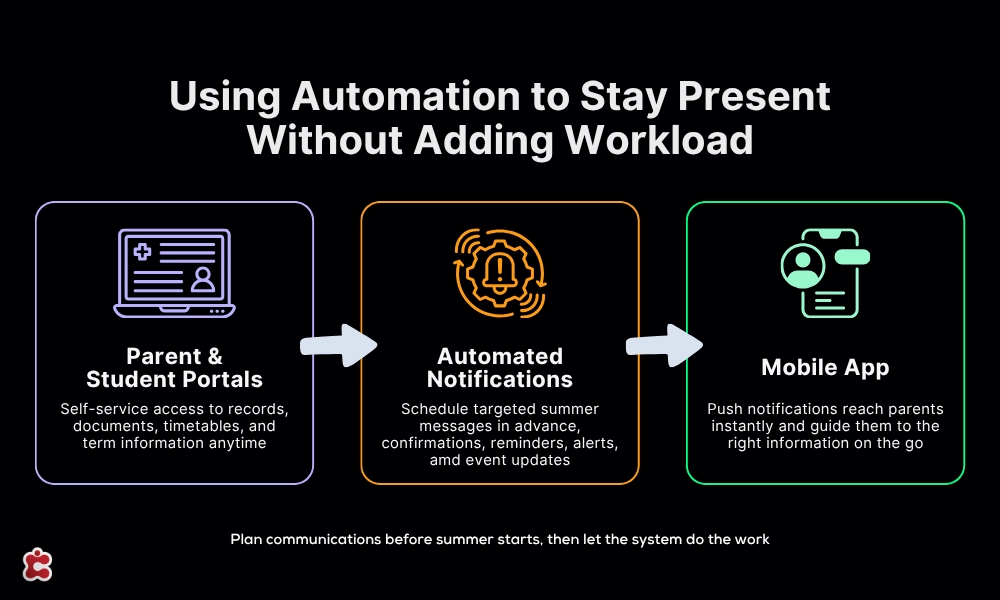
4. Using Automation to Stay Present Without Adding Workload
The objection most schools raise when discussing summer communication is a reasonable one: we don’t have the staff capacity to manage a messaging programme over summer. The answer is that with the right K12 parent communication strategy and tools, most of the work happens before summer starts.
Classter’s platform is built around this principle. Here is how the different components work together to keep families informed with minimal ongoing effort.
The Parent and Student Portals: Self-Service Information, Always Available
The most powerful thing a school can do for summer communication is make information available on demand rather than delivering it in batches. Classter’s parent and student portals give families access to their own records, documents, and updates whenever they need them without requiring a staff member to respond.
Over summer, this means parents can log in to check enrollment status, download supply lists, review term dates, and access any documents the school has published at 10pm on a Sunday if that is when they happen to think of it. The portal is the single source of truth, and it is available around the clock.
For students, particularly older ones managing their own schedules, the student portal provides access to timetables, course materials, and any pre-term requirements. Giving students this autonomy over summer supports their readiness for September and reduces the volume of parent queries about information students should be managing themselves.
Automated Notifications: The Right Message at the Right Moment
Automated school notifications allow schools to schedule communications in advance and deliver them at the right time without manual intervention. In practice, this means that a school can spend an afternoon in late June configuring a full summer communication schedule, and the messages go out on their own throughout July and August.
Classter’s automated messaging functionality handles this at scale. Notifications can be targeted by year group, programme, or enrollment status, so families receive only the information that is relevant to them. A parent of a new joiner receives the induction day invitation. A parent of a returning student does not. The system handles the segmentation.
Typical automated notifications over summer include: enrollment confirmation messages, document reminder alerts for families with outstanding items, timetable publication alerts when schedules go live on the portal, event reminders sent a week and a day before each activity, and a first-day logistics message in the final days before term.
The Mobile App: Communication That Meets Parents Where They Are
Summer is not a time when parents are sitting at desks checking school websites. They are on holiday, managing childcare, and moving between activities. The Classter Mobile App is the communication channel that meets them where they actually are.
Push notifications through the mobile app have significantly higher open rates than email for time-sensitive updates. A notification that a new timetable has been published, or that enrollment documents are now available to sign, reaches parents immediately and takes them directly to the relevant information in the app rather than requiring them to navigate a website.
For schools that want to establish a modern, attentive image, the mobile app also signals something important: this school understands how families actually communicate. That signal matters, particularly to parents of secondary-age students who are used to digital-first experiences in every other area of their lives.
5. Practical Steps to Get Your Summer Communication Right
If you are planning to put a summer communication strategy in place, here is where to start.
Before term ends
- Map out every piece of information families will need between July and September and assign a target send date to each.
- Configure your communication calendar in Classter so automated messages are scheduled and ready to send.
- Ensure the parent and student portals are populated with the documents families will be looking for over summer: supply lists, term dates, enrollment documents, and event information.
- Brief your team on what is being sent automatically so they are not caught off-guard by parent responses.
During summer
- Let the automation run. Resist the temptation to override scheduled messages unless something material has changed.
- Monitor the portal for any outstanding enrollment documents and ensure automated reminders are reaching the right families.
- Use the Academic CRM to follow up personally with families who have unresolved enrollment queries or who have not engaged with communications.
Before September
- Send a final first-day logistics message through the mobile app in the last few days before term drop-off times, what to bring, any last-minute reminders.
Review which communications generated the most engagement. Use this to refine next summer’s calendar.
Ready to Close the Summer Communication Gap?
Summer does not have to mean silence. With Classter’s parent and student portals, automated notifications, and mobile app, your school can stay present in families’ lives throughout July and August without putting a single extra task on your summer to-do list.
Set it up before term ends. Let it run. Arrive in September with families who feel informed, confident, and ready.
Book a demo with the Classter team before the summer rush begins.
FAQ’s
If your communication platform supports scheduled messaging, most of the setup can be done in a single afternoon before term ends. The work is in deciding what to send and when the platform handles the delivery. Schools that treat this as a one-time annual setup rather than an ongoing summer task find it becomes faster each year as they refine the same template.
Send what you have and acknowledge what’s still coming. A message in early July that confirms enrollment, outlines key dates, and tells parents when to expect class assignments is significantly better than silence. Families don’t need everything at once they need to know the school is on top of it and that information will arrive before they need it.
For time-sensitive updates, consistently yes. Email open rates in education typically sit between 20–35%. Mobile push notifications regularly exceed 60–70% open rates, and they deliver parents directly to the relevant content in the app rather than requiring them to navigate elsewhere. For urgent or time-bound communications timetable changes, first-day logistics the mobile app is the more reliable channel.
Only if they’re written that way. Automated delivery doesn’t mean generic content. A well-written enrollment confirmation that addresses the parent by name, references their child’s year group, and provides genuinely useful information feels attentive regardless of whether a staff member pressed send. Reserve personal outreach for families with unresolved issues. Use automation for everything predictable.
This is exactly why a self-service portal matters alongside push notifications. If a parent misses a mid-July message about supply lists, they should be able to log into the portal at any point and find the same information waiting for them. Automation handles the proactive delivery. The portal handles on-demand access. Together they cover both types of parent behaviour.