



Growth in education often brings new opportunities alongside new pressure. As enrollment increases and programs expand, many schools begin to question whether their existing tech stack can keep up. The instinct is often to replace everything at once, but large-scale system changes can be costly, disruptive, and risky for daily operations.
Today, digital transformation does not have to mean starting over. With modern School Management Software and integrated school platforms, institutions can scale gradually by connecting systems, centralizing data, and building on what already works. This article explores how schools can support growth while protecting continuity, investment, and operational stability.
Why Growth Often Breaks Traditional School Systems
As schools expand, systems that once supported daily operations can begin to feel strained. Growth introduces new demands across departments, and traditional setups are often not designed to handle increasing complexity at scale. Over time, small operational gaps become more visible and harder to manage.
Common ways growth challenges traditional school systems:
- Disconnected tools across departments: Admissions, academics, finance, and communication often operate in separate systems, slowing collaboration and making it less transparent.
- Fragmented data within the tech stack: Information lives in multiple places, leading to inconsistent reporting and limited visibility for leadership teams.
- Manual processes that no longer scale: Staff rely on spreadsheets, workarounds, or duplicate data entry, increasing workload and the risk of errors.
- Limited flexibility for new programs: Expanding offerings can require complex adjustments when systems are rigid or tightly configured.
- Delayed decision-making: Without centralized insights, leaders struggle to access real-time data needed to guide growth confidently.
- Increased pressure on IT teams: Maintaining integrations and troubleshooting across disconnected school platforms becomes time-consuming and reactive.
These challenges often signal that growth has outpaced existing structures, creating the need for more connected School Management Software and a thoughtful approach to digital transformation rather than a complete system replacement.
The Hidden Costs of Replacing an Entire Tech Stack
Replacing an entire system can seem like the fastest way to solve growing pains. When processes feel fragmented and teams are working around limitations, starting fresh may appear to promise simplicity. In reality, a full tech stack replacement often introduces challenges that extend far beyond the initial investment.
- Operational disruption during transition: Large-scale migrations can interrupt daily workflows, affecting admissions cycles, academic management, and communication with students and families.
- Data migration risks: Moving years of institutional data between systems can lead to inconsistencies, lost context, or extended validation periods that demand significant staff involvement.
- Extended implementation timelines: New School Management Software deployments can take months or even years, delaying the benefits leaders expect from change.
- Staff retraining and adoption fatigue: Faculty and administrative teams must relearn processes, which can temporarily reduce productivity and increase resistance to change.
- Unexpected integration gaps: Existing tools that previously worked together may not integrate seamlessly with new school platforms, creating new silos instead of solving old ones.
- Higher long-term costs: Beyond licensing, institutions face consulting fees, customization expenses, and ongoing support requirements that are often underestimated.
What Scalable Infrastructure Looks Like in Modern Education
As schools grow, scalability is less about adding more tools and more about creating systems that adapt alongside the institution. Modern education environments need technology that supports change without forcing constant restructuring. Scalable infrastructure allows schools to expand while maintaining stability behind the scenes.
| Element of Scalable Infrastructure | What It Means in Practice | Impact on Growing Institutions |
| Connected tech stack | Systems communicate seamlessly across departments | Reduces silos and improves collaboration |
| Centralized data visibility | One reliable source of institutional data | Faster, more confident decision-making |
| Modular School Management Software | New capabilities can be added without replacing systems | Supports gradual, low-risk expansion |
| Flexible school platforms | Technology adapts to institutional workflows | Minimizes operational disruption |
| Automation of routine processes | Administrative tasks run more efficiently | Frees staff time and reduces errors |
| Built-in integrations supporting digital transformation | Existing tools connect easily | Enables growth without full system replacement |
The Role of School Management Software in Sustainable Expansion
Expansion places pressure on coordination, visibility, and consistency across departments. School Management Software plays a critical role, not as a replacement for existing systems, but as a unifying layer that helps schools operate more cohesively as they scale.
Modern platforms help align academic, administrative, and operational processes, enabling teams to work from shared information rather than isolated workflows. Instead of adding complexity, the right system creates structure, ensuring that new students, programs, and campuses can be supported without multiplying manual effort.
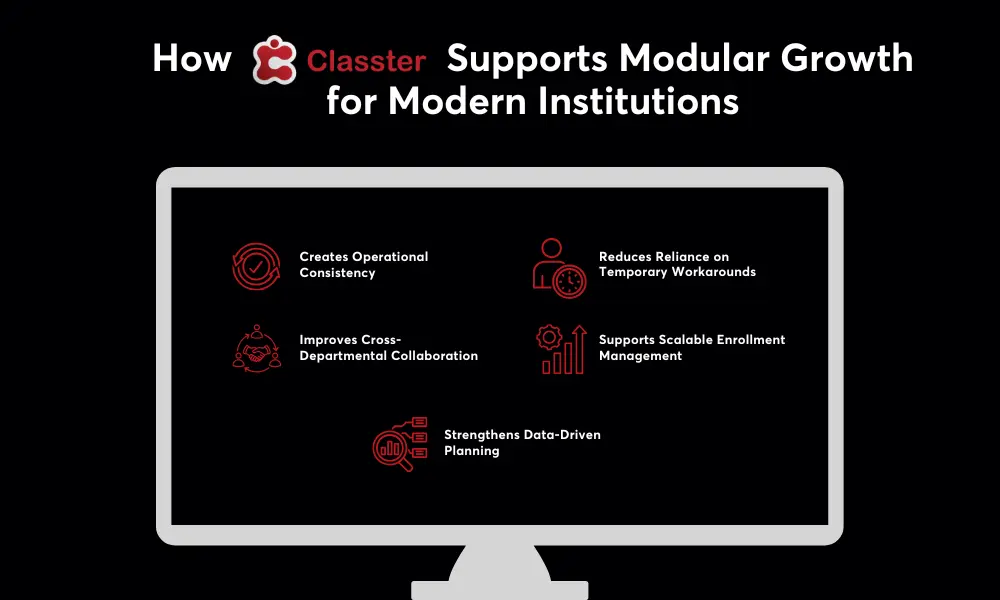
- Creates operational consistency: Standardized workflows help maintain quality and compliance as institutions grow across departments or locations.
- Improves cross-departmental collaboration: Admissions, academics, finance, and student services operate with shared visibility, reducing bottlenecks and miscommunication.
- Supports scalable enrollment management: Processes adapt more easily to rising application volumes and evolving student journeys.
- Strengthens data-driven planning: Leadership teams gain clearer insights into performance, resource allocation, and future growth opportunities.
- Reduces reliance on temporary workarounds: Automated processes replace manual coordination, allowing staff to focus on strategic priorities rather than on administrative fixes.
How Classter Supports Modular Growth for Modern Institutions
For many institutions, growth happens gradually through new programs, expanding enrollment, and evolving operational needs. Classter supports this natural progression by offering modular School Management Software that allows schools to expand capabilities without replacing their entire tech stack. Instead of forcing large-scale change, institutions can introduce new functionality over time while maintaining continuity across existing school platforms.
By centralizing data and enabling integrations, Classter provides a smoother path to digital transformation, helping leadership teams strengthen coordination, improve visibility, and scale operations in a way that feels controlled and sustainable.
FAQs
No. Many institutions can scale successfully by integrating systems and adopting modular School Management Software instead of starting from scratch.
Modular platforms allow institutions to add new capabilities gradually, enabling growth without rebuilding their entire technology environment.
Classter enables gradual digital transformation by centralizing data, connecting workflows, and allowing institutions to adopt new capabilities step by step.