



Most schools don’t decide to modernize their systems all at once. They decide to fix the one thing that’s currently on fire, admissions this year, billing next year, grading the year after, and only later realize those decisions add up to a full technology overhaul. The mistake isn’t making the decision this way. The mistake is choosing software that can’t be adopted this way, and ending up locked into a single, all-or-nothing rollout for a problem that was never actually all-or-nothing.
This is the case for modular school management software: not because gradual is inherently better than fast, but because most institutions don’t have the budget, staffing, or risk appetite for a single, simultaneous replacement of every administrative system they run. Modularity isn’t a consolation prize for schools that can’t afford a “real” implementation. It’s a different, often better-fitting strategy for getting to the same destination.
The Real Alternative Isn’t “Modernize or Don’t.” It’s “All at Once or in Sequence.”
Every institution eventually chooses between two broad strategies for replacing legacy administrative systems: a single, simultaneous cutover, sometimes called a “big bang” implementation, or a staged rollout where modules go live one at a time. Neither is universally correct, but the trade-offs are well documented outside education, in exactly the kind of enterprise software projects that schools are effectively running when they replace a SIS, LMS, or finance system.
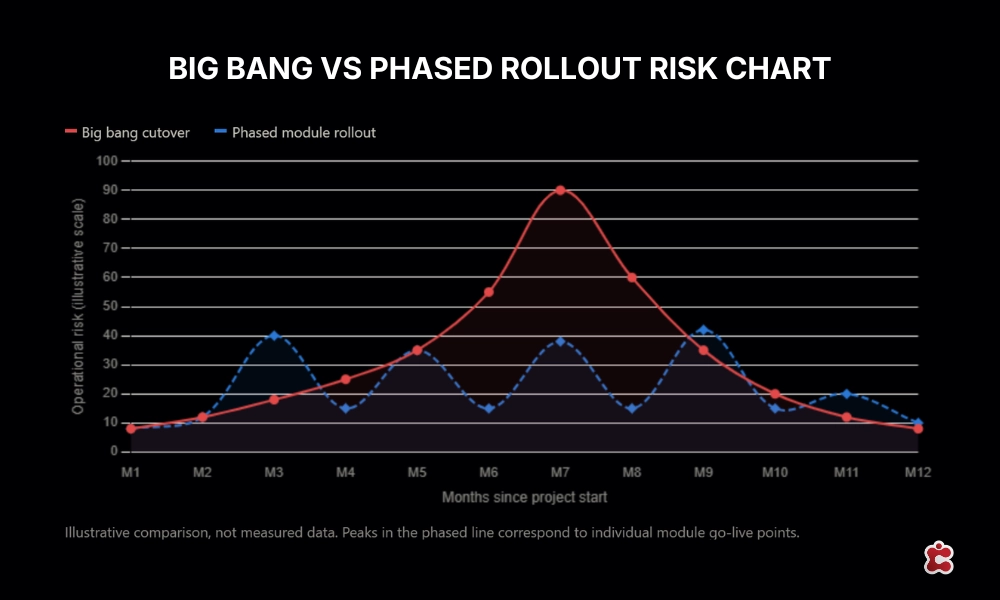
A big bang cutover can be faster and cheaper to deliver on paper, but it concentrates all the risk into a single date: every department goes live simultaneously, every staff member has to adapt at once, and any configuration or data error cascades across the entire institution before anyone has a chance to catch it in a smaller, contained setting. A phased rollout spreads that risk out. Issues get caught and fixed within one module’s scope before the next one goes live, and staff adapt to one new workflow at a time instead of relearning their entire job in a single week.
The trade-off is real: a phased approach usually takes longer and can mean running two systems side by side for a period, which has its own cost. But for most schools, that cost is smaller and more predictable than the cost of a single failed or badly disrupted cutover across the entire institution at once.
Why This Matters More for Schools Than It Might Seem
Higher education and K-12 institutions face a version of this decision that’s arguably higher-stakes than in most industries, because the “downtime” isn’t abstract. A billing error during a big bang cutover doesn’t just create an internal support ticket, it shows up as a wrong invoice in a parent’s inbox.
A grading system misconfiguration doesn’t just need an IT fix, it needs to be resolved before report cards go out. Schools operate on a calendar that doesn’t pause for a rocky software transition, which makes the “replace everything at once” strategy considerably riskier than it would be for a business that can absorb a quiet week of internal friction.
At the same time, the pressure to modernize hasn’t eased. Guest analysis on legacy systems in higher education has pointed to the coming enrollment pressures facing many institutions as a reason schools can’t simply leave outdated administrative systems in place indefinitely, while also noting that institutions adopting adaptable, modular systems have positioned themselves to integrate more easily with whatever comes next, compared to those locked into rigid, monolithic platforms. Separately, higher ed technology leaders surveyed on 2026 priorities pointed to a related lesson from cloud adoption: institutions that waited too long to plan for multiple interacting systems created governance and cost complexity that was difficult to unwind later, a pattern just as relevant to sequencing administrative modules as it is to managing multiple cloud services. The pressure to modernize is real. The pressure to modernize everything simultaneously is largely self-imposed.
What a Phased Module Rollout Actually Looks Like
In practice, phased modernization means sequencing modules by urgency and dependency, not adopting everything in parallel. A workable sequence usually starts with whichever administrative area is causing the most acute daily pain, since that’s where staff will feel the benefit fastest and where institutional buy-in for the next phase gets built.
A common, sensible order looks something like this:
| Phase | Typical starting point | Why it usually comes first |
| 1 | Core student records and admissions | Everything else depends on having one accurate, central student record |
| 2 | Billing and payments | Financial errors are visible and urgent; automation here has immediate, measurable payoff |
| 3 | Academics, grading, and attendance | Requires the student record foundation from Phase 1 to be reliable first |
| 4 | Communications and engagement tools | Builds on data from earlier phases to personalize outreach effectively |
| 5 | Advanced reporting and analytics | Only becomes genuinely useful once data from prior phases is centralized and clean |
This isn’t a rigid formula. A school with a particularly painful admissions bottleneck might start there instead of with records; a district under new state reporting requirements might prioritize compliance-related modules earlier. The point isn’t the specific order, it’s the principle: modules can go live independently, each one solving a real, contained problem, without the entire administrative operation needing to hold its breath for a single go-live date that touches everything simultaneously.
The Data Foundation That Makes This Actually Work
Phased adoption only works cleanly if the modules share a single underlying data model. Otherwise, a school ends up doing exactly what modular adoption was supposed to prevent: rebuilding the same student record, invoice history, or grade data separately in each new module, recreating the fragmentation that legacy systems already had.
This is the distinction between genuinely modular software and a loose collection of separately built tools bundled under one brand. Genuinely modular platforms let a school turn on a Core module, then Billing, then Academics, with each new module reading from and writing to the same central student record rather than maintaining its own separate copy. That’s what lets phase two build on phase one instead of duplicating it, and it’s the difference between phased modernization actually reducing risk versus just spreading the same integration problems across a longer timeline.
Where Classter Fits
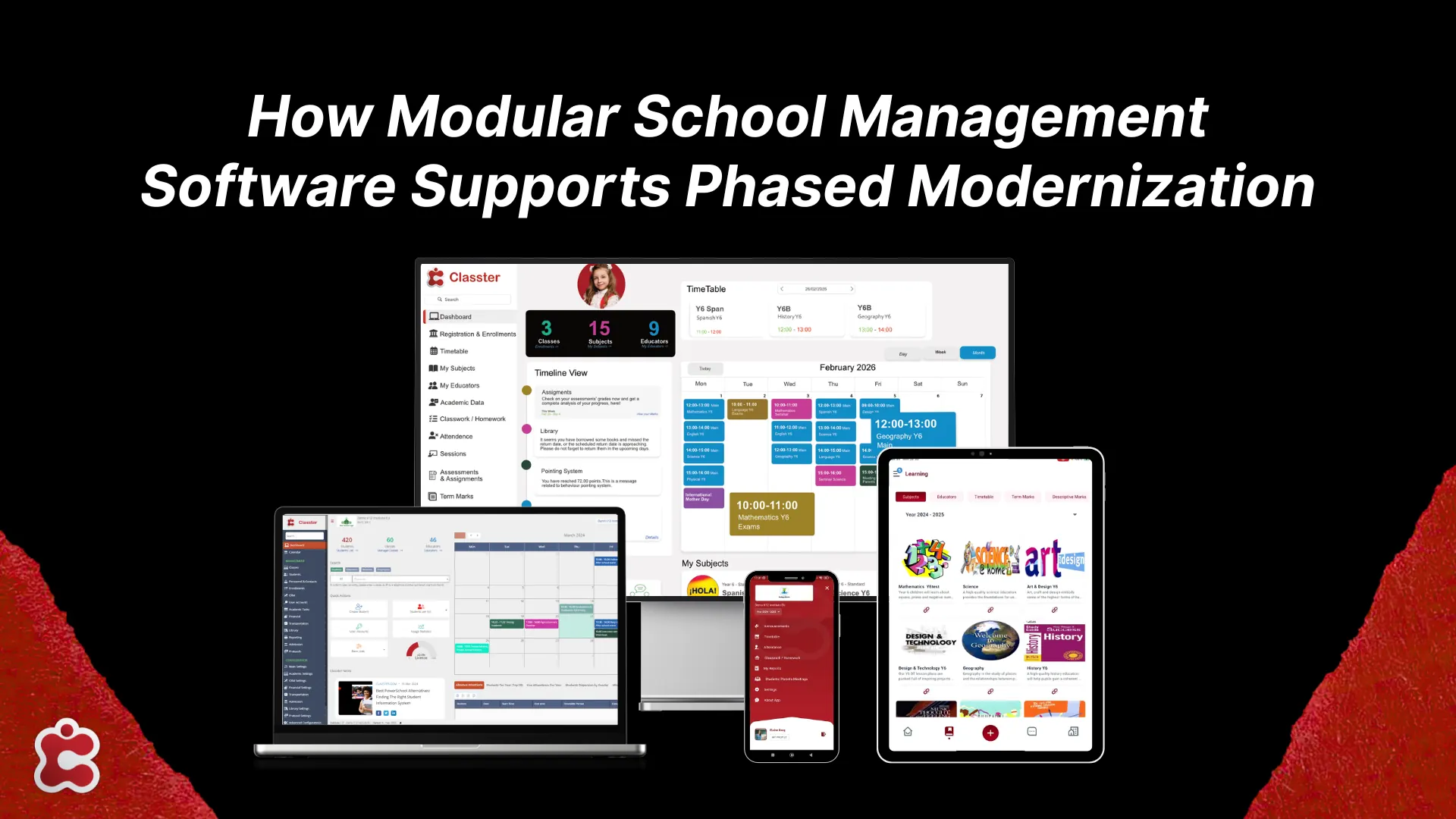
This is the design principle behind Classter’s modules structure: a shared Core module holds the central student record, and modules like Admissions, Billing & Payments, and Academics & LMS can be adopted in whatever sequence fits an institution’s actual priorities, without each one requiring a separate data migration or a separate configuration project from scratch. A school can modernize admissions this year and billing next year without redoing the work already done, because both modules are reading from the same underlying record.
For institutions actively mapping out what a multi-year modernization sequence should look like, this connects directly to the kind of planning covered in Classter’s guide to building a school’s digital transformation roadmap, which walks through prioritizing which systems to tackle first based on institutional pain points rather than a generic template.
The Bottom Line
Modernizing a school’s administrative systems doesn’t have to mean a single, high-stakes cutover that puts every department, every parent invoice, and every report card at risk on the same day. Modular software makes it possible to sequence modernization around actual institutional priorities, solving the most urgent problem first, building institutional confidence and momentum, and layering on the next module once the last one is stable, all without losing the benefit of a single, unified student record underneath it. The schools that modernize successfully aren’t always the ones that moved fastest. They’re the ones that moved in an order that matched their actual capacity to absorb change.
See how Classter’s modular structure lets you modernize on your own sequence, not a vendor’s all-or-nothing timeline. Book a demo
FAQ’s
Usually in total calendar time, yes, since modules go live in sequence rather than simultaneously. But “slower” doesn’t mean riskier. Institutions often reach stable, reliable use of their first one or two modules faster than they would reach stable use of an entire system replaced all at once, because each phase is smaller and easier to get right.
No, though the data underlying whichever module goes live first does need to be migrated properly. Historical data for modules planned for later phases can often be migrated closer to when that specific module goes live, rather than all at once upfront.
Start with whichever administrative area is causing the most acute, visible pain right now, since that’s where staff and leadership will see the clearest benefit fastest, which builds support for the next phase. Compliance deadlines or urgent operational failures can reasonably override a “typical” sequence.
Only if the underlying platform isn’t genuinely modular in the data sense, meaning each module keeps its own separate copy of student information rather than sharing one central record. That’s the key question to ask a vendor before starting a phased rollout, not after.
Not necessarily in total cost, since running parts of an old system alongside new modules for a period has its own overhead. What it typically reduces is the size and cost of any single failure, since a problem in one module during its rollout phase doesn’t put every other administrative function at risk simultaneously.