



Ask ten school leaders what “AI-ready” means and most will describe a tool: a chatbot for admissions questions, an AI-powered scheduling assistant, a predictive model that flags at-risk students. Almost none will describe a data pipeline. That’s backwards, and it’s the reason so many AI pilots in education quietly stall after the first semester, not because the AI was disappointing, but because it was asked to reason over student records that were incomplete, duplicated, or scattered across four different systems that never quite agreed with each other.
AI readiness isn’t a feature schools buy. It’s a condition their data has to be in first. Reframed this way, the question stops being “which AI tool should we adopt” and becomes “is our student, academic, and administrative data clean enough, connected enough, and reliable enough for any AI tool to be trustworthy on top of it.” That second question is far less exciting to talk about in a board meeting, and far more decisive in whether an AI initiative actually works.
What “AI-Ready” Actually Means, Beneath the Hype
Institutional guidance on generative AI readiness consistently centers on the same unglamorous prerequisites, not model selection or vendor comparisons. The EDUCAUSE Higher Education Generative AI Readiness Assessment, developed with AWS, frames data readiness around a specific, checkable set of conditions: whether data definitions and standards exist for key data sets, whether data use appropriately balances access with privacy and security, and whether data is treated as a strategic asset with clear accountability, rather than something that lives wherever a given department happened to put it. None of that is about AI capability. It’s about whether the ground underneath an AI tool is solid enough to build on.
Three properties tend to show up across nearly every serious readiness framework, whether it’s aimed at higher ed or K-12:
Clean. Records without duplicates, consistent formatting, and accurate values. A predictive model trained on attendance data with inconsistent absence codes across three campuses won’t just be less accurate, it will be confidently wrong in ways that are hard to detect until a decision has already been made on top of it.
Connected. Data that lives in one coherent structure rather than fragmented across a SIS, a separate billing system, a spreadsheet-based communications list, and a standalone gradebook that nobody remembers syncing. AI tools that need to reason about a student holistically, flagging a retention risk, for instance, need attendance, grades, payments, and engagement data to actually be joinable, not stored in incompatible formats across disconnected platforms.
Reliable. Data that’s current, governed, and trusted by the staff who work with it every day. A system that’s technically connected but where staff have learned not to trust the numbers, because it’s been wrong before, doesn’t actually support AI adoption; it just adds a confident-sounding layer on top of data nobody believed in the first place.
The Data Foundation Problem Is Already Visible in the Numbers
This isn’t a hypothetical concern. A 2025 CoSN member survey on how districts are actually approaching AI in their operations found the data layer to be the clearest bottleneck: while a quarter of surveyed districts reported that some of their data had been cleaned and shared, roughly six in ten still described their data as dirty, siloed, or both. That’s not a small technical detail sitting behind a promising AI strategy, it’s the primary constraint on whether that strategy can work at all. Technical infrastructure in the same survey scored notably better, most districts reported at least some level of technical readiness, which makes the data gap even more telling: the pipes are often more ready than what’s flowing through them.
Governance tells a similar story. Institutions are moving to adopt AI far faster than they’re moving to govern how it’s used, and a meaningful share of K-12 systems still don’t have a written policy covering AI use at all. That combination, immature governance paired with immature data, is exactly the pattern that turns a promising pilot into a source of institutional risk: an AI tool making recommendations based on ungoverned, uncleaned data, with no clear policy for how those recommendations should be reviewed or challenged.
What to Build Before Adopting Any AI Tool
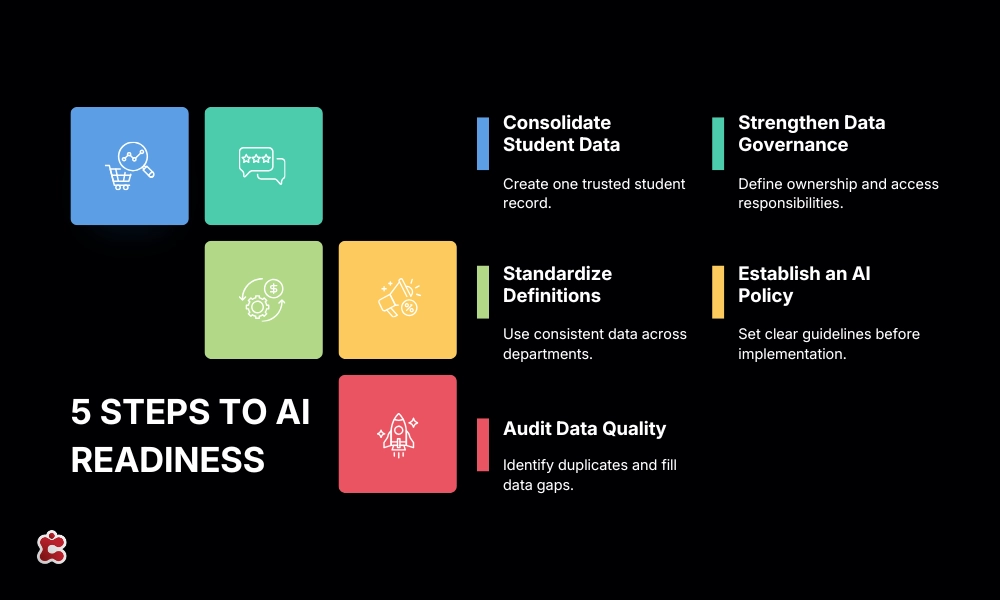
None of this means schools should wait for perfection before touching AI. It means the preparation work belongs earlier in the sequence than most institutions currently put it. A practical readiness checklist, before evaluating a single AI vendor, looks like this:
- Consolidate the student record. Attendance, grades, billing, admissions, and engagement data should be traceable back to one authoritative student profile, not five different systems each claiming to be the source of truth.
- Standardize definitions across departments. “Completion,” “active status,” and “at-risk” need to mean the same thing everywhere they’re used, or any AI tool built on top of them will quietly inherit that inconsistency.
- Audit for duplicates and gaps before, not after, deployment. The CoSN data above suggests this step alone is where most districts currently are, and skipping it is the single most common way an AI pilot underdelivers.
- Establish data governance and accountability. Someone specific needs to own data quality and access decisions, not “IT” as an undefined collective, mirroring the cabinet-level accountability EDUCAUSE’s own readiness framework calls for.
- Write the policy before the pilot, not after. A written AI use policy doesn’t need to be exhaustive on day one, but having none at all leaves staff improvising judgment calls about privacy, accuracy, and appropriate use in real time, on live student data.
Readiness by Dimension
| Dimension | What it looks like when it’s missing | What it looks like when it’s ready |
| Clean data | Duplicate student records, inconsistent grading codes, outdated contact information | De-duplicated records, standardized fields, regular data quality checks |
| Connected data | SIS, billing, and communications data live in separate, unlinked systems | A single student record that every module reads from and writes to |
| Reliable data | Staff maintain shadow spreadsheets because they don’t trust system reports | Reports are trusted enough that staff use them as the default source |
| Governance | No named data owner; access rules are informal or inconsistent | Clear accountability for data quality, access, and AI use policy |
Why This Belongs in the Software Layer, Not Just the Policy Layer
It’s tempting to treat data readiness as a governance exercise, a policy to write, a committee to form. Policy matters, but it can’t fix a structural problem: if grading, attendance, billing, and admissions data live in separate systems that were never designed to share a common student record, no amount of policy will make that data connected. The fix has to happen at the platform level first.
This is why Classter’s approach to AI-powered features is built on top of a single Student Information System data model, rather than layering AI onto data pulled from disconnected modules after the fact. When attendance, grades, billing, admissions, and engagement data already live in one coherent structure, the “clean, connected, reliable” prerequisites aren’t a separate project a school has to complete before adopting AI, they’re a natural consequence of how the underlying Core module is built.
The Bottom Line
The institutions that get real value from AI in the next few years won’t be the ones that adopted the flashiest tool first. They’ll be the ones that quietly did the less exciting work: consolidating student records, standardizing definitions, cleaning duplicate data, and establishing who’s actually accountable for data quality, before a single AI feature went live. AI readiness was never really about AI. It was always about whether an institution’s data could be trusted enough to build something reliable on top of it.
See how a unified student data model puts Classter’s AI features on solid ground from day one. Book a demo
FAQ’s
Not entirely, but the areas an AI tool will actually use, such as attendance and grading data for a retention model, need to be reasonably clean and consistent first. Deploying AI on top of known data quality issues tends to produce confidently wrong outputs rather than obviously broken ones, which is a harder problem to catch.
Digital data can still be fragmented, a SIS, a billing platform, and a communications tool can all be digital and still fail to share a common student record. Connected means those systems reference the same underlying student profile, so an AI tool reasoning about one student can actually see the full picture rather than one disconnected slice of it.
A named individual or small group, not an undefined “IT” catch-all. Readiness frameworks consistently point to clear, cabinet-level or leadership-level accountability as a distinguishing factor between institutions that make real progress and those that stall.
They address different risks but reinforce each other. Clean, connected data reduces the chance an AI tool produces unreliable output; a written policy defines how staff should review, question, and act on that output. Institutions that have neither tend to combine both risks at once.
Ongoing. New records, new integrations, and new staff all introduce fresh opportunities for duplication and inconsistency. Institutions that treat data quality as a continuous practice, with regular audits, tend to stay AI-ready, while those that treat it as a one-time cleanup before a specific pilot often drift back into fragmentation within a year or two.