



A student’s relationship with your institution begins long before they enrol, and it doesn’t end when they graduate.
Between the first enquiry and the last alumni newsletter, there are dozens of distinct interactions applications, document submissions, orientation sessions, course registrations, grade reviews, payment queries, support conversations, graduation checks, and career touchpoints each one managed by a different team, often through a different system. When those systems don’t share data, the student doesn’t experience a journey. They experience a series of disconnected episodes, each of which requires them to re-introduce themselves to a new part of the institution.
Managing the complete student lifecycle means treating that entire journey as a single, continuous relationship one that the institution can see in full, support at every stage, and sustain long after the student has graduated.
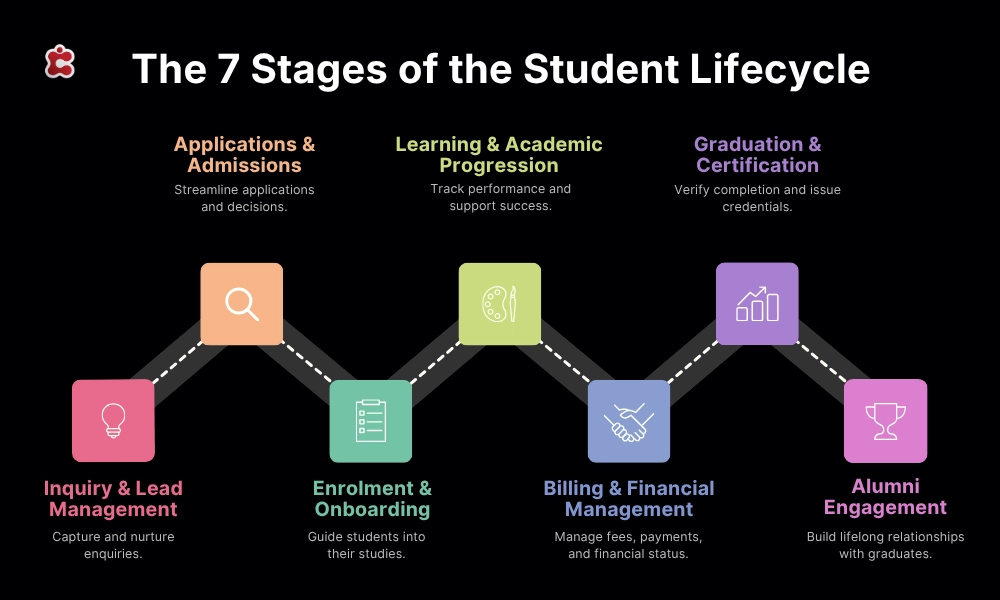
This article walks through each stage of that lifecycle, explains what institutions typically get wrong at each one, and shows what it looks like when a unified platform manages the journey from end to end.
Why Lifecycle Management Matters Now More Than Ever
The context for student lifecycle management in 2026 has shifted significantly. Spring 2026 postsecondary enrolment totalled 18.6 million students in the US up 1% from the previous year but the headline growth conceals a more complex picture. Private four-year institutions saw undergraduate enrolment fall, and the onset of what demographers call the “enrolment cliff” is already affecting smaller colleges and regional public schools, with a projected 15% decline in 18-year-old high school graduates by 2029.
In this environment, every stage of the student lifecycle carries higher stakes. An enquiry not followed up promptly is a prospective student who goes elsewhere. A student who feels unsupported in their first term is a withdrawal that doesn’t show up until the following year’s retention report. A graduate who feels forgotten the moment they collect their degree is an alumnus who never mentors, never refers, and never gives.
The institutions managing this landscape well are those who have stopped treating the student journey as a sequence of departmental handoffs, and started treating it as a single institutional relationship that technology can support from beginning to end.
Stage 1: Inquiry and Lead Management
Every enrolment begins with a signal of interest. That signal might arrive through a website contact form, an open day registration, a social media enquiry, a phone call, or a referral from a current student. What happens next determines whether that signal converts.
The common failure at this stage is not responsiveness most institutions have admissions staff who respond to enquiries. The failure is consistency. When enquiries arrive through multiple channels and land in multiple inboxes, some are followed up within hours and others wait days. There is no single view of who has enquired, what they asked about, which programme they’re interested in, or whether they’ve had a response. Counsellors working from personal email threads have no visibility into what a colleague already told the same prospective student last week.
A structured enquiry management system often called an education CRM captures every incoming contact in one place, assigns it to a responsible person, logs the interactions, and flags when a follow-up is overdue. It also makes visible something that email can’t: which channels are producing the most qualified enquiries, which programmes attract the most interest from which populations, and where in the early funnel prospective students are dropping off.
This matters because the inquiry-to-enrolment funnel is tighter than institutions often assume. Of 5,000 enquiries, a typical institution might convert 40% to applications, 75% of those to offers, and 30% of offers to actual enrolments an overall conversion rate of around 9%. Small improvements in follow-up speed and personalisation at the enquiry stage compound significantly across the full funnel.
Stage 2: Application and Admissions
The application stage is where the relationship moves from a signal to a commitment and where administrative friction most visibly affects the prospective student’s experience.
A manual application process paper forms, email submissions, document requests sent back and forth is slow for students and labour-intensive for admissions teams. Documents are submitted, lost, re-requested, resubmitted. Application status is updated manually in a spreadsheet that three staff members access simultaneously and sometimes overwrite each other’s entries. A student who submits a complete application and hears nothing for three weeks is not experiencing institutional indifference they are experiencing the downstream effects of a disconnected process.
Digitising the application process means more than moving forms online. It means building a workflow where each submission triggers an automatic acknowledgement, incomplete applications generate automated prompts, document verification is tracked in the system, and admissions decisions are logged against the applicant record which then becomes the foundation for the student record once they accept an offer. The data enters the system once, at the point of application, and follows the student through every subsequent stage.
For institutions managing rolling admissions across multiple programmes, multiple entry points, and multiple intake cohorts simultaneously, the only way to maintain quality and consistency is through a system that handles the routing, tracking, and communication automatically freeing admissions staff to focus on the decisions that require human judgment, rather than on the administrative work that doesn’t.
Stage 3: Enrolment and Onboarding
Accepting an offer and becoming a student are not the same thing. The period between an acceptance and the first day of classes is one of the highest-risk stages in the student lifecycle and one of the most neglected from a support perspective.
Research on “summer melt” the phenomenon in which accepted students fail to complete enrolment shows attrition rates as high as 40% for certain student populations, particularly low-income students and those heading to community colleges. The students who melt are not always the students who were least committed. They are often the students who encountered an obstacle a registration form they didn’t understand, a financial aid step they didn’t complete, a document they didn’t know was required and didn’t have a clear person to ask.
Effective onboarding management means maintaining active, personalised contact with every accepted student from the moment they accept an offer until they complete registration. It means knowing which enrolment steps each student has completed and which are outstanding, and triggering targeted communications for each not a generic newsletter, but a message that says specifically what this student still needs to do and by when.
It also means that the onboarding record is continuous with the student record. The information gathered during admissions programme of study, prior qualifications, contact details, any declared circumstances populates the student profile that every team will use for the next three to five years. Entering it again during enrolment is not just inefficient; it introduces the risk that two versions of the student’s information exist in different systems and diverge over time.
Stage 4: Learning and Academic Progression
Once enrolled, the student enters the longest and most operationally complex stage of the lifecycle. Academic progression involves timetabling, attendance tracking, coursework submission, grade recording, degree progress monitoring, academic support referrals, and personal tutoring across every term, every module, and every academic year the student is enrolled.
The data produced at this stage is the most detailed and most valuable in the student record. It is also the data most likely to be fragmented. Attendance lives in one system, grades in another, academic support contacts in a third, and degree progress requirements in a fourth. No individual has a complete picture of any student’s academic journey unless they manually pull reports from each system and reconcile them.
What this means in practice is that the early warning signs that would enable proactive support a student whose attendance has been declining for three weeks, whose grade trend is downward, and who hasn’t logged into the learning platform in a fortnight are not visible to any one person. The pastoral tutor sees attendance. The academic module leader sees grades. The learning platform administrator sees login data. Nobody sees the pattern.
A unified platform connects these data streams against the same student record, making the complete academic picture visible to the people responsible for supporting each student. It also enables degree audit tools that show students and their advisers exactly what has been completed, what remains, and whether they are on track to graduate on time.
Stage 5: Billing, Payments, and Financial Management
Financial administration sits alongside academic administration throughout the student lifecycle, but in most institutions it operates in a completely separate system with limited or no connection to the student record that everyone else uses.
The consequences are predictable. A student flagged by their tutor as potentially at risk may also have an overdue payment that the finance team is handling separately. Neither team knows about the other’s concern. A student who misses classes because they are managing a financial crisis doesn’t appear in any joined-up view. The two signal academic disengagement and financial pressure that together predict withdrawal more reliably than either alone, sit in different systems, visible to different people, never combined.
Financial stress is one of the most significant predictors of student withdrawal. Research consistently shows that a substantial proportion of students who leave before completing their programme cite financial pressures as a contributing factor. Early identification of students experiencing financial difficulty through payment deferrals, missed instalments, or outstanding balances allows institutions to intervene before the financial situation becomes a withdrawal decision.
This requires billing data to be connected to the student record that pastoral and academic staff use, not siloed in a finance system that only the finance team accesses. It also requires a billing module that handles the full range of payment scenarios instalments, deferrals, partial payments, scholarships, fee adjustments and that maintains an accurate, current record of each student’s financial status without manual reconciliation between systems.
Stage 6: Graduation and Certification
Graduation is, for many students, their most visible interaction with the institution’s administrative systems and one of the most consequential if it goes wrong.
The process involves confirming that every academic requirement has been satisfied, that all outstanding fees have been settled, that the student’s identity and programme details are accurate in the official record, and that the correct credential is issued through an auditable process. In institutions where academic and financial records live in separate systems, producing a graduation clearance requires manually cross-checking both a process that is slow, error-prone, and disproportionately labour-intensive at the one time of year when administrative teams are already under maximum pressure.
A unified platform streamlines graduation processing by bringing together the academic completion check, the financial clearance, and the credential issuance into a single workflow. Degree audit data shows which students have met all academic requirements. Billing data confirms that accounts are settled. The graduation record, once completed, flows directly into the alumni record so that the relationship continues without a gap, rather than restarting from scratch in a separate system.
The credential itself matters increasingly in a world where digital verification is becoming standard. Institutions that issue digital certificates that can be independently verified give graduates a portable, shareable record of their achievement and give employers a reliable way to confirm it.
Stage 7: Alumni Engagement and Lifelong Connection
Graduation is not the end of the student lifecycle. It is a transition from one kind of relationship to another.
The case for investing in alumni engagement is both relational and financial. Institutions with structured alumni engagement programmes see up to 40% higher donor participation rates than those without them, according to CASE research. But treating alumni primarily as a fundraising audience is precisely the approach most likely to undermine long-term engagement. Alumni who feel that the only time their institution contacts them is to ask for money disengage and once disengaged, they are difficult to re-engage.
The data on what alumni actually want is instructive. Research shows that 85% of alumni are willing to mentor current students, 67% would participate in digital mentorship programmes if they existed, and 69% are interested in lifelong learning benefits such as certifications, workshops, and webinars. Yet only a fraction of institutions offer these programmes in any structured form. The appetite for continued connection is significant; the provision falls short.
Effective alumni management treats the alumni relationship as a continuation of the student relationship built on the same record, informed by the same academic history, and personalised based on what the institution actually knows about each graduate. An alumnus who studied international business is interested in different events, mentorship opportunities, and continuing education content than one who studied healthcare. A platform that can surface that distinction makes it possible to communicate with graduates in ways that feel relevant rather than generic.
This requires the alumni database to be connected to or derived from the academic record. When alumni records are maintained in a separate system with no link to the SIS, institutions quickly lose track of current contact details, programme history, and career progression. The database becomes unreliable, communications become imprecise, and engagement declines. Institutions that maintain alumni data as a continuous extension of the student record avoid this drift and preserve the capacity for meaningful, personalised engagement years after graduation.
What Lifecycle Management Looks Like on a Unified Platform
The practical argument for managing the complete student lifecycle on a single platform is not that it makes everything simpler. Many aspects of institutional administration are genuinely complex. The argument is that it makes complexity manageable by ensuring that every team works from the same student record, every interaction is logged in the same place, and every stage of the journey is visible to the people responsible for supporting it.
| Lifecycle Stage | Fragmented Approach | Unified Platform |
| Inquiry | Multiple inboxes, no shared view | Single CRM, all enquiries tracked centrally |
| Admissions | Manual document tracking, email chains | Structured workflow, automated prompts and status updates |
| Enrolment | Re-entry of admissions data, manual follow-up | Single record, targeted communications for outstanding steps |
| Academic Progression | Attendance, grades, LMS data siloed | Unified student view, early warning dashboard |
| Billing | Finance system disconnected from student record | Payment status visible alongside academic and pastoral data |
| Graduation | Manual cross-checking of academic and financial clearance | Automated clearance workflow, direct flow to alumni record |
| Alumni | Separate database, no link to academic history | Continuous record, personalised engagement based on programme history |
Classter is built on this unified model. Every module the Academic CRM for enquiry and admissions management, the Student Information System for academic records and progression, the Billing and Payments module for financial management, the Learning Management System for course delivery and engagement, and the Alumni Management module for post-graduation engagement reads from and writes to the same student record.
A student’s journey through Classter is a single, continuous thread. The enquiry becomes an application. The application becomes an enrolment. The enrolment becomes an academic record. The academic record becomes a graduation clearance. The graduation clearance becomes an alumni profile. At no point does the data need to be re-entered, transferred, or reconciled between systems because there is only one system.
As EDUCAUSE and similar bodies have consistently highlighted, the institutions seeing the strongest outcomes on retention, satisfaction, and long-term engagement are those investing in digital transformation initiatives that integrate academic and administrative systems rather than layering more tools onto fragmented foundations. The student lifecycle strategy is only as strong as the infrastructure that supports it.
Building a Lifecycle Strategy: Where to Start
For institutions that are currently managing different lifecycle stages through different systems, the transition to a unified approach is a project not an overnight change. These principles help make the transition effective.
Start with the student record as the foundation. Every module and every workflow should draw from and write to a single, authoritative student record. Before adding new tools or workflows, establish what that record looks like and where it lives. Everything else is built on top of it.
Map where data currently enters the system and where it should. In most institutions, the same student information is entered multiple times: once during enquiry, once during application, once during enrolment, and sometimes again during the financial registration process. Each duplicate entry is an opportunity for error and a point of divergence. The goal is a single entry point at the beginning of the journey, with all subsequent stages enriching the same record rather than creating new ones.
Define lifecycle ownership clearly. Each stage of the student lifecycle has a primary team responsible for it admissions, academic services, finance, careers, alumni relations. A unified platform doesn’t dissolve those responsibilities; it makes them visible to each other. Define who has read access to what data at each stage, and ensure that the teams responsible for adjacent stages can see what’s relevant to the handoff they’re managing.
Measure at every stage. The value of lifecycle management data is not just operational it’s strategic. Enquiry-to-application conversion rates reveal where the admissions funnel is losing students. Enrolment-to-retention rates reveal where early disengagement begins. Graduation rates by cohort, programme, and demographic reveal where academic support is working and where it isn’t. Alumni engagement rates reveal how effectively the institution is sustaining its relationships beyond graduation. None of these measures is available without the data infrastructure to produce them.
Conclusion
The complete student lifecycle from first enquiry to active alumnus is the full scope of an institution’s relationship with every person it educates. Managing it well is not just an operational matter. It is a strategic one.
Every stage of that journey is an opportunity to support a student, strengthen a relationship, and build the kind of institutional reputation that attracts the next generation of enquirers. Every stage is also an opportunity to lose a student to a slow follow-up, a confusing process, an unseen warning sign, a graduation system that doesn’t work, or an alumni programme that feels like a fundraising campaign.
The institutions that manage the full lifecycle effectively do so because they have built the infrastructure to see it whole. Not seven separate stages managed by seven separate teams through seven separate systems but one continuous journey, visible from end to end, supported at every point by the same data and the same platform.Interested in seeing how Classter supports every stage of the student lifecycle on a single unified platform?
Book a demo and we’ll show you how it works for institutions like yours.
FAQ’s
Student lifecycle management is the approach of treating a student’s entire relationship with an institution from first enquiry through graduation and alumni engagement as a single, continuous journey rather than a series of separate departmental interactions. It involves aligning systems, data, and workflows so that every team involved in a student’s journey works from the same information, and so that support can be proactive rather than reactive at each stage.
While the exact framing varies by institution, the core stages are: enquiry and lead management, application and admissions, enrolment and onboarding, academic progression and learning, financial management and billing, graduation and certification, and alumni engagement. Each stage generates data that is valuable not just for managing that stage but for supporting the next one which is why connecting them in a single system matters so much.
When different stages of the student journey are managed in different systems an admissions CRM, a separate SIS, a disconnected billing platform, a standalone alumni database the same student information is entered multiple times, versions diverge, and no single team has a complete view of any student’s journey. This makes it difficult to identify students who need support, to produce accurate reports, and to provide the consistent, personalised experience that students increasingly expect.
Summer melt is the phenomenon in which students who have been accepted and indicated their intention to enrol fail to complete the final registration steps and don’t start. Attrition rates at this stage can reach 40% for certain student populations. Prevention requires active, personalised communication with every accepted student during the pre-enrolment period specifically tracking which enrolment steps each student has and has not completed, and triggering targeted outreach for each outstanding step rather than sending generic newsletters.
By leading with value rather than solicitation. Alumni are significantly more likely to engage and eventually to give when the institution offers things they actually want: mentorship opportunities, career networking, continuing education content, and events relevant to their professional interests. According to CASE research, institutions with structured alumni engagement programmes see up to 40% higher donor participation than those without them but that engagement is built on relationship, not repeated fundraising asks.
In practice, it means that a student’s record follows them through every stage without being re-entered or transferred. An enquiry becomes an application, an application becomes an enrolment, an enrolment becomes an academic record, and an academic record becomes an alumni profile all within the same system, visible to the teams responsible for each stage. It means early warning dashboards that surface at-risk students by combining attendance, grade, and financial data. It means graduation processing that draws on academic and financial records simultaneously. It means alumni communications personalised based on programme history and engagement patterns. All of this is possible when the lifecycle runs on one platform and significantly harder when it runs on seven.