


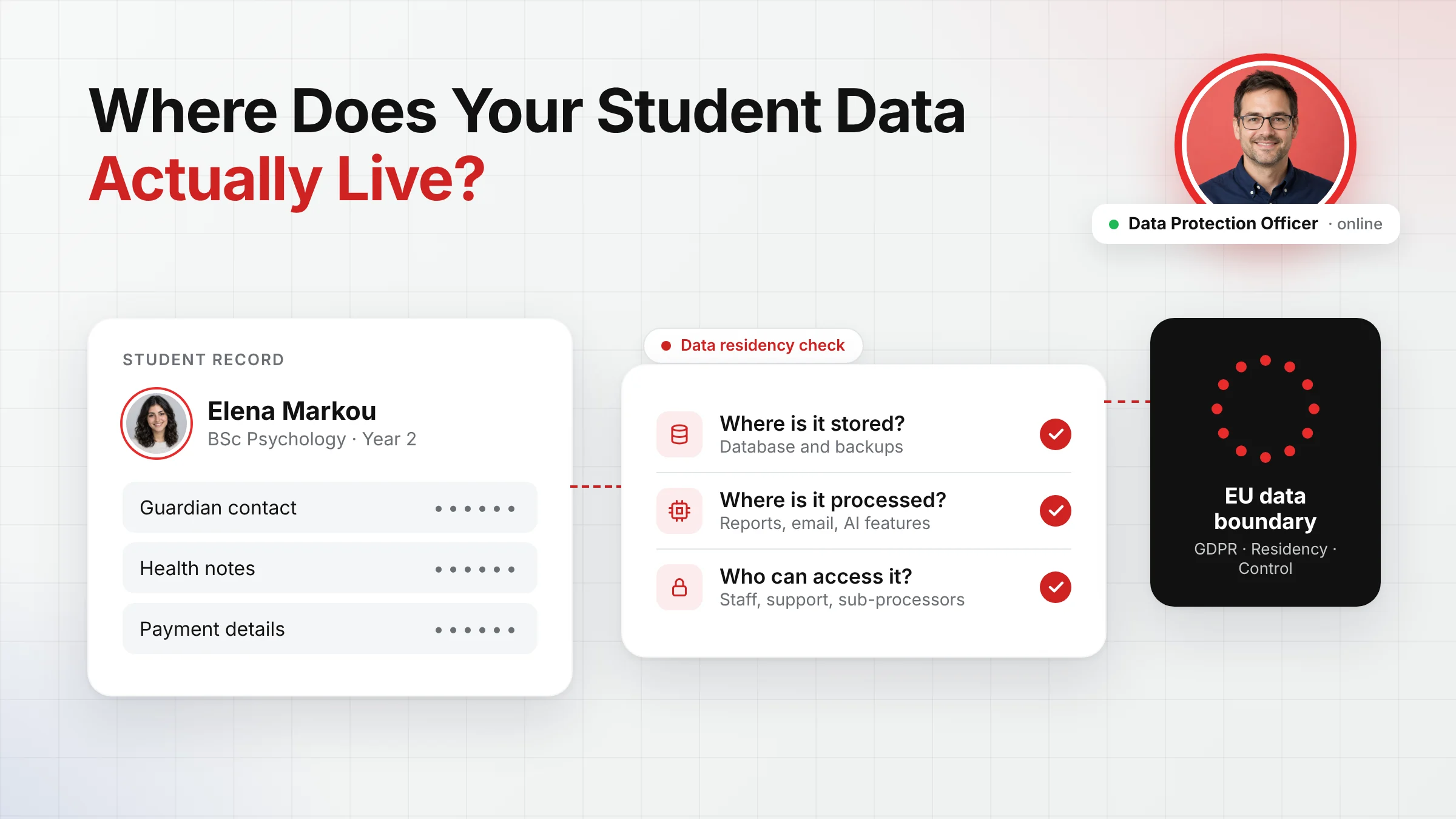
Ask most school leaders where their student records are stored and you’ll get one of two answers: “in the system” or “in the cloud.” Both are true, and neither is an answer. A student’s record can be stored in one country, backed up in another, processed by a third and reachable by a support team somewhere else again.
For years that was treated as an IT detail. In 2026 it has become a policy question, and European schools are being asked to answer it properly.
Europe is making data sovereignty an education priority
On 3 November 2026, the European Commission formally established the European Digital Infrastructure Consortium on Education (EDU-EDIC). Eight member states, including Greece, France, Spain, the Netherlands and Finland, have joined, with the consortium based in The Hague. Its stated aims include building sovereign and interoperable digital infrastructure for education, strengthening education data governance and reducing schools’ dependence on technology providers outside the EU.
Individual countries are moving too. Six German states, among them Berlin, Hamburg and North Rhine-Westphalia, can now choose a school cloud that runs only in German data centres. Data protection authorities in several countries have challenged the use of mainstream productivity suites in schools over the past few years, and universities in the Netherlands have publicly called for less dependence on big tech.
Even the largest global vendors are adjusting. Microsoft has committed to bringing processing for the third-party AI models in its Copilot assistant inside its EU Data Boundary by the end of 2026, because European customers want new AI features without giving up the residency commitments they rely on.
The message for schools is consistent: knowing where your data lives is no longer optional.
Storage, processing and access are three different questions
When a vendor says “your data is hosted in the EU,” it usually answers only one of three questions.
- Where is it stored? The physical location of the database and its backups. This is what most hosting statements describe.
- Where is it processed? Where the data goes when the software does something with it, such as running a report, sending an email or answering a question with AI. Processing can happen outside the storage region if a feature calls on an external service.
- Who can access it, and under which law? Which people and companies can reach the data, including support teams and sub-processors, and which governments can compel them to hand it over. A server in Frankfurt run by a company subject to non-EU law is a different risk from one run under EU law alone.
A complete answer covers all three. That matters even more now that AI features are arriving in school software, because AI is often where processing quietly leaves the region.
Why school data deserves extra care
Student information is not ordinary business data. A single record can hold a minor’s identity, family contacts, health notes, special educational needs, behaviour incidents and payment details, and it stays relevant for years after the student leaves.
That combination is why student data raises ethical questions as well as legal ones, from consent to data minimisation. eLearning Industry’s overview of student data privacy sets out these dilemmas well, and recommends principles such as transparency and privacy by design that apply to any school system.
Under GDPR, the school is usually the data controller. It can delegate the hosting, but not the responsibility. If a parent asks where their child’s data is held, “our vendor handles that” is not a sufficient answer. cheduling or errors caught in billing are easy to check. Learning gains from an AI tutor are much harder to prove.
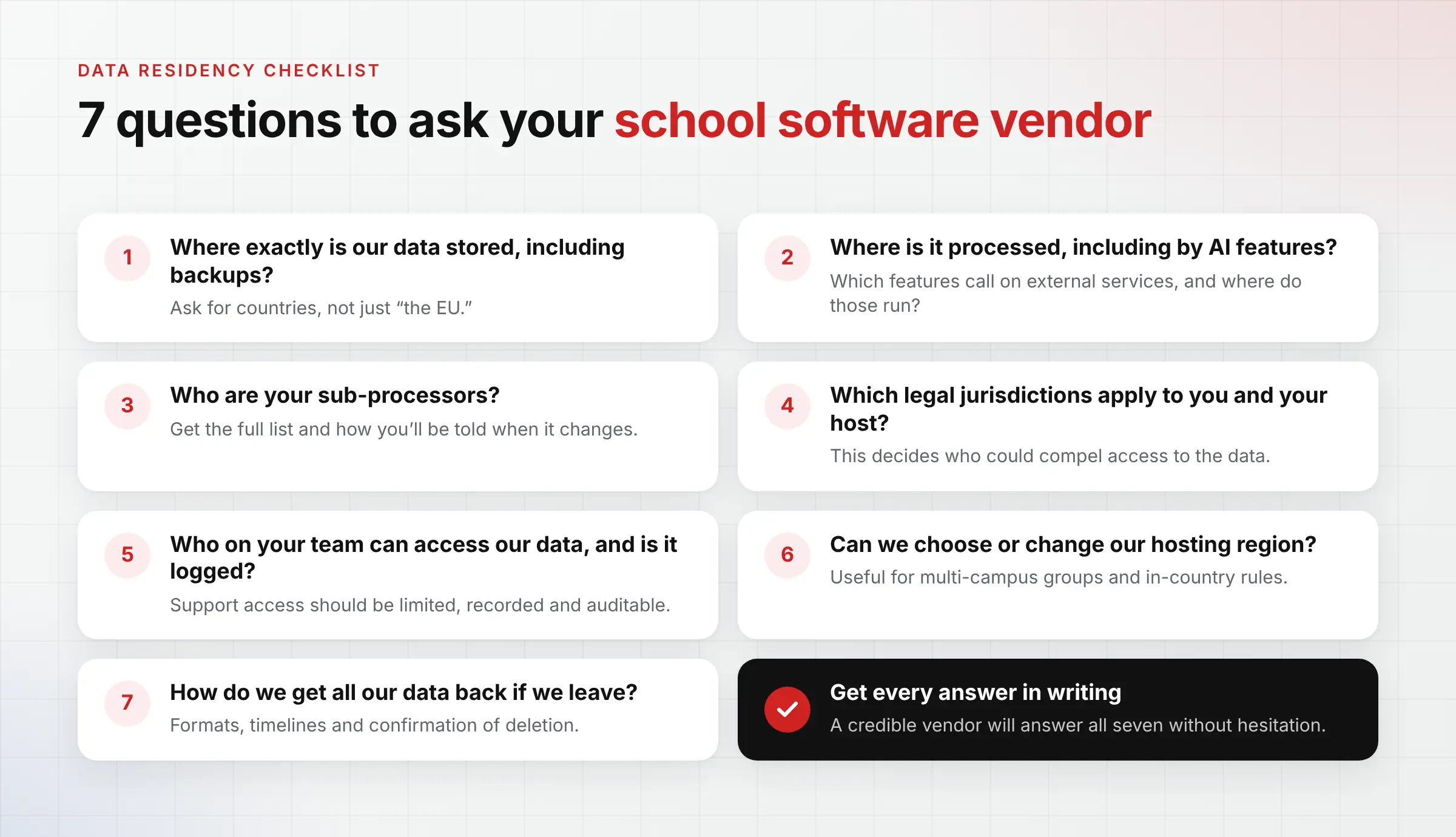
Seven questions to ask your school software vendor
Use these with your current provider or in any procurement. A credible vendor should answer each in writing.
- Where exactly is our data stored, including backups? Ask for countries, not just “the EU.”
- Where is it processed, including by AI features? Ask which features call on external services and where those run.
- Who are your sub-processors? Request the full list and how you’ll be notified when it changes.
- Which legal jurisdictions apply to you and your hosting provider? This determines who could compel access to the data.
- Who on your team can access our data, and how is that access logged? Support access should be limited, recorded and auditable.
- Can we choose or change our hosting region? Useful for multi-campus groups or schools in countries with in-country requirements.
- How do we get all our data back if we leave? Ask about formats, timelines and confirmation of deletion afterwards.
How Classter approaches hosting and residency
As a European company, Classter builds for GDPR from the start rather than adapting to it later, and both of the claims schools most need to check have been independently verified this year.
In May 2026, Classter achieved ISO 27001 certification, the international standard for information security management. A month later, Classter passed an independent EU GDPR audit with zero deviations across every area reviewed, from personal data processing and individual rights to data security and incident response.
The audit maps closely to the vendor questions above:
- Storage: production databases are encrypted both in transit and at rest.
- Access: access to personal data is limited to people who need it, enforced by access control policies and monitored in real time.
- Sub-processors: suppliers with access to personal data go through periodic vendor risk assessments and sign Data Processing Agreements.
- New features, including AI: every new feature and system change goes through a privacy risk assessment before release.
- Rights requests: data subject requests follow a documented process with identity verification and a 30-day response commitment.
Schools can see Classter’s certificate, security policies and compliance status in the Classter Trust Center at trust.classter.com, which makes the first conversation with a data protection officer a short one.
The bottom line
“In the cloud” was an acceptable answer five years ago. With the EU building its own education infrastructure, national governments setting expectations and global vendors redrawing their data boundaries, schools now need a precise one. The good news is that it’s a straightforward conversation to have, as long as you ask the right questions.
Want a clear answer on where your student data would live with Classter?
Book a demo with our team
FAQ’s
Student data sovereignty means a school knows, and controls, where its student data is stored and processed, who can access it, and which country’s laws apply. For European schools, that usually means keeping data within the EU and protected by GDPR.
Storage is where the database and its backups physically sit. Processing is where the data goes when the software does something with it, such as running a report, sending an email or answering a question with AI. A vendor can store data in the EU but process some of it elsewhere, which is why schools should ask about both.
Not always, but GDPR places strict conditions on transferring personal data outside the EU, and the school stays responsible even when a vendor hosts the data. Many schools prefer EU hosting because it keeps the data under EU protections and makes compliance much simpler.
EDU-EDIC is the European Digital Infrastructure Consortium on Education, formally established by the European Commission on 3 November 2026. Eight member states have joined, including Greece, France, Spain, the Netherlands and Finland. It aims to build sovereign, interoperable digital infrastructure for education and to reduce schools’ dependence on technology providers outside the EU.
Ask where data is stored, including backups, and where it’s processed, including by AI features. Also ask for the full list of sub-processors, which legal jurisdictions apply, who on the vendor’s team can access your data, whether you can choose your hosting region, and how you get all your data back if you leave. A credible vendor should answer each question in writing.
Classter is ISO 27001 certified and passed an independent EU GDPR audit with zero deviations in 2026. Data is encrypted in transit and at rest, access is limited to people who need it and monitored, and suppliers with access to personal data sign Data Processing Agreements. Schools can review Classter’s certifications and policies in the Classter Trust Center at trust.classter.com.